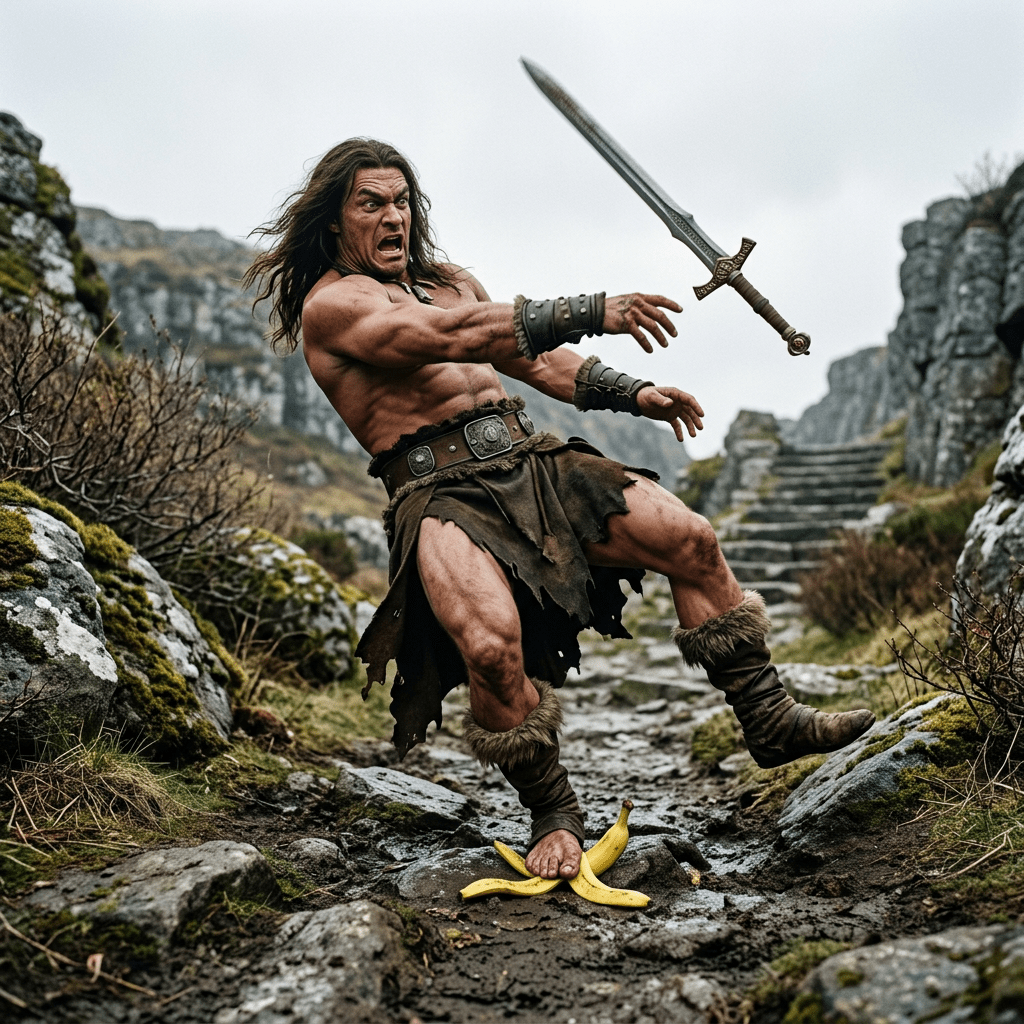
The problem with most roleplaying games is that their premises collapse the moment the players fall on their asses.
Which, unless you really railroad them within an inch of their lives and fudge every dice roll, is going to happen. It’s just a fact of life. People mess up. Humiliating accidents happen. We all know that from our real, actual lives set in comfortable First World environments… and the sort of high-risk shenanigans we get up to in TTRPGs offer a lot more chances for things to go demoralisingly wrong.
The problem is, most TTRPGs try to emulate fiction, and in fiction people tend to succeed at anything that is broadly achievable. When they fail, it tends to be because it was hopeless right from the start. If the hero loses a fight, it’s because he’s not skilled enough and needs a training montage. Or his opponent was unkillable by mere steel, and he needs a special magic sword. Or some nefarious traitor slipped drugs into his breakfast stew. It’s never just because, well, he had an off day. He zigged when he should have zagged. He was a little too slow with that one parry. Hey, shit happens. You win some, you lose some. But not in fiction.
So what TTRPGs produce – partly since they have randomised elements like dice, but mostly because they have the ultimate randomised element of human beings making bad judgment calls and misreading situations because they haven’t read the script – is usually less like the sort of fiction they’re supposed to be based on, and more like a parody of the same. It’s Conan the Barbarian, except he falls on his face when trying to scale a wall. It’s Lord of the Rings, except the Fellowship wanders in circles for a week because they can’t figure out the map. It’s Robin Hood, but the Sheriff’s men spotted the ambush because someone burped at the wrong time.
And it gets worse the more high-powered and dignified the game is meant to be. There’s a reason why the origin of the hobby was a bunch of random schmoes skulking through a dungeon and trying to steal some gold without being eaten by a giant slime mold. When your first-level halfling thief trips and falls into a bottomless chasm, well, it’s about what you’d expect, isn’t it? But when a game is meant to be beautiful, evocative and heroic, the cracks start to show. When your immortal champion of light and justice trips and falls into a bottomless chasm, it’s really kind of wretched.
I think that if you want tonal consistency in your games, you really just have two options. Call them comedy and tragedy. The senseless setbacks will happen. You have either be prepared to laugh, or be prepared to cry.
I don’t mean, of course, that your only options are non-stop slapstick or wall-to-wall angst. You can run fun adventures or intricate intrigues or passionate drama or anything you want. What I mean is that the potential for comedy or tragedy (or both) have to be there right from the start. You need to set the game in the sort of universe where things can suddenly go wrong and where everyone knows that they can suddenly go wrong.
For a good example – and one of the few franchises that I think actually lends itself well to roleplaying – you can look at Star Wars. There you have epic conflicts and pulse-pounding action, to be sure. But it all takes place in a world where silly things happen, even to characters who are stalwart heroes or fiendish villains. Darth Vader goes to rout the forces of good through his terrifying presence and unmatched dogfighting skills… and gets sent spinning into space because some jerk managed to shoot him down from behind. Luke Skywalker has a vision of his friends being in danger, so he runs to the rescue… and completely blows it and ends up needing them to rescue him. It doesn’t mean that they’re not an inspiring hero and a terrifying villain, it just means that they’re both at the mercy of a bad die roll.
Among roleplaying games, the one that comes to mind for leaning into this is of course Paranoia, where things getting wildly out of control is meant to be part of the fun. It definitely embraces comedy. And in (ahem) my own labour of love, Monstrous Mishaps, I of course do the same thing. The more ridiculous and dignity-free a way the players find to succeed, the better it fits the game’s themes. Which is, I still think, an excellent way of doing it.
But I actually think that a better example for how you can open the door to randomness without going all out on it is the early Vampire: the Masquerade books I’ve been reading my way through.
And, look, I know what you’re thinking. VtM? The game that’s justifiably blamed for the entire “roleplaying is aaaaaaaaart, man!” vibe that dominated the nineties and encouraged GMs to force through their Incredibly Important Themes no matter how badly they had to mutilate the game to do it? The gold standard for pretentious, oppressive metaplot? And, well, yes, that’s fair. But I mean the very early days.
Because, you see, in those early days, the premise of the game was still that you were something that shouldn’t exist… but that you existed anyway. And that coloured everything. It took place in a world that had lost the plot, where there was no justice and no consistency, just cold facts of the environment. You were a vampire, but you weren’t a sleek, elegant movie vampire – you were just some person who had gotten stuck with the powers and limitations of a vampire and had to figure out what to do about it. You weren’t guaranteed success or failure, because if the universe had been in the habit of guaranteeing anything, it would have made sure you never existed in the first place.
You could see it in the NPCs, too. A lot of them were powerful, sure, but they were also usually not wholly successful – their backstories usually read like a laundry list of phyrric victories and disappointments, of half-measures and derailed plans. You could just hear the dice rattling in the background. The game clearly took place in a world that usually refused to serve up simple, satisfying plots, where pratfalls didn’t break the ambience but just gave you another thing to feel gloomy about. It embraced tragedy.
Needless to say, it didn’t last, but still… it makes reading those early books informative.
 Mister Monster's Workshop
Leave a comment