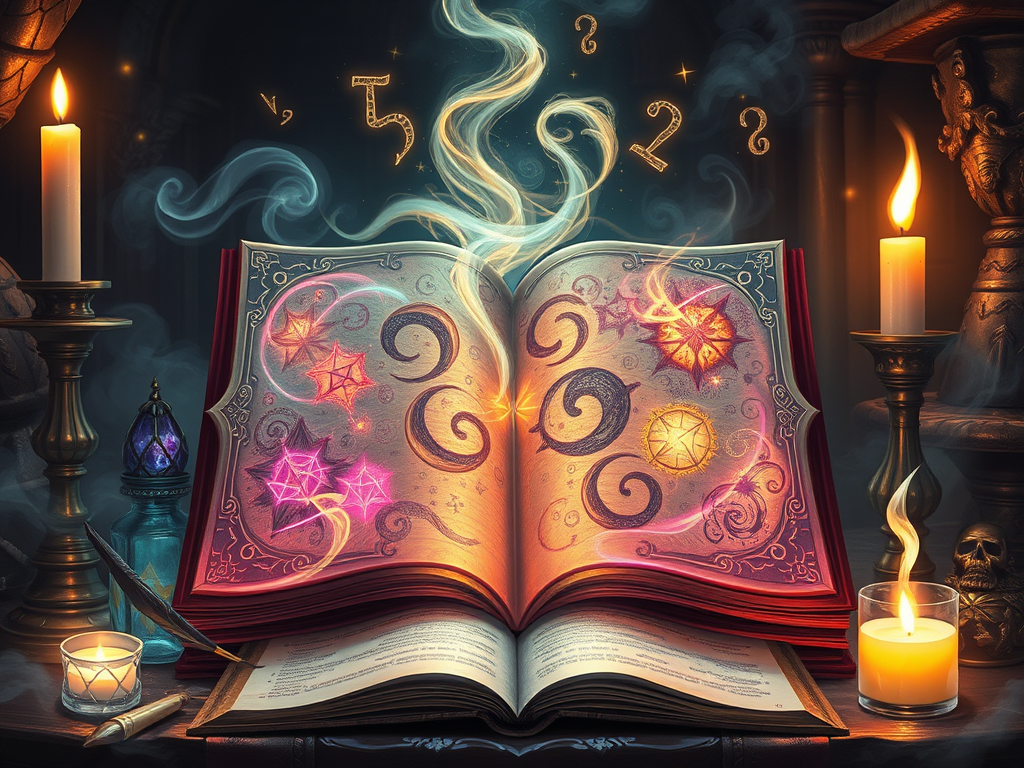
All right, day two of my let’s-get-this-stupid-quickstart-finished marathon. I’ve read through everything I’d written so far and found it more or less passable, though I should probably put in one of those boring sections in the front that explained just what in tarnation this thing even is. I mean, I don’t know who would download this stuff without already having a pretty good idea, but somehow it just feels incomplete without it. Anyway, for now I’ve written up the combat section (unusually sparse, in this game – in my experience of playtesting it, fights do happen, but they tend to be short and frantic and undignified, so they don’t need a lot of complicated rules) and I’m working on the spellcasting system.
That spellcasting system is one that I’m quite proud of, though I concede that there is probably some room for improvement. It draws a little on the freeform magic system from Angel, with some Unknown Armies and Mage: the Ascension thrown in for salt, but I’ve also added some additional structure to make it easier for the GM to manage.
In its simplest form, it really just comes down to everyone in Monster World being able to work ritual spells. There is a single Ability for it called Hocuspocus, and any spell you might find or invent has a Challenge Level to cast, and if you pass the Challenge it goes off. Sounds a little too simple, right?
Well, there are two things limiting you from just flinging around magic to solve all your problems. The first is it’s all gated by GM approval. You can cast only what spells that GM tells you you can cast at any given time – even if you’ve already cast a certain spell several times, the mystical conditions can have changed and now it won’t work again for another few centuries. Now, the GM is encouraged to provide at least some kind of suggestion for a spell you could attempt when you want to attempt a spell, because just saying “no” is always boring, but you’ll take what you can get.
The second thing is the Conditions. See, every spell comes with between two and six Conditions: Cost, Blood Sacrifice, Complexity, Side-Effects, Misfire and Retribution. Cost means that you need something that you can get hold of fairly easily but not in unlimited amounts – you’ll have to spend either money or goodwill. Blood Sacrifice means that it’ll cost HP, either your own or someone else’s. Complexity means that there are some sort of finicky requirements that you’ll need to satisfy, requiring you to either go on a mini-adventure or otherwise have to rearrange your plans for them.
The second half of the Conditions are sneaky, because when they apply, the GM won’t tell you until after the spell has been cast. Side-Effects mean exactly that, when the spell takes effect something else happens in addition to what it said in the recipe. Misfire, on the other hand, means that the spell just plain does something different than what you were told it would do, though it’ll probably still be in the general area – for example, you might cast a spell for being able to leap tall buildings in a single bound, and instead it turns you into a human rubber ball who can bounce over tall buildings (and then keep bouncing all the way down the block, because rubber balls aren’t known for being able to break on a dime). Retribution, finally, means that you get afflicted by a hostile force that keeps making your life miserable for some period of time after the spell is cast.
Every spell has at least two Conditions, and the ones that have more get their Challenge Level for casting them lowered by one per Condition. That way, even some top-level spells might be available to novice sorcerers, albeit at considerable effort and cost. And again, the GM is the one who decides precisely what spells are and are not available to you at any given time. She might present you with one that can turn your worst enemy into a toad and which still only requires an Advanced Hocuspocus Challenge and no exotic ingredients, and you know that that means it’s got some subset of Side-Effects, Misfire and Retribution baked into it, but it’s tempting, isn’t it? You kind of want to do it just to see what happens, don’t you?
That’s the idea. The sweet spot is meant to be riiiiiight where magic is probably strictly speaking more trouble than it’s worth, but it’s still sexy enough that the players want to try it anyway. Then the GM can just sit back and cackle maniacally, which is a thing that any true GM loves to do.
 Mister Monster's Workshop
Leave a comment