This week, I have started hammering away on my Monstrous Mishaps quickstart again. I absolutely need one of those, because I need something I can hand out for free to give people a sense of what the game is all about, so that they might become inclined to pay me actual money for it… but man, it’s not exactly playing to my strengths. As my snarkier friends love to remind me, keeping it short and sweet isn’t really my thing. Adding another 200 pages so I can be absolutely certain I made myself clear, that’s my thing.
Still, I’ve made some progress on the brief descriptions of my game’s splats – “Breeds” in the game’s nomenclature. The following are my five favourite ones out of the total twelve. See, I’m leaving the other seven out for now! I can be brief! Though it pains me.
BREEDS
The first thing you need to do when creating a character is choose a Breed. Your Breed is the sort of creature the world insists that you “intrinsically” are; a shambling Zombie, a foul-smelling Harpy, or some other character straight out of fantasy central casting. Most Monsters surrender to the strictures of their Breed to some extent, since it seems to be no escaping them, and at least being a Monster gives you an excellent excuse for not being socially acceptable (“of course I haven’t done the vacuuming – I’m one of the walking dead! You should be amazed I can do anything other than decompose!”). Others try to fight against it, usually with limited results (“crap, my B.O. is back. Guess it’s time to take the sixteenth shower of the day…”).
Each Breed is marked out by having a particular curse, a Bane, that applies to it. It also provides access to a set of special powers called a Doom. Both are described along with their associated Breed. In the game proper, each Breed has several Dooms and several Banes, but for this quickstart, we’ll make it easy for ourselves and stick to one each.
A Doom provides several different powers, one for each Level of the Doom. Since in the quickstart each Monster is assumed to have reached the Limited Level of its Breed’s Doom, your character has ready access to the Minimal and Limited powers for his Doom, can make a one-time use of the Basic power by spending 1 GP, and can make a one-time use of the Advanced power by spending 3 GP. Don’t worry too much about what any of that means – we’ll go over it in more detail later.
Each Breed is called by the name of the mythological beast it designates a Monster as being, but each one also has another, more informal name, that reflects how other Monsters tend to see it. Thus, Dragons are also known as “Hoarders” for their obsessive collecting of one thing or another. The two names are used interchangeably through the rest of the quickstart.
CREEP (GOBLIN)
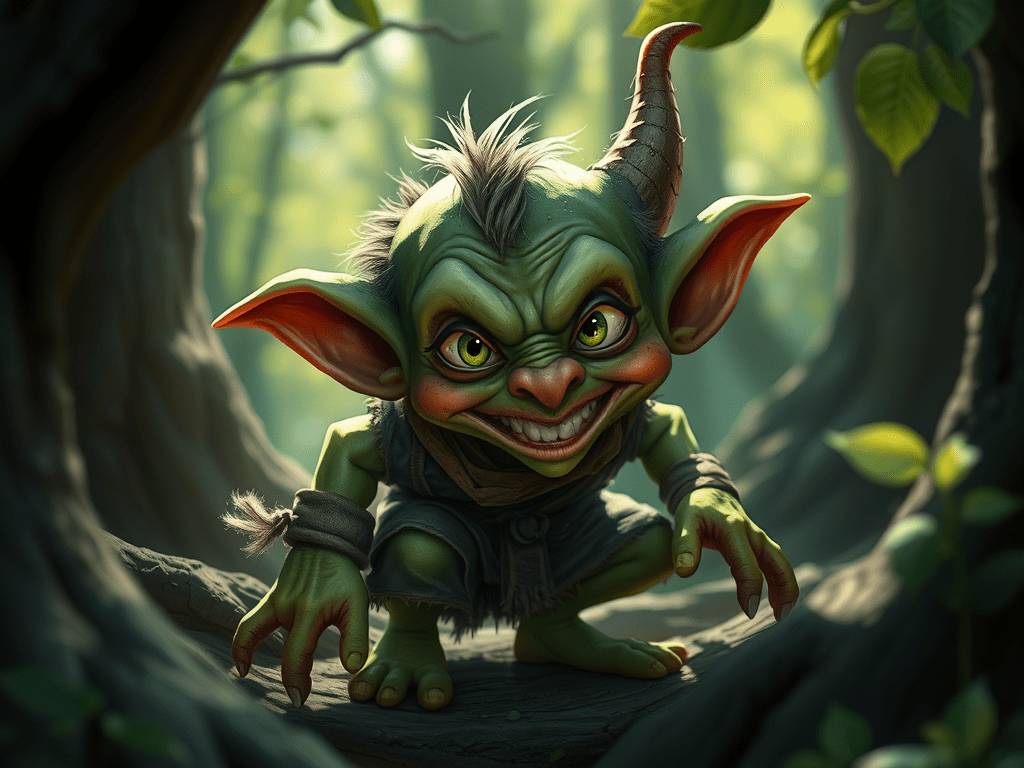
Creeps can’t seem to help getting on people’s nerves. Part of it is their habit of, well, creeping around and spying on people, all in the service of their insatiable curiosity. Part of it is the attempt to use rote memorisation of pop psychology as a substitute for developing actual people skills. But mostly, there is just something about them that ticks people off, something that makes them give off an air of perversity and weakness that makes others want to punch them on general principle. This, needless to say, just gives the Creeps more incentive to skulk and hide, making them even creepier and easier to hate, and furthering the vicious cycle. Their mythological source appears to be Goblins or the nastier and more old-fashioned kind of fairies.
Bane: Abhorrent Face. It doesn’t matter how hard a Creep tries to please others; it always comes across as incredibly slapable. Once per Session, the GM may have an NPC physically assault the Creep on the flimsiest pretext. The NPC is only affected for a moment, so after taking the initial swing he might immediately calm down and be shocked and apologetic, unless of course he’s the sort of person who takes a pride in always finishing what he’s started.
Doom: Fae’s Trickery. Goblins are mysterious and elusive, or at least slippery little bastards who never seem to be around when you’re looking for them. The Doom of Fae’s Trickery is one of stealth, illusion, and getting out of trouble – a highly useful skill for a Breed that’s always in hot water.
- Minimal Fae’s Trickery: Just Pretend I’m Not Here. The Creep can make itself undetectable, for an Interval of Minutes, in any way by anyone who does not pass a Minimal Grit Challenge. Since almost no one has less than Minimal Grit, this in practice means that the Creep can only hide from people who not only have low Grit in the first place but who for some reason suffers Disadvantages to Grit Challenges – for instance, the intoxicated, the exhausted, or those in serious pain. If the Creep does anything other than stand or walk very slowly while keeping absolutely quiet, the effect immediately ends.
- Limited Fae’s Trickery: Please Not Me. Whenever the GM declares that the someone targets the Creep at random with any Action (e.g., an angry dog deciding who of two intruders in its yard to bite), the Creep can use this power to redirect the unwanted attention to another possible party. This does not work when the Creep is the only possible target, nor when the attention is evenly spread over all possible targets (e.g., if there were two angry dogs in the yard, each would naturally go for a different intruder; this power could not be used to make both of them go for the Creep’s companion). This trick sees much use from teenage Goblins who don’t want to be called on to answer questions in class.
- Basic Fae’s Trickery: No Soul. The Creep can cause itself to have no reflection in mirrors for an Interval of Minutes. During this time it also does not show up video recordings or photographs. The same goes for any other technological way of detecting someone’s presence, like proximity alarms, etc. The Creep remains fully visible to the regular human senses. Edge cases may create strange results – for instance, a near-sighted person would see the Creep through her spectacles looking as blurry as if she wasn’t wearing them, even though everything else in her field of vision remains clear.
- Advanced Fae’s Trickery: Behind A Single Blade of Grass. The Creep makes itself capable, for an Interval of Minutes, of hiding even in the complete absence of any visual cover or concealment; effectively, the Disadvantage caused by lack of cover is completely negated. The Creep must still win a Hiding vs Keenness Contest against the people it tries to hide from as normal, and any Disadvantages not related to cover still apply normally.
HOARDER (DRAGON)
Hoarders like to, well, hoard things. Usually it’s some weirdly specific thing, like porcelain cats or works of Czech literature in their original language. Whatever it is, the Hoarder is constantly scheming to get more, better, and rarer specimens to increase its mostly worthless treasure trove, even if it means spending its last dime or getting thrown in prison for it. Their mythical origin seems to be the cunning, greedy Dragon, forever roosting on its pile of gold.
Bane: It Must Be Mine! Hey, a Hoarder’s gotta hoard. The PC has an obsessive need to collect some sort of items. It starts each Story having picked out some moderately hard-to-get-hold-of item that it absolutely must have for its collection (if it was trivially easy to get hold of, it’d have already have gotten it). Until it has managed to secure the object, it is distracted and doesn’t notice what’s going on around it, taking a Moderate Disadvantage to all Keenness Challenges.
Doom: Wyrm’s Discernment. Dragons are cunning and wise, capable of seeing what others cannot and of spotting things of value where others see only dross.
- Minimal Wyrm’s Discernment: Read the Writing on the Wall. By passing this Challenge, the Monster can instinctively know which of the people and objects currently within its line of sight are in some way “important.” Precisely what that means is up to the GM; generally, it means whether they have a major part to play in a currently ongoing adventure (for instance, named GMCs are usually “important”). The power imparts no further information, but it does make it possible to make cryptic utterances that will later make it seem like you knew what was coming all along.
- Limited Wyrm’s Discernment: Ooooh, Look at The Colours… Passing this Challenge enhances an Understanding vs Bullshitting or Understanding vs Grit Contest to get an idea for a GMC’s personality, granting a Minor Advantage to the Monster by giving it a vision of a coloured aura around the target. The power also tells the Monster whether the target is currently acting under some kind of duress, though if they are it provides no insight into just how and why and by who they are compelled.
- Basic Wyrm’s Discernment: Nose For Gold. By passing this Challenge, the Monster immediately knows the location of the most object that is most valuable or useful to the Monster (by the GM’s best estimation, and as the Monster defines value) within an area roughly equivalent to a large room. It does not provide any information about the nature of the prize. The usefulness of the object can depend on factors that the Monster is not currently aware of, e.g., if the Monster is about to be attacked the power might point it to the closest convenient improvised weapon.
- Advanced Wyrm’s Discernment: By the Pricking of My Thumbs… For an Interval of Minutes after passing this Challenge, the Monster can sense the presence and rough direction of any immediate threats to its person, its friends and its property. When applicable, this grants a Major Advantage to Keenness Challenges to spot and identify such threats by the normal senses.
KLUTZ (GIANT)
Klutzes take up too much space. It doesn’t matter how large or small they physically are, they still can’t seem to fit comfortably inside regular human-sized buildings, and certainly they can’t be trusted with breakable human furniture. Accordingly, Klutzes tend to walk through life with the put-upon air of people who spend a lot of their time apologising and promising to pay for the damages. They appear to be intended to be some kind of Giants, or possibly trolls – some kind of big, clumsy thing that’s prone to stepping in it, at any rate.
Bane: World of Cardboard. Once per Session when the Klutz does something that requires speed or finesse, the GM can declare that it breaks some inanimate object. It can be anything, up to and including entire buildings, but it’s never organic or sentient (because that’d just be too sad!).
Doom: Titan’s Prowess. Unsurprisingly, the Giants’ Doom revolves around being very big and strong.
- Minimal Titan’s Prowess: Mr. Muscle. The Giant can cause its muscles to swell and bulge to grotesque size for a few seconds. Unless the Giant’s clothes are unusually spacious or flexible, they burst and are reduced to tatters. Any restraints the Giant is in are also destroyed, though the Giant takes damage from the process depending on how sturdy the restraints were, on the general Level of 1 HP for cloth, 5 HP for rope or 10 HP for chains. The display is also unsettling and may provide a Minor Advantage to Volume Challenges against people who saw it, at the GM’s discretion.
- Limited Titan’s Prowess: Fists of Fury. The Giant causes its bare hands and feet to have the weight and hardness of solid stone, and therefore count as a Minimal Weapon. The effects last for an Interval of Minutes.
- Basic Titan’s Prowess: Made of Iron. The Giant gives itself 3 extra HP. These HP are lost before any of its normal HP are lost. The power does not restore any lost HP; current injuries remain, only future ones are lessened. If the power is used when the Monster still has one or more extra HP left from previous uses of the power, the old extra HP immediately disappear. The effects last for an Interval of Minutes.
- Advanced Titan’s Prowess: That Hideous Strength. The Monster can break and destroy any inanimate object that it can hold in its hands or wrap its arms around, regardless of how durable it is.
LOUDMOUTH (HARPY)
Loudmouths are, well, loud. In fact, they tend to have a thing about drawing attention in general – positive or negative doesn’t matter so much, what’s important is that everyone looks at them and only them, all the time. In this, they seem to be the avatars of the mystical Harpy, a dirty and disagreeable creature that was also big on screeching to high heavens. This is not to say that they are an all-female Breed, mind. In fact, those Loudmouths who are of the feminine persuasion often feel that being obnoxious, overbearing, and in dire need of shower seems to be more socially acceptable for men, and that this double standard is definitely something that needs to be pointed out as often and with as much volume as possible.
Bane: Shutterbug. The PC thrives on attention and can’t stand feeling unseen and ignored. It has a Moderate Disadvantage to all Challenges where no one can see what it’s doing. That means all Challenges performed in solitude (though a webcam counts as someone watching) and also all Bullshitting, Trickery and Hiding Challenges where the PC obscures its true motivations and actions from all the people watching. However, the PC can still hide its actions from some or all the people present without penalty, if it has told at least one present person ahead of time what it’s planning to do so that he can see how clever it’s being as it does it.
Doom: Garuda’s Swiftness. It is the way of the Harpy to soar on the high winds, or at least to be very quick to get away from people trying to beat it up. The Doom of Garuda’s Swiftness embodies this need for speed.
- Minimal Garuda’s Swiftness: The Hand Is Faster Than the Eye. For an Interval of Minutes after passing the Challenge, the Loudmouth blurs oddly when it moves, seeming to snap from stance to stance so quickly that its motions can’t be seen. This does not bestow any actual speed – its limbs stay still for the same amount of time they would otherwise have spent moving before suddenly blinking to their new position – but it looks cool. It also grants a Minor Advantage to Trickery Challenges that rely on hiding what the Harpy does with its hands. This explicitly includes picking pockets.
- Limited Garuda’s Swiftness: Dance Like a Butterfly. Passing this Challenge grants an immediate Moderate Advantage to a single Asskicking vs Asskicking Contest where the Loudmouth is being purely defensive, trying to dodge and weave and avoid being hit.
- Basic Garuda’s Swiftness: Ah-HUP! Passing this Challenge while standing near an immobile straight vertical surface immediately makes the Loudmouth float up along it like a soap bubble, ending up at the top of it after an Interval of Seconds. The precise height of the edifice does not make a difference as long as it rises straight up at roughly a ninety-degree angle; tall trees and skyscrapers can be ascended with equal ease. Note that the power does not offer any opportunity to steer, nor any protection against obstacles; using this on an indoor wall will lead to you bumping your head on the ceiling before falling down again, and when scaling a mighty redwood it is advisable to first check that there aren’t any sturdy branches immediately above you.
- Advanced Garuda’s Swiftness: A Leaf on the Wind. For an Interval of Minutes after passing this Challenge, the Harpy does not take any damage from falling, no matter how high the fall. While it doesn’t fall “slowly,” it effectively stops accelerating after the first meter or so, causing it to land hard, but not hard enough to cause injury.
MOOCHER (VAMPIRE)
Moochers mean well, really. They just have this… thing they have to have, often and in great quantities. Just what it is varies, and it’s usually something silly; some Moochers absolutely have to eat themselves sick on sour cream bagels, others need to apply overpriced beauty products to their tender skin. And the problem is, being honest about having a problem somehow removes all the satisfaction from it. Thus, Moochers are forced to lie, scheme and connive to get their fix, and have their sorely strained friendships and relationships to show for it. They resemble somewhat shabby Vampires, out to charm the unwary… though their ultimate aim is not to sink their teeth into their victims’ throats, just to borrow some money.
Bane: Horror Hunger. The PC has a supernatural addiction to some sort of activity or physical sensation (choose one when creating the character), and if it doesn’t get to binge on a regular basis it grows weak and haggard. Once per Story, the PC must indulge in a virtual orgy of its particular craving, or else it starts the next Story at 3 HP below its maximum. The player needs to negotiate some sufficiently over-the-top way of binging on their addiction with the GM – if what he suggests is too easily achievable, the GM is perfectly within rights to raise the stakes in whatever way she can think of.
There is one hard and fast rule for this Bane – the binge must be acquired in a way that does not involve any other person’s agency in any way. Horror Hunger is about personal, selfish gratification – the moment someone else gets involved, it spoils the satisfaction. Thus, the binge cannot involve anything being given (as that requires someone else to willingly participate) or taken (as that requires violating someone else’s agency) but only stolen (whether literally through picking a pocket or breaking into a house under cover of night, or figuratively by lies and deceit). Vampires are decidedly icky with their skulking and scheming to get what they want, but they are also physically harmless – they can’t violently force someone to give them what they want, no more than they can forthrightly ask for it.
Doom: Siren’s Voice. Moochers have a preternatural ability to charm and beguile people, all the better to take advantage of them.
- Minimal Siren’s Voice: Eyes Meeting Across the Room. By passing this Challenge, the Moocher causes another nearby person to notice and look at it, without knowing why.
- Limited Siren’s Voice: Charm You with A Smile. Passing this Challenge enhances a single Schmoozing vs Grit or Bullshitting vs Understanding Contest where the Vampire is trying to persuade or cajole someone into something, removing all Disadvantages caused by unfamiliarity. The target instinctively and irrationally feels like the Vampire is a long-time casual acquaintance, even if they only just met; while it does not in any way predispose her to do any favours for it, she will not show any reluctance caused solely by not having known it for long. All other Modifiers apply normally.
- Basic Siren’s Voice: To Me, My Minion! By passing this Challenge, the Moocher makes a single human who it has met in person instinctively know where the Moocher is and what its current dominant emotion is (for instance, the human will know if the Moocher is currently fearing for its life). The power works irrespectively of distance. The target has no direct compulsion to do anything, though if he cares about the Moocher and is inclined to trust his intuition he will probably come running if he gets the sudden sense that it needs him. Likewise, a human who knows about this power will know that getting a sense of irritated impatience with an address attached means that the Moocher wants him to come and get yelled at over something.
- Advanced Siren’s Voice: Promise You the World. By passing this Challenge, the Vampire compels a single person to believe it when it claims that it will reward him in a certain way if its terms are met. The target is not forced to take the bargain, but he is forced to believe that it is a genuine and honest one and is incapable of even imagining that the Vampire might go back on its word on this subject. The Vampire must be reasonably capable of performing the named service to the best of the target’s knowledge for the power to work; if it promises to pay the target a million dollars, the target must have reasonable cause to believe that the Vampire possesses or can acquire a million dollars.
 Mister Monster's Workshop