Monstrous Mishaps came about because I felt thoroughly sick of fake losers.
The X-Men are really the ur-example here. Don’t get me wrong, I love the X-Men. They’re cool and colourful and dramatic and they fight giant robots, what’s not to like? But the idea that people like them would ever be some kind of oppressed minority is insane. They’re sexy and rich and hyper-competent and they have godlike powers. They wouldn’t inspire hate groups, they’d inspire fan clubs.
Aberrant, for all its faults, is right on the money there. If people started manifesting incredible powers, then they wouldn’t be hunted down like animals. Nor would they start conspiring to take over the world. They wouldn’t need to. Because all the normies would hand them the world, free of charge! Power is attractive.
No, it’s weakness that gets persecuted, weakness that – perversely enough – makes people hate and fear you. I blame evolution, frankly. We’re not wired to respond negatively to people who are strong, because those people are dangerous to cross but potentially useful to befriend. We’re wired to respond negatively to anyone who seems sickly and weak, because there’s no downside in pelting them with rocks until they go away. They weren’t going to help us anyway – they lack the ability – and who knows, whatever they have might be contageous.
Knowing this from (ahem) painful personal experience, any sort of Randian “they hate me because I’m better than them!” moaning has always rubbed me the wrong way. And for someone who loves his fantasy, that’s a bit of a handicap, because fantasy is shock full of the sentiment. It seems like every other setting focuses on some group of supernatural beings who are stronger, smarter and wiser than everyone else, and who inexplicably get kicked around for it.
So with Monstrous Mishaps, my starting position was this: can I create a group of supernatural beings who really would be kicked around, without making them have done something to earn it? Could I create beings with magical powers that were so useless, and whose weaknesses were so obstructive and crippling, that they’d naturally gravitate towards the very bottom of society?
And that idea paired off nicely with another one that’s always fascinated me, that of essential identity unsupported by fact. I think it came from reading the Emperor Norton issue of Neil Gaiman’s The Sandman back in the day. Here was a guy who decided that he was the Emperor of America, and was completely unbothered by the fact that no one else took him seriously, because why would an Emperor care what a bunch of peasants thought of him? Of course, his regal dignity was also the only thing that sustained him in the face of a life as a failure and a pauper.
Or, for a less whimsical example, this angsty short story they made us read in Swedish class, about a guy who through mistaken bureaucracy was declared to be a moose. He ended up having to spend hunting season living at the town zoo since otherwise someone might shoot him without breaking any laws. Now that guy, you must admit, was a real hard-luck case!
So taking that a step further, what if someone decided they were a dragon, albeit a dragon that inexplicably looked and functioned just like a regular ol’ human being in every way? What would that guy be like, as a character? Well, for one thing, he’d be kind of put upon, feeling like a failure for not getting to roost on a pile of looted gold like a dragon like himself ought to be able to. He’d see himself as a massive underachiever, wouldn’t he?
So from there, I started sketching out my supernatural Real True Losers, the Monsters. I did give them some supernatural powers, because I felt like it’d provide some flavour, but I tried my hardest to make those powers as underwhelming as possible – the sort of abilities characters in most supernatural games could pull off right out of the gate, I placed at the end of a long and painful learning curve. I also added some supernatural weaknesses, the metaphysical equivalent of Mr. Moose Guy’s exile to the zoo, and made them as bothersome as I could manage without making the characters completely unplayable.
And, like I outlined in a previous post, the setting of Monster World sort of grew up around that concept. It turned out that while the Monsters might be more benighted than most, no one in the setting was particularly successful. In fact, in the end I decided that Monsters weren’t even oppressed, at least not in any systemic way – their failure at living up to their archetypes was so complete that no one even cared, except for the Slayers (and mostly because they were all even more pathetic!).
So in the end, I guess I didn’t quite achieve my goal of creating a genuine, realistic oppressed supernatural group. But hey, them’s the breaks. If I was used to succeeded at stuff, I wouldn’t have been inspired to make a whole game about failing!
The setting for Monstrous Mishaps just kind of developed on its own, and along the way turned out to be in a lot of ways more interesting than the actual Monsters it’s named for. When I first started sketching on the Monster Breeds, they inhabited some sort of vaguely gothic-punk reality, since – not to blow your mind or anything – I was mostly working off of a World of Darkness template, only with everything made as pathetic as possible. There were mentions of knives gleaming in dark alleys and Klutzes fleeing from angry mobs after they accidentally killed someone. It was, all in all, both derivative and kind of pretentious.
But at some point, I started smoothing out the sharp edges. The fights became less deadly. The conflicts became more at the same time more frantic and with lower stakes. Characters stopped moaning in agony and started sighing in aggravation. It all developed more of a cartoony feel, with bright pastels replacing the shades of grey.
At the same time, I was hard at work coming up with potential plot hooks for the setting. After all, my complaint about a lot of games is that they don’t give you a sense of what you should actually be doing with all those interesting setpieces. And what I ended up going back to were the sort of sitcoms and Disney comics that I grew up watching and reading. That fit nicely with the more upbeat feel of the characters, and in the end it sort of crystallized into a simple concept: Monster World is a place where people care about things in reverse proportion to how much they actually matter.
Thus, to create a scenario in Monster World, just put the stakes as absurdly low as you can, and then have every GMC act like the fate of the world depends on them. You have a job delivering pizzas, and your annoying in-law is determined to delay you enough that he gets his pizza for free! Your neighbor borrowed your lawnmower and won’t return it, and has put up traps all over his property to keep you from stealing it back! At the same time, the actual risks and concerns should be treated as irrelevant – nothing really bad is going to happen, and things will more or less go back to normal by the next Story.
This works really surprisingly well for creating silly situations that will make the players feel faintly ridiculous just for having to engage with them. And the rule system – which functions best when trying to do relatively simple things under trying circumstances, and where basic competence is so rare as to be almost a superpower – works really pretty well for it. As one of my play testers put it, take out the Monsters and it’s basically 90s Sitcom: The RPG.
Which does make me wonder if maybe I would have been better off just ignoring the urban fantasy pastiche altogether… but, well, it’s a little late to revamp the whole thing now. Still, it might be an idea for a supplement somewhere down the line. I could call it Suburban Silliness…
All right, day two of my let’s-get-this-stupid-quickstart-finished marathon. I’ve read through everything I’d written so far and found it more or less passable, though I should probably put in one of those boring sections in the front that explained just what in tarnation this thing even is. I mean, I don’t know who would download this stuff without already having a pretty good idea, but somehow it just feels incomplete without it. Anyway, for now I’ve written up the combat section (unusually sparse, in this game – in my experience of playtesting it, fights do happen, but they tend to be short and frantic and undignified, so they don’t need a lot of complicated rules) and I’m working on the spellcasting system.
That spellcasting system is one that I’m quite proud of, though I concede that there is probably some room for improvement. It draws a little on the freeform magic system from Angel, with some Unknown Armies and Mage: the Ascension thrown in for salt, but I’ve also added some additional structure to make it easier for the GM to manage.
In its simplest form, it really just comes down to everyone in Monster World being able to work ritual spells. There is a single Ability for it called Hocuspocus, and any spell you might find or invent has a Challenge Level to cast, and if you pass the Challenge it goes off. Sounds a little too simple, right?
Well, there are two things limiting you from just flinging around magic to solve all your problems. The first is it’s all gated by GM approval. You can cast only what spells that GM tells you you can cast at any given time – even if you’ve already cast a certain spell several times, the mystical conditions can have changed and now it won’t work again for another few centuries. Now, the GM is encouraged to provide at least some kind of suggestion for a spell you could attempt when you want to attempt a spell, because just saying “no” is always boring, but you’ll take what you can get.
The second thing is the Conditions. See, every spell comes with between two and six Conditions: Cost, Blood Sacrifice, Complexity, Side-Effects, Misfire and Retribution. Cost means that you need something that you can get hold of fairly easily but not in unlimited amounts – you’ll have to spend either money or goodwill. Blood Sacrifice means that it’ll cost HP, either your own or someone else’s. Complexity means that there are some sort of finicky requirements that you’ll need to satisfy, requiring you to either go on a mini-adventure or otherwise have to rearrange your plans for them.
The second half of the Conditions are sneaky, because when they apply, the GM won’t tell you until after the spell has been cast. Side-Effects mean exactly that, when the spell takes effect something else happens in addition to what it said in the recipe. Misfire, on the other hand, means that the spell just plain does something different than what you were told it would do, though it’ll probably still be in the general area – for example, you might cast a spell for being able to leap tall buildings in a single bound, and instead it turns you into a human rubber ball who can bounce over tall buildings (and then keep bouncing all the way down the block, because rubber balls aren’t known for being able to break on a dime). Retribution, finally, means that you get afflicted by a hostile force that keeps making your life miserable for some period of time after the spell is cast.
Every spell has at least two Conditions, and the ones that have more get their Challenge Level for casting them lowered by one per Condition. That way, even some top-level spells might be available to novice sorcerers, albeit at considerable effort and cost. And again, the GM is the one who decides precisely what spells are and are not available to you at any given time. She might present you with one that can turn your worst enemy into a toad and which still only requires an Advanced Hocuspocus Challenge and no exotic ingredients, and you know that that means it’s got some subset of Side-Effects, Misfire and Retribution baked into it, but it’s tempting, isn’t it? You kind of want to do it just to see what happens, don’t you?
That’s the idea. The sweet spot is meant to be riiiiiight where magic is probably strictly speaking more trouble than it’s worth, but it’s still sexy enough that the players want to try it anyway. Then the GM can just sit back and cackle maniacally, which is a thing that any true GM loves to do.
This being my third and final week of Christmas vacation, I have resolved to get my rear in gear and actually do some work on the Monstrous Mishaps quickstart. And while I’m at it, and just to keep my mind on track, I should probably post some information about the game here, too. After all, the blog is named after it, and I originally started it so I could have a place to promote it. It’s just that, being scatterbrained, I ended up talking about absolutely everything other than what I meant to. Oh well. Let’s see about making an actual introduction.
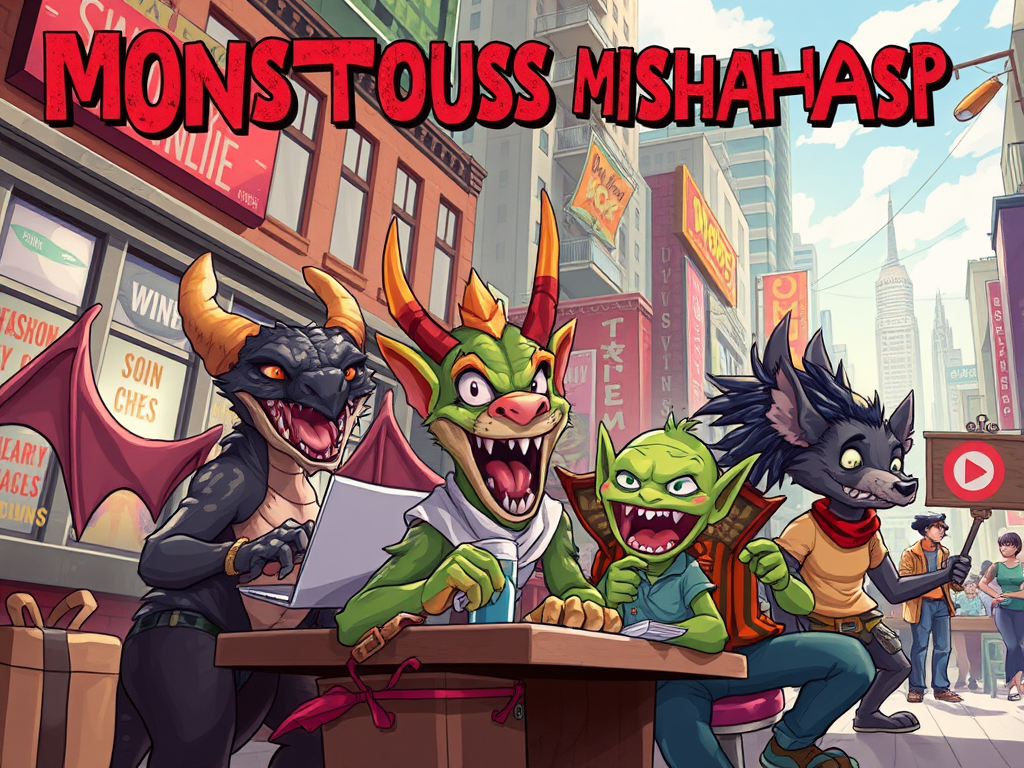
Monstrous Mishaps takes place in a place called Monster World, which is a looser and sillier version of our own world. It is a world right out of a wacky sitcom or sardonic cartoon, where epic feuds are fought over petty disagreements, people turn their character defects into fervently held ideals, everything seems set up to be as annoying and unhelpful as possible, and no one ever solves a problem by common sense if a madcap scheme will do. Everything that can go wrong will go wrong, but rarely in a way that will actually matter in the long run, and hilarity ensues at the drop of a hat.
It’s also a world where some people are Monsters – Dragons and Goblins and Werewolves and Aliens and all the staples of pulp fantasy. But in keeping with Monster World’s general perversity, Monsters are only nominally Monsters. That is to say, they don’t look like Monsters, they don’t have the power of Monsters, and for the most parts they don’t even act like Monsters, but by some kind of obnoxious cosmic law they just are Monsters. Which kind of sucks for them, to be honest. It’s hard enough being a working schmoe without the world insisting that you are, in some ineffable way, a Giant. Especially when you keep getting fined for accidentally knocking buildings over, even though you shouldn’t reasonably be able to knock buildings over, and certainly can’t seem to do it on purpose.
In Monstrous Mishaps, you play one of these long-suffering people as they go about their life. Think of it as urban fantasy playing out as a 90s sitcom. Your goal is to go about your life, impress your crush, keep from getting fired from your job, and foil your annoying neighbour’s attempts to mess with you, all of which is made harder by having a persistent and embarrassing metaphysical condition. It’s meant to be light, breezy, and poking fun at absolutely everything within poking range.
Mechanically, the game uses an innovative diceless system where you have a fixed set of Abilities ranked with a Score of between 1 and 15. The Score translates into a Level: a Score of 1 is a Minimal Level, indicating the sort of thing that just about any bozo can do, a Score of 2-3 is a Limited Level, indicating a hint of talent or an amateur interest, and so on. When you try to do anything, the Game Master sets a Challenge Score for you to reach, sprinkles with situational Modifiers to taste, and checks whether you’re good enough to succeed or not.
You can also goose your skill by spending Grit Points, which double your Score (after Modifiers) for the purposes of that one Challenge. You regain Grit Points by maintaining good relations to the important people in your life and by living up to the moral Values you’ve picked for yourself. Conversely, acting contrary to those Values makes you lose Grit Points – having the courage of your convictions is very important for a health self-esteem!
That’s about the short version. I’ll try to add some more later in the week.
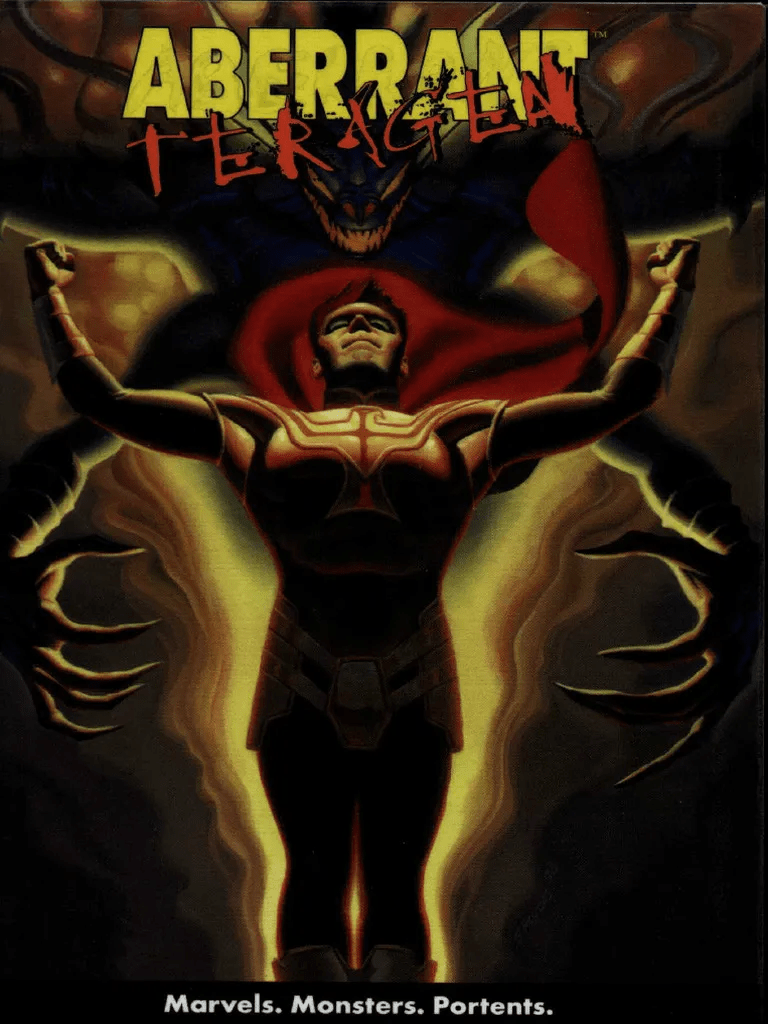
Our Aberrant – the totally not superhero game that we can of course play as a superhero game if we’re philistines – readthrough have finally arrived at the Teragen, the totally not supervillains who we can of course use as supervillains if we’re philistines. And… oh man. This one stands out.
In an earlier part of the readthrough, I identified the Teragen as one of the two ideological poles of the game, the other being Project Utopia/Team Tomorrow/The Aeon Society. Where the latter is your basic superhero do-gooders (albeit with shady NGO backers and a massive civilian support structure) who are working selflessly to make the world a better place because with great power comes great responsibility and so on and so forth… the Teragen are the ones who say, no, that’s a sucker’s game. Why should we lift a spandex-clad finger? Fuck you, I’ve got mine!
Of course, like all spoiled brats, the Terats don’t play particularly nice together, so they have about half a dozen different factions who all think that they’re the ones who really get it, man. Each faction gets its own sympathetic writeup where it gets to explain in its own words why it rules and everyone else drools, and each faction is also not-so-secretly one possible kind of villain you can throw at your players.
Nova Vigilance go around killing any baseline who “threatens novas,” which is interpreted precisely as freely as you might assume. Oh, and any nova who supports baselines who threaten novas, including by trying to argue that you shouldn’t go around killing them. So basically, they kill a lot of people and act completely self-righteous about it. Handy if you want a villain who’s terminally straightforward in his evil but has maybe just the tiniest bit of a sympathetic motivation at the bottom.
The Harvesters are physical monsters and express their body-positivity by going around acting like moral monsters as well. Including by eating people who offend them by going around having the standard-issue number of arms, legs, eyes and tails. Handy if you want pure creature-feature villains with a hint of “tragic monster” about them.
Pandaimonium want sex, drugs and rock’n’roll, and they want no limits to it whatsoever, and they’ll happily make a buck running drug and prostitution rings. Handy if you want to cut down on the angst and have villains who are basically just superpowered gangstas who like living large and sticking it to the man.
The Casablancas are subtle schemers who trade in secrets. They don’t do terribly much on their own, but they share information with the other factions and help coordinate them. Handy if you want villains for a more intrigue-based, investigative story.
The Cult of Mal worship the Teragen’s Magneto-wannabe, Divis Mal. Like, they literally think he’s a god and everyone should do what he says. Handy if you want villains who are religious fanatics.
The Companions are middle-eastern. That’s… pretty much it. Handy if… I don’t know, you want to spite political correctness by reveling in islamophobia? Maybe? Honestly, they’re kind of boring.
The Primacy, finally, just basically hate Utopia and baselines and the entire current world order and want to quantum-bolt it to ashes so they can build a new one. Handy if you want some cackling megalomaniacs who are after – WORLD DOMINATION! MUAHAHAHAHA!!! With, again, just the tiniest bit of actual ideological underpinnings for it to make it feel slightly less cringy.
The book also contains an overview of the “canonical” future of the setting (since it’s the backstory of another game called Trinity). Basically, novas get increasingly crazy with Taint, baselines get increasingly freaked out by novas being crazy, and just generally novas join the Teragen in increasing numbers, and finally there’s a massive war between baselines and novas and the novas lose and leave Earth for greener pastures. The Aberrants and Project Proteus are pretty much completely irrelevant to the whole thing, and Project Utopia as a whole fades into nothing as everyone gets up on the whole nova-baseline-co-existence thing. I guess technically that means that the Directive wins, but they’re still so boring that they don’t even get a mention here.
Now, I mentioned this book standing out, and it does. Because this book… this book, you see…
This book is actually kinda-sorta good.
I mean, it’s not amazing or anything, but there’s some real passion and imagination in it. The Teragen’s inner circle are lavishly described and idiosyncratic – they are actually characters that seem like they’d be fun to portray, and whose schemes and vendettas seem worth getting invested in. Like, there’s one guy called Leviathan who looks like a giant shark on legs and lives in a ruined cathedral in the flooded catacombs beneath Venice but is secretly a screwed-up twenty-something kid who was abused by his mother, and DEAR LORD, you can just FEEL the writers’ relief at finally getting to be gothic-punk again, can’t you?
And the factions, likewise… Well, this is what White Wolf was always so very, very good at: taking a messed up perspective and arguing persuasively for it, and then taking a different messed up perspective and making an equally compelling case for it. White Wolf, at its finest, was an exercise in extreme empathy, the playing of devil’s advocate turned into an art form. And here, at long last, we finally get a taste of it.
Of course, this also means very vividly seeing how half-hearted the rest of the setting is in comparison. The writers just didn’t care, at all, about the members of Team Tomorrow. They did care about getting to show off how smart they were by showing how real-world problems could be actually addressed using comic book superpowers, but the actual personalities that would be involved in such things? Nah. Give them a shark-boy with mommy issues any day!
And that’s fair, we all know that the villains are usually the more interesting characters… but it does raise the question of why they even made this game in the first place, then. Or at least why they didn’t just skip the pretensions and made it all about angsty Teragen revolutionaries from the start. I mean, a game where Killer Croc is the misunderstood antihero fighting against Superman the clueless patsy of a fascist authority would perhaps not be to everyone’s taste, but it would certainly be different, and they would have enjoyed writing it a lot more than I think they enjoyed writing most of this game.
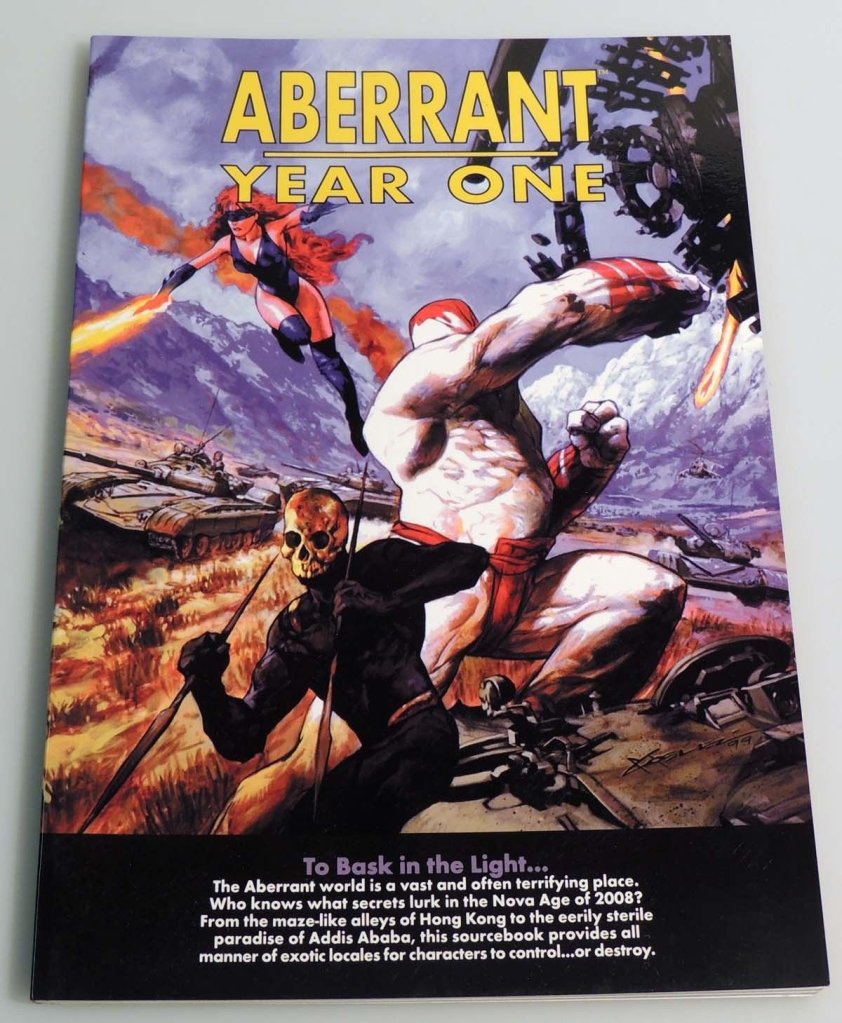
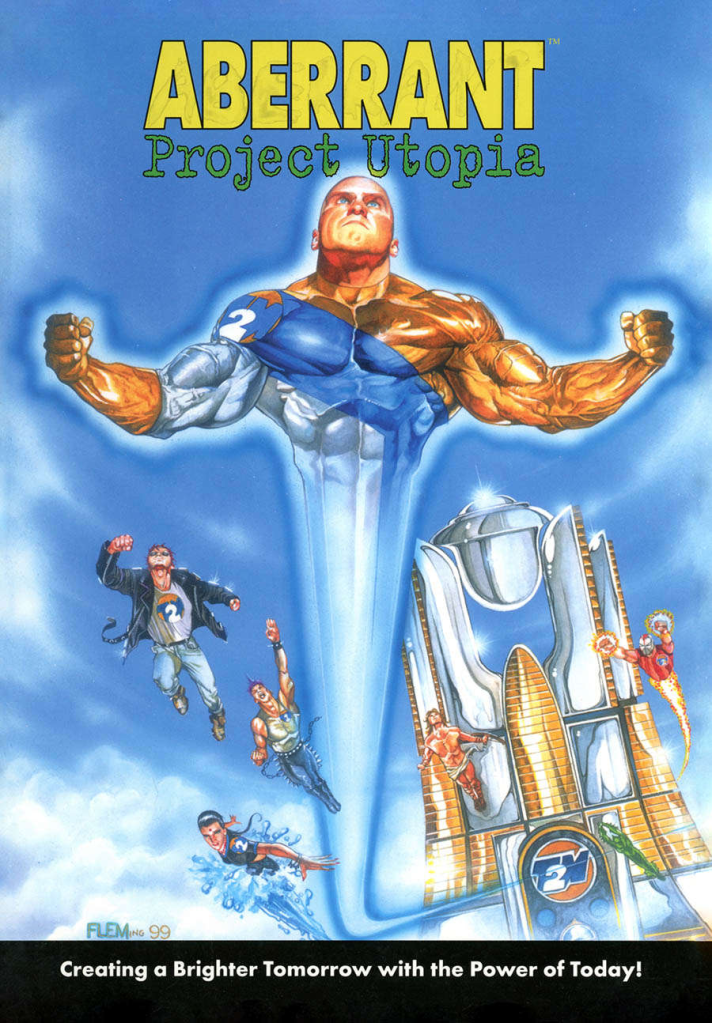
Ploughing on with our Aberrant readthrough, this week we are going to cover Year One (which is a general setting book) and Project Utopia (which is about, well, Project Utopia).
Both of these books are, I think, absolutely vital to running the game, for the reason that Aberrant is not the sort of setting where you can just make shit up. This is clearly by design – the developers didn’t want an anything-goes kind of setting, but one that was well-defined, interconnected, and where things happening in one place had consequences in other places. Whether that was necessarily a good idea is up to debate, of course – I’ve complained earlier about how it makes it really hard to really make good on the game’s promise of letting you use your superpowers to change the world. Everything is so bolted down and slaved to a rigid metaplot that the things you can change just feel flimsy and unimportant… and on the flip side, if you do manage to change the setting, then it’s no longer the same setting and all those expensive setting books just became obsolete. But okay, for better or worse this is clearly what they were going for.
The bulk of the book describes a dozen major world cities and explains what nova-related shenanigans are going on in them, with a signature nova or two statted up at the end.
New York is boisterous and caught in a three-way tug-of-war between nova-hating religious nuts, nova-worshipping religious nuts, and nova-led rational inquiry (which also may contain nuts). Also, a nova has gone crazy from Taint and is actually leading both the pro-nova and anti-nova factions, under different identities, which is at least kind of funny.
Los Angeles is full of degenerate has-been celebrities and is plagued by police brutality. And within the game, it also has a dozen different time zones within the same city! (yes, yes, cheap shot)
Havana has gone from communist to an extreme laissez faire capitalism whereby anything is permitted as long as you can afford it. It’s a great place to buy and sell outlawed technology, corporate or state secrets, and the services of specialised novas. The fact that it sounds a lot like an old-timey pirate port mixed with a Cold War thriller is probably not coincidental.
Mexico City is the headquarters for Team Tomorrow Americas (Team Tomorrow is basically the best of the best among Project Utopia’s novas) and has gotten a lot wealthier in a hurry. However, people are suffering collective whiplash from all the changes and are starting to grumble, especially since a lot of Mexicans are sensitive about Americans and Europeans not respecting their culture.
Quebec is cold and bleak and boring, because this is a White Wolf publication, and I think the White Wolf writers considered Canada the polar opposite of all that was cool, edgy and gothic-punk, so any supplement that mentions it is going to portray it as absolutely miserable. They don’t like novas and they are killing each other over the stupid French/English thing. Feh.
Venice has also gotten a makeover, including a ton of new islands to plonk down new buildings on. It’s the headquarters for Team Tomorrow Europe and, much like Mexico City, there is some friction between the frantic future-optimism of Project Utopia and the people who actually quite liked yesterday and aren’t at all sure they want to have it paved over without even getting a say-so.
Lagos is under the competent but oppressive rule of a baseline dictator who is enlisting Nigerian novas to bolster his regime. I kind of like this guy just because he’s pretty much the only baseline I’ve seen so far that gets treated with some gravity. He’s clearly meant to be an example of the sort of realistic villain you can encounter in the setting, which is cool – he’s not out for WORLD DOMINATION!!!!, but he’s sure as hell out to expand his borders and cement his rule, and that will lead to him committing all sorts of interesting human rights violations that he’ll furiously deny to the media.
Addis Ababa is the headquarters of Team Tomorrow Central, and is sitting pretty since Project Utopia terraformed Ethiopia’s deserts to perfection. It’s basically a scale model of what Project Utopia is hoping to turn the world into, hyper-modern and prosperous and with high-speed rails and cleaning robots everywhere.
Moscow is the seat of the Directorate, which I’m still not going to go into too much because they’re still boring, but anyway, Moscow is basically a hotbed of Cold War style espionage and misdirection and general paranoia. It’s grim, it’s cold, and your hotel room is definitely bugged.
Mumbai is the new movie capitol of the world, having beaten out Los Angeles. Novas flock here to make really flashy movies where you’ll believe a man can fly because he actually is flying.
Jakarta is a mess. The whole nova boom just kind of didn’t happen here, and everyone is cranky about it. Also, organised crime.
Hong Kong. More organised crime, and the meeting between the West and the East or some such cliche.
Tokyo loves novas to a slightly unsettling extent. There are religions worshipping them, and even the secular fans are a bit scary. The Japanese government is part of the Directive but basically likes novas fine as long as they’re its novas, having formed a Japanese super team called Nippontai to compete with Team Tomorrow. We don’t find out much about them, which is a shame.
After the cities, there is a section about cutting-edge technology in the alternate year of 2008. Again, this is absolutely essential, because the books keep mentioning how the novas have created cool new technology while also stressing that this is not the sort of anything-goes setting where a super-genius can whip up a time machine in a few hours, and balance can be tricky to strike if you’re not up to date on what the latest technological forecasts are.
Specifically, new technology includes hypercombustion (cars still run on petrol, but they’re a lot more energy-efficient about it), a new super-fast Internet called the OpNet (which, impressively enough, really does resemble the Internet of 2025 to a prescient extent), genetically engineered microorganisms that can clean up pollution, limited cloning and limited cybernetics. People have abandoned floppy disks and CDs in favour of miniaturised “chips” that can be plugged into a carriable reader (yeah, it no doubt seemed terribly futuristic in 1998). Flying cars actually do exist, but most countries don’t let civilians drive them for obvious reasons. Reasonably lifelike remote-controlled robots likewise exist, but they are very limited (for one thing, they have a physical wire trailing after them) and so are mostly just used by politicains who want to make public appearances despite concerns about assassination. Cold fusion is being worked on, but no one managed to figure it out yet. Oh, and someone has invented a miniature remote-controlled tank, and the crime syndicates are absolutely going to get their hands on some and use them against the players.
Project Utopia! Another thing you absolutely need, because this is supposed to be the massive organisation that has reshaped the entire world and who have their fingers in every pie, and the shady dealings of which form the spine of the entirely-too-inescapable metaplot. You need to read this book to play the game.
So it’s a shame that it’s so damn boring. Most of it is just the same tiresome gushing about how Project Utopia is doing all those things that all reasonable people agree ought to be done, and nyeeh-nyeeh-nyeeh to all the nay-sayers who said it wouldn’t work because they tried it and it totally does. We get a slightly more detailed history of the Project, most of which we already knew from the core book, and we get a rundown of all the various divisions and who’s running and them and what they do to make the world a better place. Again, this is certainly necessary, a lot of those details are ones that you need in order to really imagine how the organisation works and therefore how it will affect the players, but it’s just so dry.
We eventually get a description of Project Proteus and its secrets, which is a tiny bit more interesting. It turns out that Proteus isn’t a huge organisation or anything, it’s really just a small group of people who have cover identities within Utopia and keeps quietly co-opting its resources for their own shady business.
For example? Well, Utopia supposedly negotiated a peace treaty between Israel and Palestine (oooof, that’s a little harsher in hindsight) through nothing but skillful diplomacy and appeals to everyone’s better nature, but that’s a complete fib and Proteus actually covertly threatened both sides with complete destruction if they didn’t play ball.
There was this thing called the Equatorial Wars where a lot of Third World countries started hiring nova elites to fight each other, and Team Tomorrow supposedly went in and busted heads and got them to stop. Except that’s a lie and Team Tomorrow actually got their asses handed to them and just sort of declared victory and went home, with the press helpfully over-emphasising their few victories and downplaying the fact that there is, somehow, still a thriving market for elites after Team Tomorrow supposedly put a damper on them.
Utopia also fixed the Y2K bug, and what no one knows is that while it did so Proteus used the access to every computer on Earth to hide any and all evidence that novas existed (in limited numbers) long before the Galatea incident. And that’s good as far as it goes, but it’s still a somewhat thin gruel.
Also, have I mentioned before that the sterilisation plot and vivisection labs cause a MASSIVE tonal mismatch with the frantic happy-happy-joy presentation of Utopia as a whole? It’s like the writers genuinely didn’t see what the big deal was – they explicitly say things like how Project Utopia is the closest thing to a pure “good” faction that a “realistic” game allows, and uhm… STERILISATION PLOT! VIVISECTIONS! Come on, guys, I’m all for moral nuance, but if you mix squeaky-clean public service on the outside with double-plus-mega-Nazi crap on the inside, what you get isn’t a morally nuanced organisation, it’s a ridiculously evil organisation that is passing itself up as a ridiculously good one!
Anyway, know how I said that with these two books, I’d finally figured out Aberrant? Well, here it comes. Do not brace yourself, the truth is not particularly shocking. It’s like this:
Aberrant presents itself as a deconstruction of superhero tropes, but it’s actually not. It’s better thought of as reconstruction of them. A deconstruction takes the tropes and shows how absolutely terrible they would be in practice, or how they would absolutely not work that way in reality. A reconstruction, on the other hand, takes the tropes and attempts to justify them, attempts to present ways that they could still work very much as they do while still being realistic.
And that, pretty much, is Aberrant. It’s not a deconstructed superhero world. It’s a superhero world with additional narrative scaffolding and semi-realistic consequences.
Project Utopia is the Justice League if they dealt mostly with peacekeeping, disaster relief, and other real-world issues rather than battling supervillains. Team Tomorrow is the high-publicity frontal figures that form the actual “superhero team,” but Project Utopia is much bigger because saving the whole world takes a lot of boring non-sparkly people in addition to the “superheroes.”
The Teragen are Magneto’s Brotherhood of Mutants with some actual philosophical examination of the whole “we are the future, not them” sentiment, and with the caveat that while some of them are superpowered terrorists, others are more subtle and thoughtful in how they apply their posthuman ideals.
The Directive are a version of SHIELD that acts more like a real intelligence agency crewed by cynical Cold War veterans rather than a bunch of action heroes in skintight uniforms.
The elites are the sort of supercrooks-for-hire that tend to show up on the payroll of unpowered crooks like Lex Luthor and Wilson Fisk, except their profession is semi-legal (if only because they only admit to the jobs that are roughly above-board) and they charge a lot more than a local crime boss could afford, so they mostly work for dictators and international syndicates.
So, if we ignore Proteus and the Aberrants and the stupid sterilisation plot, how do you run Aberrant? Drum roll here, please:
You run it… like a superhero game.
Seriously. It’s a superhero game. It’s just a superhero game where you stop a little more often and consider the logistics and infrastructure behind the plots. You will probably play as a bunch of superpowered do-gooders (probably on Utopia’s payroll) with flashy costumes and nicknames (for publicity purposes) who run around righting wrongs (but the wrongs are real-world wrongs like terrorism, pollution, and poverty) and constantly have run-ins with superpowered goons (who are either elites hired by whomever you’re annoying with your do-gooding, or Terats who oppose novas doing good for baselines on general principle). There will be shiny technology that gets stolen, sabotaged or malfunctions, but it’ll be things like genetically engineered supercrops or alternate energy sources, not time machines. And so on. There’ll be shady government secrets, but the secrets will be things like, “bombed somewhere they weren’t supposed to bomb,” not attempts to build all-destroying superweapons. You take a regular superhero scenario, and then you turn it down a notch. That’s Aberrant.
Which at least makes it playable… but it’d have been nice if the game could just have admitted that without prevaricating quite so much…
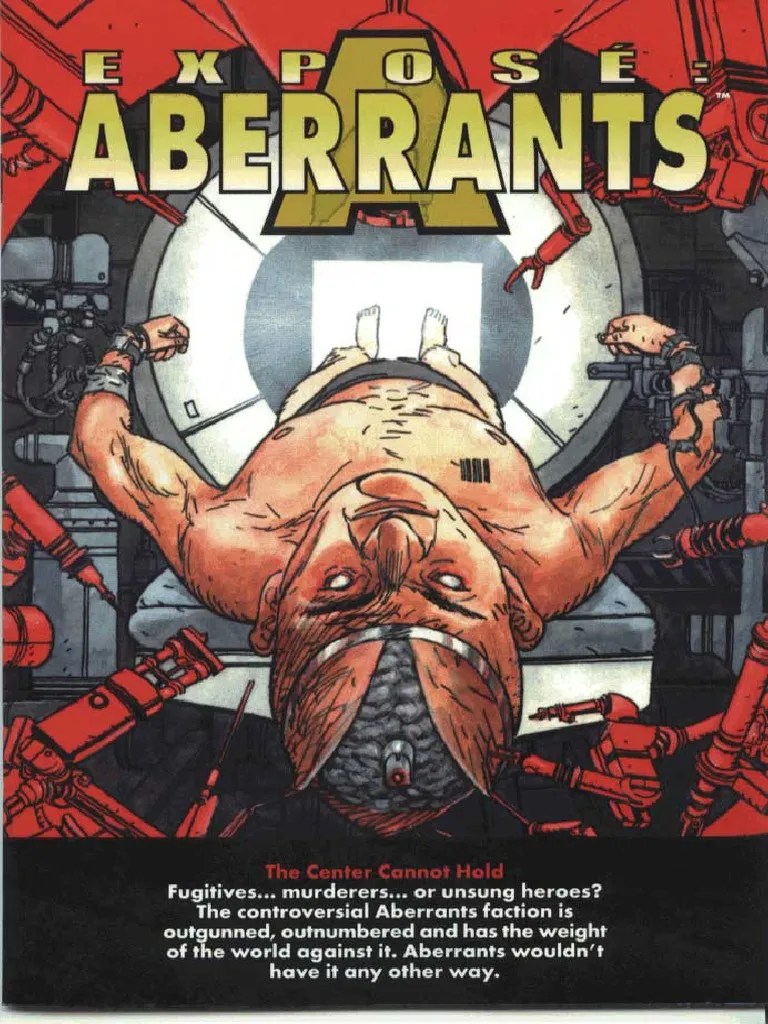
Moving on in my first-edition Aberrant readthrough, this week I will talk about the first two supplements released: the Storyteller Companion and Expose: Aberrants.
The Storyteller Companion is divided into two halves, one that provides further worldbuilding and one that is a three-act adventure. The worldbuilding is, as always with Aberrant, composed of a number of in-world documents (and a comic or two), but it can be roughly broken down into two parts: business and religion.
The business part is mostly forgettable, but it does establish that industrial espionage, and security against the same, are two things that novas are frequently employed for. That’s good, it means that you can run any number of “steal the McGuffin” or “find out who stole the McGuffin” type scenarios.
The religion part is a little more varied. The Pope has formally declared novas to be human (which maybe kinda totally had less to do with theology and more to do with Mega-Charismatic nova celebrity Alejandra meeting with him just before), and the crustier elements of the clergy are plotting to have him assassinated by hired novas. The Unitarians are super-optimistic and friendly to novas, because of course they are, and American fundamentalists (because remember that we’re back in the 90s, so fundies are of course the epitome of all earthly evil) are bigoted and ignorant and hate novas. Israel is claiming that God hasn’t erupted a single nova in Israel because Jews are too awesome to need them, but they are totally lying and all Israeli novas have just been quietly recruited into the armed forces. Shiite Muslims think novas are the work of the devil (and the fact that a nova set to be executed freaked out and blew up a small town hasn’t made anyone on either side feel better about it), while Sunni Muslims are cautiously open to the idea that maybe novas are blessed by Allah… though there are heretical Sunni sects who think that they can get nova powers by killing novas and eating their “blessed” bodies. Okay, as far as geopolitical tensions that might involve the players go, a lot of those are at least decent.
Nova cults are also a thing, especially in India, where rural novas are frequently worshipped as avatars of the gods, and in America, because skeevy cults are a hit there. One particular nova makes a habit of eating her cultists and then using Mega-Charisma to get juries to bend over backwards to excuse it as a voluntary religious practice. Ick, but kind of cool. Japan also has a growing Buddhist sect that considers novas to be divine, and some of whom have started bombing subways for no particular reason. Again, this is fairly decent and provides some information for both outright villains and for non-obvious moral questions that the players might weigh in on.
The adventure in the second half of the book is kind of lousy, to be honest. It does provide some description of Ibiza (and perhaps more importantly its premier nova night club, the Amp Room, which was mentioned in the core book and will become relevant again later), Marrakesh and Monaco in the Nova Age, which might be handy, but the story itself is a bland railroad where the players should preferably do as little as possible because the NPCs will just fix everything on their own if the players don’t do anything as rude as trying to roleplay.
Briefly, the players are agents of either the Aberrants, Project Utopia, or Project Proteus, and they’ve been sent to find this nova lady who maybe knows some stuff she shouldn’t. Project Proteus has also sent a one-dimensional psychopath named Chiraben after her. Like, I cannot possibly stress enough how flat this character is, he’s basically just some moronic nutcase who enjoys killing people (especially women, because of course especially women) and for some reason he keeps being given Project Proteus’ most delicate assassination jobs.
The only other significant character is Count Orzaiz, the signature Teragen. He’s just as boring in the other direction – the text just can’t shut up about how dark and lordly and charismatic he is, and how everyone loves him (except Chiraben, because he’s dumb and smells bad). Even his freaking dad is perfect (though I will grant you that I thought it was a little bit funny that his take on Orzaiz’s wholesale adoption of Teragen philosophy amounts to, “oh, he’s acting out for attention with that whole ‘I have evolved beyond base humanity’ thing. Ah, well, boys will be boys, he’ll get over it eventually”). Orzaiz is the one who keeps fixing everything, by the way – the supposed climax of the story is basically just him going up to Chiraben and paying him some money to go away and stop bugging him, whereafter he proceeds to bang the nova the players were sent to capture into joining the Teragen. Yes, really.
Expose: Aberrant is the splatbook (or as close to this game comes) for, well, the Aberrant faction, but since there is very little to be said about it, it’s just this little 26-page thing. It’s a splatpamphlet, basically. Most of the pagecount is taken up by a lot information about how the inept assassination (by Chiraben, naturally) that set off the metaplot was very unconvincingly covered up, which, since we already know what happened there, it’s terribly uninteresting.
That said, there is some guidance for how to portray the Aberrants. There are basically three mini-factions among them, the quiet supporters who are trying to infiltrate Utopia to find out the truth, the fugitives who have gone on the run and try to uncover the truth along the way, and the I-Can’t-Believe-It’s-Not-The-Teragen who think they already know as much of the truth as they care to and are just flat out attacking Utopia’s operations.
Interesting characters, effectively just one named Dr. Worm who’s a hyper-Nietzschean who would be perfect for the Teragen except he thinks even they aren’t hyper-individualistic enough (in fairness, he’s got a point; whether it was intentional or not, Divis Mal comes across as very much the sort of demagogue who preaches radical freedom but has very strong feelings about what people ought to do with their radical freedom once they have it). Interesting plot hooks, about one and a half – there is an example of something Utopia was doing (sponsoring the building of a dam that would drown the property of some people who didn’t want to move) that exemplifies the “serving the greater good, and brushing the cost under the carpet” thing that would actually make Utopia an interestingly grey faction. On the opposite side of things, apparently Project Proteus has secret facilities where they run horrific experiments on captive novas, which… well, it’s something concrete that we’ve been told about them doing, at least.
What both these books mostly bring home for me is just how… completely uninterested the writers were in the Aberrant movement and Project Proteus, despite those being supposedly their main heroic faction and their main villainous faction, respectively. Even in their own book, the Aberrants get nothing in particular to do except retread points from the core. And Proteus, supposedly the overarching villain of the setting? Well, they are over there doing… like… evil stuff. Or something.
What do the writers want to talk about? Two things, mostly. Firstly, the moral perfection of Project Utopia, and all the wonderful things they do, and how wonderful they are for doing so many wonderful things, and how wonderful it is that they are so wonderful as to do so many wonderful things. And secondly, the amoral perfection of the Teragen and how they are cool and edgy and totally don’t subscribe to your, like, slave morality, man. Notably, the Teragen are the only people allowed to criticise Utopia without being portrayed as inbred rednecks or unwashed conspiracy theorists who should keep their mouth shut about their betters – the Teragen, in contrast, are allowed to make actual arguments, and instead it’s Utopia who can never muster an argument about them that doesn’t amount to, “duhhhhh, they terrorists, terrorists baaaaad.”
So no matter what the writers initially intended, what the game actually shaped up to be seems to be a conflict between the people who think that novas can and should make the world perfect, and the people who think that the novas certainly could do that, but why should they demean themselves to do anything for those filthy baselines? And I feel like what’s missing from that duality is any sort of moral agency for the baselines, and any sense that the novas might not have the capacity to “save the world,” to say nothing of whether they have the right. There is a faction called the Directive that’s supposed to be a mostly-baseline organisation that tries to champion baseline nation states against unchecked nova power, but there is a reason why this is the first time I’ve mentioned them, and it’s that they’re just that boring and underdeveloped.
Honestly, that’s very in character for White Wolf. Everything is always ultimately about the shiny magical people, with everyone else being reduced to either fawning admirers, easily dispatched mooks, or faceless grey masses. It’s kind of especially blatant here, though – I recall at one point, the narration (which is not in character, in this case, but part of the GM instructions) snidely asks you why, if novas aren’t in fact superior to common mortals, you are playing as one. Yeah…
Ah well. Next up is Year One and Project Utopia. And there, by Jove, I think I actually figured out how to play this game. I’ll warn you, though, the answer a little bit of a anticlimax.
The thought occurred to me that if I’m going to read my way through all of first-edition Aberrant, I might as well post my thoughts here. It’s not going to be a full readthrough, but I’ll go over each supplement in turn.
So, starting out with the core book. It starts off without preamble with in-universe documents, and get used to that, because that’s going to be most of these books. White Wolf was always fond of that, but I don’t think it works quite as well here as in most of their other lines, for reasons I’ll get into later unless I forget.
Anyway, to try to summarise a tremendous amount of setting lore, ten years ago (in 1998) the space station Galatea exploded and drowned the world in quantum energies, and as a result about one person in a million “erupted” into a “nova” who can manipulate the quantum forces of the universe in ways that for some reason is completely identical to stock superhero powers. The books even admit that “quantum energies” are just things like gravity and electromagnetics, but novas can still teleport and read minds and change shape and they can do it Because Quantum. Which would be fine, except the book spends long, tiresome sections technobabbling away to try to make it all seem reasonable and sciency.
Anyway, an NGO called Project Utopia emerged suspiciously quickly to provide guidance for novas and, using a mix of nova powers, technological breakthroughs enabled by nova powers, and public goodwill generated by the above, set about cleaning up the environment, toppling dictatorships, arranging peace treaties, and just generally fixing real-world problems. Not all novas work for Utopia, though, a lot of them have cushy corporate jobs or serve as mercenary “elites” who hire themselves out as superpowered bruisers – indeed, the primary way to wage war has become hiring some novas to fight the novas the other country is hiring.
There aren’t supervillains per se, but there is a group called the Teragen led by a Magneto-wannabe called Divis Mal who claim that novas aren’t human anymore and therefore they have no obligation to respect “baseline” laws or ethics. Project Utopia considers them a bunch of terrorists, which is not completely true but not completely false either.
But Teragen aside, there is a loooooot of frankly tiresome in-setting documents outlining how novas have changed fashion, music, the entertainment industry, and how everything is super-great and everyone is happy except maybe a few stupid pootiehead malcontents… and then all of a sudden we learn that ACTUALLY, there is a secret conspiracy inside Utopia called Project Proteus, and it is up to no good and have sterilised every single nova in the world. Yes, all of them. Somehow. And some chick called Slider found out and they killed her, and her layabout bestie Corbin have gone on the run accused of the crime and he’s founded a resistance movement called the Aberrants who wants to put a stop to Proteus.
And, ugh… this plot hook, man. This freaking plot hook. It’s dead centre in the game, almost everything leads back to it and it’s just – so – STUPID. For one thing, how did Proteus even get to every single nova in the world? And how exactly did they expect this would work out, no one would ever notice that six thousand high-profile people had fertility issues all at once, and none of the super-genius intellects of the setting would ever put two and two together? And thematically, it’s just a mess. Here, have a game about playing a glamourous picture-perfect superhero! Oh, but you’ve been castrated without noticing. Yeah, that doesn’t ruin the power fantasy at all…
Honestly, it feels a bit like the guy who thought of it was very childfree and he thought it’d actually be kind of neat if all his shiny superheroes could be hot, single, and absolutely untouched by the messy business of reproduction. Because while there is some finger-wagging about how forced mass sterilisation is, like, bad and stuff, there seems to be about zero understanding of just how big a deal it would be in the real world and how hard most people would take it. It does kind of feel like the kind of idea I would have had back in my twenties, in fairness…
But anyway, even aside from that, it’s not even especially useful as a plot hook. It’s simultaneously too big and too tightly defined. If novas are secretly being subject to genocide by the people who are supposed to direct them in building a better tomorrow, then that makes pretty much everything else they get up in the setting look stupid and pointless… but at the same time, the Aberrants-versus-Proteus conflict is just too straightforward to work as a starting point for your own ideas. Proteus isn’t a nebulous evil organisation doing all manner of inventive bad things that the players can get into – it’s doing one particular bad thing, and it’s pretty well-understood right from the start why and how it’s doing it, so all that’s really left is trying to prove it to the public. And yes, you can build a campaign around that, but that’s just it – you can build one campaign around that. It’s not something you can riff on and take in a ton of different directions.
So, anyway, that’s the setting, and aside from (sigh) THAT THING, it’s not a bad one – certainly it feels vivid and lived-in, and there is some appeal in playing a character with superpowers in a setting where having superpowers doesn’t necessarily make you a superhero but where powers are being put to all sorts of personal, financial and political tasks. My main problem is actually that the core book spreads itself pretty thin over a ton of different parts of the setting that it wants to point to, and the fact that it insists on presenting everything as in-setting documents just make it worse, because making those informative and not just flavourful is pretty hard, and I don’t feel like the writers here were really up to the challenge. There’s a very strong feeling that this book was meant to give you a taste and nothing more. You want to actually use Project Utopia, buy their book! You want to use the Teragen? They’ll get a book! Oh, and there are these massive criminal syndicates who have adapted to nova crime-fighters by joining together, but if you want to know more about those than that they exist, you’ll need to wait for their book.
After that, there are the rules, and… well… look, it’s the Storyteller System, okay? The rules aren’t meant to actually be used, they’re meant to sit there and look pretty. Suffice to say, you can put a nova together that is on the general level of, say, Spider-Man pretty easily, and just about any common superpower you can think of is represented somewhere. Which does of course mean that most of them is meant for fighting, in a game which keeps reminding you that it’s totally not about going out and punching bank robbers in the face, but whatever…
The most interesting thing with the superpowers are actually the Mega-Attributes, which are relatively low-key bonuses to your regular human abilities, and the first dot in each of them comes with a free “Enhancement” that is some minor superpower tied to that Attributes. And that feels really cool, because it means that novas are, first and foremost, hyper-competent at their areas of expertise, in a way that has a lot more real-world applicability than the cheesy comicbook stuff.
Oh, and there is this thing called Taint that you can take in order to gain new powers faster, or that you might get if you strain yourself, because this is White Wolf and there has to be something that’s gradually consuming your very soul. That said, you don’t have to take Taint (or at least not much of it) if you don’t want to, and it does serve as a handy explanation for why novas end up looking and acting a bit funky.
I got to break out my Werewolf port for the first time in ages (I have one campaign I run for the whole group and one campaign for each player who might be missing… yes, even I think it’s a little OCD, okay? But anyway, the player who needs to be missing for us to run Werewolf is the second-most reliable player in the group, so the Werewolf campaign doesn’t see much use). It was fun, especially since I think the mechanics really clicked for the first time.
The big thing with Werewolf is supposed to be Rage. You’re a werewolf, you’re going to go berserk, it’s kind of your thing. You’re the Hulk, only furrier. Rage strengthens you but also takes away your control. And a large part of my reason for starting on this port in the first place (which led to my all-around porter madness) was trying to find a way to model that mechanically in a way that wasn’t too fiddly.
I may have actually worked it out now, at least in a rough fashion. The way it works is, each player has a number of Rage boxes that start out unmarked. Every time a player fails a roll, they mark a Rage box. They can then clear a Rage box to heal wounds, pull off different stunts in combat, fight whole groups at once, and badassery of that nature.
However! Whenever a player gets taunted too harshly, or fails in a way that feels too humiliating, or gets injured too badly, they have to roll +Rage (that is, 2d6 plus the number of marked boxes). If they roll 10+, they frenzy. If they fail the roll with 6-, conversely, nothing happens, but they mark Rage as usual when failing a roll. So the more Rage you have stored up, the more of an unstoppable killing machine you are in combat, but the greater the risk is of you completely losing your cool and smashing something you didn’t plan on smashing.
The Rage economy worked out really well in the fight scene we ran tonight – the player used Rage to hit far above his normal weight class, got hurt and had to fight for control, gained Rage from avoiding frenzy, and then used that Rage for more fighting. This player is a relatively feeble little Ragabash (think scout/trickster), and his opponents were two fomori with military-grade rifles and body armour, so it was a tough fight, and I think the Rage mechanic made a lot of difference.
We never did have to play out a frenzy, which is probably good, because those rules still need some work. Mechanics that take control away from the player are always tricky to formulate – you need players to still have choices, or else you’re just sitting there talking to themselves, but the whole point of Rage is supposed to be that you sometimes lose control. I am sort of considering an approach where I view it kind of like driving a speeding car that you can’t break, only steer – instead of asking, “what do you do?”, I might ask, “do you fight or flee? If the former, who do you attack? If the latter, which direction do you blindly charge off in?” With rolls required whenever they try to do anything that requires hesitation or forethought. I don’t know, though, there are a lot of pitfalls here. I’ll need to think on it.
But it was definitely fun to try out this part of the rules!
I am happy to report that I am over my Warhammer 40,000 obsession for now. So instead I am geting obsessive about Aberrant instead. Hey, I got to get my OCD on somehow.
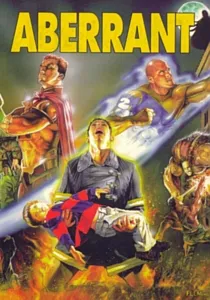
For those who don’t know, and that may be a not insignificant number of people, Aberrant is one of the lesser known White Wolf games from the 90s, one of the ones that weren’t World of Darkness or Exalted. It’s a superhero game where one person in a million has “erupted” into a “nova” who can subconsciously manipulate the quantum energies of the universe, which in practice means that they develop superpowers like flight and nigh-invulnerability and we’re going to pretend that it makes sense Because Quantum. Oh, and though no one knows it yet, all novas are slowly mutating into mad, godlike mutants called aberrants who humanity will fight in a horrible cataclysmic war, because it’s just not White Wolf if your soul isn’t being slowly devoured by something.
Otherwise, the big schtick of Aberrant is that it tries to be semi-realistic with the existence of superpowers. Most people don’t in fact put on colourful costumes and run around fighting crime – some do, but they’re mostly employed by the government or the UN, and far more novas are out there getting cushy corporate jobs, hiring themselves out as mercenaries in Third World proxy wars, or using their super-charisma to become world-famous celebrities.
It’s all kind of interesting in theory, but the execution is a little half-hearted. For one thing, it has that problem White Wolf games frequently had whereby it wasn’t exactly clear what you were meant to do. In a regular superhero game you stop bank robberies, but this game is all about avoiding that kind of cliches, and that just raises the question of what you’re meant to do instead. There are all sorts of things you could conceivably do, but since they’re all presented as completely optional, they’re not especially well-supported. Which is a little like writing D&D but just describing the monsters and magic in general terms while mentioning in the passing that some people go looking for treasures in old ruins, but you totally don’t have to be among those if you don’t want to. It leaves the whole thing with a great deal of assembling required.
It’s also got a major case of the White Wolf metaplot problem. Now, for most of these games, I don’t think the metaplot was ever as much of a problem as people made it out to be – it provided you with some texture and ambience, but the scope of the game would likely be about intrigue within a single city or region anyway, so it was easy enough to stay away from it. Not so with Aberrant. Here, the metaplot is in your face all the time, with the fundamental unimportance of single characters (yes, even the incredibly overpowered ones!) constantly stressed. Oh, this nova is really into Quebec secessionism? Yeah, that’s a ridiculous non-issue that doesn’t even matter now, so I am honestly perplexed as to how I’m supposed to care about it in a setting where physics have been turned on their head.
And to add to the problem, the metaplot is really kind of… well… bad. Like the rest of the game, it seems to not know what to do with itself. Like, it revolves around the shiny happy UN agency Project Utopia using novas to turn the world into a shiny happy paradise. But it has also managed (somehow! Don’t get me started on how stupid that plot hook is…) to sterilise 100% of all novas without anyone noticing. But it also wants to create a peaceful, enlightened one world government. But it also imprisons unruly novas and vivisects them. But it has also all but eliminated crime and pollution. But it also keeps isolated wars brewing to get novas killed off at a steady rate. But…
I am getting whiplash just from thinking about it. Like, I think it’s meant to be a case of a shiny happy facade hiding a terrible secret, but the facade is so shiny and happy and the secret is so terrible that it’s impossible to take either one seriously. It doesn’t give you that nice White Wolf feeling of a flawed ideal that it is possible to champion or oppose – it gives you the feeling that the pro-Project Utopia parts were written by a raving Project Utopia fanboy and the anti-Project Utopia parts were written by a foaming-at-the-mouth Project Utopia hater. The one thing that stays the same between them is that anyone who disagrees is clearly some sort of idiot or reprobate. That’s not shades of grey, it’s black and white constantly switching places!
To make it work, I think you’d need to actually bone down in Project Utopia’s methods and figure out how, realistically, they would be flawed. Crime has been eliminated? Okay, whose civil liberties were trampled to make that happen? A unified world government? Yeah, because stripping away the national sovereignty of poorer places surely won’t lead to them getting exploited even harder by the richer ones! You could make it into a study of why superhero morality (which was, after all, originally intended for small boys, no matter how much latter-day geeks tried to graft mature sensibilities onto it) simply doesn’t work in the real world, why we have tradeoffs and compromises, That’d be really interesting.
But no, instead we get one character screaming “what’s your sperm count?!” at another.
All of which means that this is a game that needs some tender loving care. Which is, as it happens, my stock in trade…


 Mister Monster's Workshop