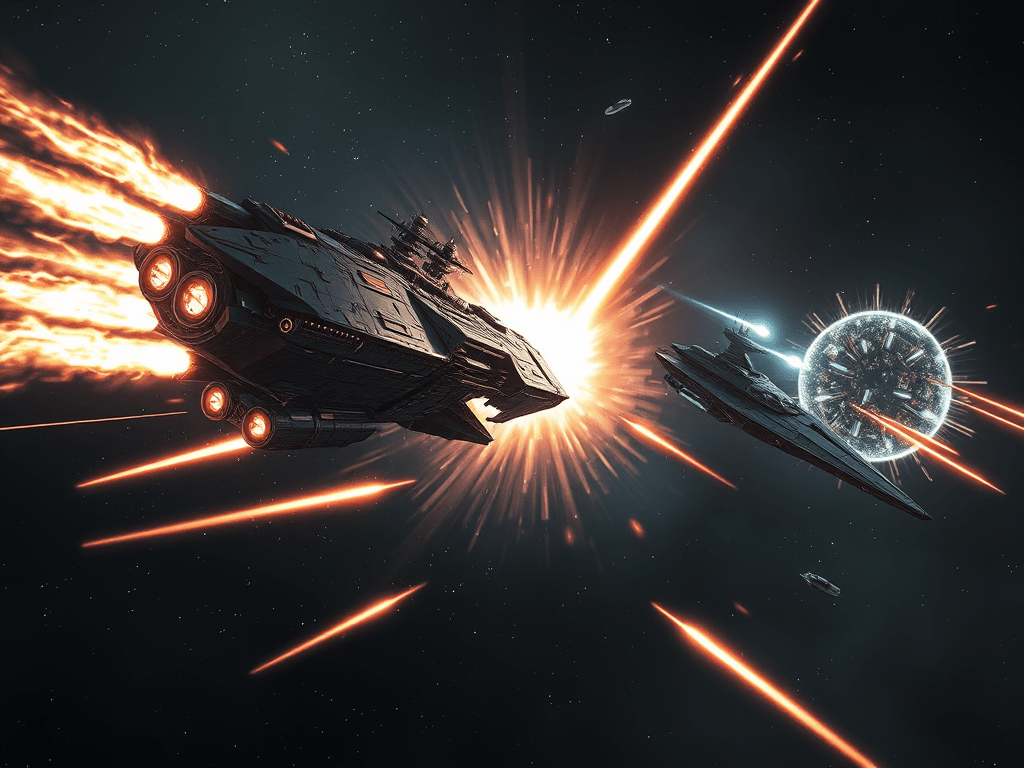
Having continued my obsession with Warhammer 40,000, this week I sat down and wrote up some basic rules for void ship combat, drawing on the Battlefleet Gothic table top game and the Battlefleet Gothic: Armada video game. I ran a test session with those of my players who could make it this week, and it actually worked out pretty well.
SHIP TYPES
First off, I cavalierly ignored all the finicky rules about different hull types, at least as far as NPC ships go. Instead, I’ve divided ships into these categories:
- Battleship: Hull 15, Shields 10, Armour 4, Turrets 4, Damage 2d10
- Battlecruiser: Hull 12, Shields 8, Armour 4, Turrets 3, Damage 1d10h
- Cruiser: Hull 10, Shields 6, Armour 2, Turrets 3, Damage 1d10 damage
- Light Cruiser: Hull 8, Shields 4, Armour 2, Turrets 2, Damage 1d10l
- Frigate/Destroyer: Hull 5, Shields 2, Armour 1, Turrets 2, Damage 1d5
- Transport/Raider: Hull 3, Shields 2, Armour 0, Turrets 1, Damage 1d5l
WEAPONS
Secondly, there’s weapons. There are three kinds that I’ve outlined so far:
- Lances: ignore Armour, but shields absorb them well. When a lance weapon hits a vessel, reduce the damage by the current Shield value, then reduce Shield by 1, to a minimum of 0. The remaining damage, if any, is subtracted from the ship’s Hull.
- Macrobatteries: struggle against Armour, but can batter down Shields. When a macrobattery hits a vessel, roll the ship’s Damage, reduce the result by the current shield value, then reduce the Shield value by the same amount, to a minimum of 0. The remaining damage, if any, is further decreased by the ship’s Armour before being applied to the ship’s Hull. The Damage roll is also adjusted by the following considerations:
- Targeted ship is at boarding range: +1 damage.
- Targeted ship is at augury range: -1 damage.
- Targeted ship is moving towards you: +1 damage.
- Targeted ship is moving on a parallel trajectory: -1 damage.
- Target vessel is a transport or raider: -1 damage.
- Target vessel is a cruiser or battleship: +1 damage.
- Torpedoes ignore Shields but can be shot down by Turrets. When a torpedo swarm hits a vessel, roll the weapon’s Damage and inflict it on the ship’s Hull, reduced by Armour+Turrets. If there is anything behind or right next to the target, roll the weapon’s damage again, minus the damage rolled the first time, subtracted by Turrets but not by Armour. If the result is positive, the object behind the target takes that much Hull damage, reduced by its own Armour+Turrets. Torpedoes can be fired at any range, even beyond augury range as long as the location of a target is known. Torpedoes must be reloaded in between each shot. The damage from torpedoes is adjusted in the following ways:
- Targeted ship is moving towards you: +1 damage.
- Targeted ship is moving on a parallel trajectory: -1 damage.
- Target vessel is a transport or raider: -1 damage.
- Target vessel is a cruiser or battleship: +1 damage.
Ranged are boarding (up close and personal), artillery (at the maximum range of most guns), and augury (at the edge of what a ship can perceive).
Weapons must be fitted somewhere, either as broadside weapons, prow weapons, or dorsal weapons (which can be used either as broadside or prow weapons). You can only fire a weapon at an enemy if it is correctly aligned according to the fiction.
CRITICAL DAMAGE
A ship that takes damage in excess of its remaining Hull suffers Critical Damage. That means that one of the following conditions get marked (the GM decides which one):
When the players’ ship suffers Critical Damage, the GM marks one of the conditions below:
[ ] Weapon offline (choose one) – the weapon can’t be fired.
[ ] Shield generator offline – Shields drop to 0 and can’t be reignited.
[ ] Enginarium damaged – the ship can’t come to a new heading or indeed turn in any direction; it can still speed up or slow down, though.
[ ] Thrusters disabled – the ship loses forward traction and can only maneuver, poorly, by navigational thrusters; it can’t fire thrusters.
[ ] Bridge destroyed – the command staff is driven from the bridge; take -1 ongoing to all void moves.
[ ] Fire – a fire is spreading through the compartments. Until it has been put out, the GM can inflict 1d5 Hull damage, bypassing armour and shields, as a GM move.
[ ] Augury array disabled – the ship is blind to anything beyond boarding range; it can not make an augury sweep or lock on target.
[ ] Crew in disarray – the crew are rioting or panicking; the ship cannot fight in a boarding action, brace for impact, or refit and reload until order has been restored.
VOID MOVES
The following moves can be performed by any player taking a command position on a void ship. Void moves are primarily executed through dashing leadership and taking decisive charge of a situation, so any player can make any void move, irrespectively of whether it falls within their theoretical authority or not.
When you fight in a boarding action, roll +Weapon Skill. 10-14, you inflict a Critical Damage on the enemy ship before being pushed back, or push boarders off your own ship before they can do any harm. 15+, you have the option to push onward. If you choose to do so, you either harry the enemy back to their own ship, inflicting a Critical Damage on it before retreating, or you gain a beachhead on the enemy ship; the fight will continue as a regular field battle, with the ships themselves playing no further part. If you do not choose to push onward, see result of 10-14.
When you bring fire into the void, roll +Ballistic Skill. 10-14, you inflict damage by one weapon you have facing the enemy, and that enemy inflicts damage on you by one weapon it has facing you. 15+, the same, and you may also inflict a Critical Damage on the enemy struck, even if you don’t cause any Hull damage.
When you fire thrusters, roll +Strength. 10-14, choose 1 option below, but you deplete your fuel stores; take -1 ongoing to this move and the come to a new heading move until you’ve had a chance to feed the engine. 15+, choose 1 option below.
- You come to a sudden stop or power past a danger coming at you from the side.
- You escape a pursuer or catch up to a quarry.
- You ram another ship. You both deal damage to each other, reduced by Armour, and the other ship is knocked off course; if you have any broadside weapon, you may use it to deal damage on the victim on your way past.
When you brace for impact, roll +Toughness. 10-14, hold 1 that can be spent on negating the effects of a hit. However, while you have any hold at all from this move, take -1 ongoing to all other void moves. 15+, the same, but hold 2 instead.
When you come to a new heading, roll +Agility. 10-14, you change your heading to another one of your choosing, possibly aiming you away from a danger or getting a particular weapon facing an enemy. If there is an enemy, then he, at least for now, is sufficiently surprised by your deft maneuvering that it will take him precious time to adjust. However, you deplete your fuel stores; take -1 ongoing to this move and the fire thrusters move until you’ve had a chance to feed the engine. 15+, the same, but your fuel gauge remains comfortably stocked.
Note: This move represents a sharp turn that puts serious stress on the ship and crew. Coming around in a wide, leisurely circle does not require rolling to come to a new heading.
When you lock on target, roll +Intelligence. 10-14, you identify a weakness in an enemy vessel. Hold 1 that can be spent at a successful roll to fill the void with fire. If that roll is a result of 10-14, you can spend the hold to inflict a Crippling Injury. If the roll is a result of 15+, you can spend the hold to get +2 on the damage roll. 15+, the same, but hold 2 instead.
When you make an augury sweep, roll +Perception. 10-14, you get a detailed analysis of everything that is currently with augury range of your ship and isn’t trying to hide itself, as well as being told if there is anything hidden or obscured (such as a ship running on silent or within a gas cloud or meteor swarm) within it. 15+, the same, and your excellent data makes planning easier. Take +1 forward to any other void moves within the same scene.
When you command the ratings to refit and reload, roll +Fellowship. 10-14, choose 1 option below. 15+, choose 2 options, or apply the same option twice.
- You reload a torpedo tube.
- You prepare a new squadron.
- You remove 1 point of penalties to come to a new heading and fire thrusters.
When you order emergency repairs, roll +Willpower. 10-14, choose 1 option below. 15+, choose 2 options, or apply the same option twice.
- You restore 1d5l lost points of Shield.
- You undo 1 Critical Damage.
- You restore 1 lost point of Hull.
NPC SHIPS
NPCs, of course, can’t make moves, and a lot of Critical Damage conditions don’t apply to them. They can be assumed to have a broadside macrobattery and either another macrobattery, a lance, or a torpedo tube in the prow. NPC ships will normally only fire torpedoes once in a fight. They have Shields, but they won’t normally reignite shields once they’ve been depleted.
They also only have the following Critical Damage conditions that are normally marked in order:
[ ] Shields disabled – the Shields drop to 0. If the Shields are reduced to 0 by being depleted by damage, this is also automatically marked; it exists as a condition to make it possible to drop shields prematurely (in the test session today, the players manage to bring down the enemy shields with a 15+ result on a torpedo barrage, without ever having to chip away at them).
[ ] Weapon systems offline – the ship can’t fire any weapon. It almost certainly starts trying to flee or, failing that, shut down all systems and run on silent while performing frantic repairs.
[ ] Enginarium damaged – the ship can’t navigate but drifts helplessly. The crew likely readies itself for a desperate last stand against boarders, though it might also activate the warp engines (likely resulting in a giant explosion if it’s still within the gravity well of a star system).
[ ] Core meltdown – the ship explodes in a giant fireball, leaving a cloud of debris.
 Mister Monster's Workshop
Leave a comment