Having recently embarked on a quest to read every single book for every single tabletop roleplaying game that has ever interested me even one little bit, it was of course inevitable that Vampire: the Masquerade would be one of the first ones. It’s the first and most defining World of Darkness game, and I’m of course a huge World of Darkness nerd. I mean, not to blow your mind, or anything, but I am.
Thing is, though, that Vampire was always the one WoD game I could never work up any enthusiasm for. I used to hate Werewolf: the Apocalypse with a fiery burning passion, but it at least made me feel something (and I ultimately made my peace with it – look, you can work around the stupid parts and focus on the nice, wholesome ripping-mutants-to-shreds action!). Vampire just felt like a waste of space. I read a few books, if only to mine for antagonist ideas for the other games I ran, but I never took to it.
Now, having read the very first few books of the very first edition, I have to say… okay! I finally see what all the fuss was about!
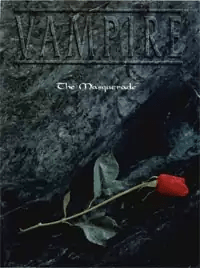
For those who don’t know (and one of my friends recently told me that her DM was unaware that there were other roleplaying games than D&D until she informed him otherwise, so I guess some people actually don’t know), Vampire: the Masquerade is a game first published in the 90s where you play… well… a vampire. Who has to hide his true vampiric nature from the world. Like in a masquerade. Again, not to blow your mind or anything.
Anyway, it was huge. Like, it was so huge that for a time, it didn’t just compete with D&D, it was bigger than D&D – a feat that no other roleplaying game has even come close to rivalling before or since. It has been mimicked and analysed and argued over with a meticulous zeal that only artsy nerds can equal. There was a well-regarded video game. There was an ill-regarded TV show. Even today, it’s not quite dead, just sort of… in torpor. Much of modern game design can trace a descent to Vampire, if only by being created by people who was so annoyed by Vampire‘s many flaws that they resolved to create something better.
Vampires, in this game, humans who have been their blood drained by another vampire and fed some of it back, causing them to rise from the grave. The first vampire was supposedly the Biblical Caine, though he’s not around anymore so no one is exactly sure. Each generation of vampires (with Caine being the single member of the first generation, and most vampires created in the modern night being somewhere between the eighth and the thirteenth) are a little weaker than the one before, with the only way to increase your effective generation to kill by feeding another vampire with lower generation than you. They lack most traditional weaknesses, except for sunlight, which does indeed cause them to spontaneously combust.
There are thirteen clans, each with its own set of special vampire powers (called Disciplines), and each being a sort of cross between a type of movie vampire and a type of high school Goth. The Brujah are rebellious bikers with strong political opinions, the Ventrue are snooty aristocrats who aren’t very good at moving with the times, the Toreador (yes, really – did I mention that a lot of things about this game are goofy as hell, despite taking themselves 110% seriously?) are pretentious arteests, the Nosferatu are creepy deformed monsters who lurk in the sewers, the Gangrel are feral shapeshifters who lurk in the woods… Everyone has their own shtick and look down their noses on everyone else.
Drinking a vampire’s blood on three separate nights, even if you’re a vampire yourself, makes you “blood bound” – effectively, you fall head over heels in love and will do anything for them. Humans who drink vampire blood without first being drained of their own become “ghouls,” which means they stop aging and get some minor Disciplines for as long as they still have vampire blood in their system. Needless to say, vampires tend to keep blood bound ghouls as servants and bodyguards.
The vampires of a city are usually ruled over by a vampire called a “Prince,” along with a bunch of elder vampires called “the Primogen.” The Prince and the Primogen enforce, first and foremost, three rules: a vampire may not kill another vampire except by the Prince’s permission, a vampire may not create another vampire except by the Prince’s permission, and a vampire may not reveal the existence of vampires to the humans under any circumstances whatsoever.
That’s about the basics, that have stayed more or less constant throughout all the editions of the game (we are up to the fifth, with the first three being during the WoD’s prime in the 90s and early 00s and the last two being a latter-day nostalgic revival). So what’s different here that made me change my opinion on the whole game?
Well… for a start, it’s pretty.
That’s really a huge thing. What put me off Vampire for the longest time was how drearily, unrelentingly ugly it was. In all the books I read, vampires were portrayed as, effectively, icky walking corpses who went around doing crappy things while serving no purpose. Every line in every book was filled with a sort of snide, smirking disgust. Everything was crap, especially you, and shame on you if you tried to make anything at all enjoyable. My constant reaction was, “… why would I want to play this thing that is intend on making me feel bad?”
First edition, though? First edition is different. Not in any one particular detail, mind. Vampires are still skeevy and self-indulgent. They still leave corpses behind. They still lie and cheat and fight vicious feuds for exceedingly petty reasons. They do all those things.
But damn, they look awesome doing them!
It’s all in the presentation. Third edition and onwards all seemed to hate their subject matter. First edition clearly loves it. The betrayals, the obsessions, the degeneracy, the hatred and the pride, the failures and the humiliations… all are described in glowing, operating terms. This is a game of beautiful damnation, of reveling in your romantic guilt. Blood isn’t just some sordid crack metaphor, it’s every forbidden pleasure, every carnal desire made red and glistening and deliciously lurid. You shouldn’t have it, you’re bad for wanting it… but it would taste sooooo goooooood!
I guess part of the reason why Vampire always rubbed me the wrong way was that it remained the only game about playing amoral characters in a set of games that, as time went on and the gleeful grimdark of the 90s shifted closer and closer to the sanctimonious outrage of the aughts, became more and more about moralising. It’s weird, given that Vampire always remained the flagship game, but it was kind of left behind in terms of tone. Every other game gave you a cause to fight for, bad guys who you should feel great about gunning down because they were bad. Vampire only made sense as part of a setting where no one was innocent and the closest thing to “goodness” was accepting your dark side enough to keep it in check. When the vampires explicitly existed in a world that ran on objective and tangible Good and Evil, they no longer looked like dashing Byronic antiheroes straddling the divide between sublime virtue and sordid vice. They just looked like lackluster posers, too dull and emotionally stunted to bother choosing a side.
I think, on the whole, that the exact incurious self-righteousness that I complained about at length in my Aberrant readthrough (not a World of Darkness product, but made by the same people) was, as it were, the stake through Vampire‘s heart. No one actually wanted to keep making the sort of “I’m a bad, bad man, I hate myself, I should be dead, and ohhhhh! – isn’t that just so romantic?!” game that it was originally (and explicitly; another thing to love about this version is, it actually states what it’s trying to convey instead of having “hidden themes” that you’re supposed to unravel on your own) designed to be, but it was still the most popular one. So they kept shoveling out books for it, and filling them all with finger-wagging about how we should in no way sympathise with the vampires because they were bad, unlike werewolves/mages/hunters/demons (yes, even the freaking demons from hell were holier than thou at that point!) who were good and fighting for a righteous cause just like you should be doing, why are you not out there saving the whales?!
Yeah… let’s just say I liked how they started out a lot better than how they ended up. Not to lie, here: back in the late 90s, I was absolutely one of the people who were sick of grimdark and clamouring for morally uplifting messages. It’s just that having since learned the fruits of self-righteous people running rampant, I have gotten nostalgic for some honest amorality.
But, let’s try to back up a bit and give you something resembling an actual readthrough rather than my fanboy gushing and ranting…
THE ACTUAL READTHROUGH
The book starts out with a letter from a vampire to a human he had previously victimised, in which he claims to try to make up for his actions by revealing the truth about vampires, their nature and their society. Also, the vampire is not-so-subtly implied to be the actual Count Dracula and the human Mina Harker. Which is, er… a choice.
But, aside from the blatant use of public domain characters that don’t really fit very well with the game, I actually love the opening. It sets the tone, presenting the narrator as someone who is monstrous enough to have done terrible things but still human enough to want to somehow make up for them… and it also has a disturbing undertone to it that lends it some extra delicacy. After all, the good count has clearly been watching Mina from afar, brooding on his sins and wallowing in guilt, and having the passionate regard of a self-confessed monster who is prone to unplanned crimes of passion is… perhaps not entirely comfortable.
That’s very much the game, the way it started out – the romance, the tragedy, and the subtle (subtle, please note!) post-modern deconstruction of them both. In contrast, the introduction to the third edition was narrated by what I can only describe as a smirking douchebag actively trying to be a shit to the woman he was talking to. It… made for a less compelling argument for continuing to read.
After that, we get a brief description of vampires (from a more clinical, out-of-character perceptive) and of the fairly straightforward rules. In brief, you roll a pool of between 1 and 10 d10s and each die that equals or exceeds a difficulty between 2 and 10 is a success. Each 1 you roll cancels out a success. If you roll more 1s than successes, you botch and something bad happens. For a simple action, you just roll, and if you get 1 success you muddle through but more successes might give you some kind of perks or bennies. For an extended action, you need a particular number of successes, but you can keep rolling until you’ve acquired them, at the cost of spending more time and risking a botch. For a contested action, you and another character both roll, and whomever gets more successes win. Not an amazing system, some improvements do suggest themselves, but simple and solid enough. Stay tuned to hear how they proceeded to mess it up (yes, sadly that happens already later in this same book!).
We also get the first few of a series of… well, call them old-fashioned cartoons, I guess, that runs through the book, each one consisting of a picture along with a few lines of narration. Put together, they tell the story of a vampire named Shelzza who lived in some ancient (Sumerian?) city and formed a mutual blood bond with the vampire who ruled it, allowing them to be in something resembling “love” to each other. To summarise, he was killed by a peasant uprising, she slept through the ages and woke up in modern times where she got it into her head that a random dude was her king reborn. She stalked him and turned him into a vampire, which he was horrified by, and he eventually killed her and thus became human again.
That’s a thing in this edition, by the way. It’s called Rebirth, and it can be achieved in a couple of different (and all rather unreliable) ways. Killing your sire soon after your own embrace is indeed one of them. Add it to the list of things I’m sorry they dropped in later editions; for one thing, if vampirism was actually theoretically curable (albeit not with any certainty, and never without considerable difficulty), it’d give Hunters of the Redeemer Creed something to actually do. Oh well.
Anyway, I really love that story and how it sets the tone. Shelzza is a monster, and not entirely sane – the story makes both things very clear. But you still get to see it from her perspective, and you feel sorry for her when she dies. Likewise, her relationship to her king is explicitly artificial and a bit disturbing, but that doesn’t make it inherently worthless. Vampires live outside of nature, they get nothing without breaking some kind of rule, without brute-force something that should be organic. But they can still value the things they have and cry out in anguish when they lose them, and that gives them agency and dramatic weight.
The book continues with character creation, which is about what I’m used to – you have nine basic Attributes, a bunch more Abilities, and you assign dots to them so that you have between 0 and 5 in each one. To that, you can add Backgrounds, which are a sort of catch-all for traits that are more conditions you live under than inherent aptitudes – for instance, Resources determine how wealthy you are, and Generation determines, well, what generation you are.
Clans and Disciplines are about what I’ve already briefly covered, except that here, there is some blessed simplicity – only seven clans are detailed, and only ten Disciplines. I love that, most of the extra Disciplines that got added over time were crap anyway. Also, Thaumaturgy (blood magic, basically) looks actually useful instead of being the boring point-sink that it’s been in every later edition I’ve seen.
Also, the clans are more comfortably stereotypical, without the later editions’ frantic insistances that “vampire are all, like, individuals, man!” Case in point, Nosferatu don’t all have unique deformities, they’re all pale and bald with pointy ears and fangs, deal with it. I mean, okay, I get why they drifted away from that over time, it probably would get a bit samey eventually, but… it’s a lot easier to just come up with a character in a hurry when you have solid archetypes to draw on.
Also, with vampires not being inherently worthless and subhuman, some of the clans work a lot better. Like, the Brujah being idealistic crusaders never made any sense in light of later editions’ presentation of vampires as completely and inherently selfish and despicable. Here, because the explicit premise is that everyone is culpable and that that doesn’t completely invalidate their virtues, the Brujah don’t look like hypocrites for claiming to want a better political system. Sure, they’re probably a bit self-serving about it, but everyone is a bit self-serving about everything, and to some extent they really do want justice and equality and all that good stuff, just as long as they get to snack on people a little on the side. Hey, it’s better than someone who doesn’t want justice and equality and still wants to snack on people, you know?
Special vampire rules! Vampires can keep a certain amount of magical mojo in their bodies at the time, called Blood Points, which are replenished by drinking blood, natch. Blood Points can be used to speed-heal injuries, though it’s still a little too slow for you to use it in a fight – it’s more something you use to restore yourself to full health after the fight has ended. Also, you can give yourself bonuses to physical actions for the duration of a scene (about 20 minutes) by spending Blood Points. Notably, it does not seem like you have to stop and concentrate to do that – you can only spend 1 Blood Point per turn, but it seems like you can do it and perform an action too. Which means that if a vampire starts with a full belly, he’ll get progressively more dangerous the longer a fight goes on. That’s kind of cool, and different from how I remember it working in later editions (where you basically had to know a fight was coming so you could hulk out in advance). Also, you have to spend a Blood Point to wake up every night, so the clock is always ticking – faster if you do a lot of crazy action stunts, slower if you restrict yourself to mere human ability, but it never stops, ever.
Vampires are subject to frenzies, where they go nuts in one way or another. When they feed while very hungry (that is, while having very few Blood Points currently in their system), they have to roll to avoid a Madness Frenzy where they basically try to guzzle every last drop of blood they can get to (which is not good news for whomever they were already feeding on). When they’re in some way bullied or humiliated, or a companion is threatened, they have to roll to avoid a Rage Frenzy, where they try to kill everything in sight. When exposed to fire or sunlight, or otherwise in severe danger, they have to roll to avoid a Terror Frenzy, where they can just run and hide until it wears off. Either way, the GM takes control of the character for the duration.
In lieu of rolling to avoid the frenzy, a vampire can decide to “ride the wave.” If she does, then she does go into a frenzy but she retains some control – she can spend Willpower points (which is the other kind of personal currency characters in this game have) to ignore the frenzy for one turn per point. Which isn’t much, but at least you can avoid doing something completely unforgivable. However, you still have to roleplay the frenzy, and if the GM thinks you’re not doing so, he’ll just dock you Willpower points for them. If you run out of Willpower points, he takes over your characters as in a regular frenzy.
If you try to resist a frenzy and botch the roll, you gain a Derangement which is sort of like a mental illness except usually based on a pop-culture-based misapprehension of how that particular illness actually works. That’s a bit of a problem in other games, where the same Derangements are used to reflect actual mental illnesses… but here, I feel like it’s a lot more okay, since hey, they’re not regular mental illnesses, they’re ways that the vampire mind breaks down under stress, and who’s to say how vampire minds work? Anyway, Derangements work under the same principle as riding the wave – you have to roleplay them, and every time the GM thinks you’re failing to do so, you lose a Willpower point, and once you have no more Willpower points the GM takes over your character.
This… is actually pretty good. This looks actually playable, in ways that the version in third or fourth edition never really did (fifth edition has a brand new one that I think is a lot better, but I think I prefer this one even over that one). It really brings forth the themes of the game more elegantly – you need to decide how much compromise to make with your feral impulses, because they are always stronger than you and if you try to complete repress them you’ll lose and they’ll run wild. It all does rely on there being a workable Willpower economy, with well-defined ways of regaining Willpower, which I think is not really the case in this or any other edition, so that’s a shame. Still, it seems like a wonderfully solid system.
Humanity is another special vampire stat, which measures how much morality you’ve managed to hold on to. If you do something like kill or steal, you have to roll to feel bad. No, really, that sounds like the kind of joke you’d make about this game, but it’s literally a thing. If you fail the roll, then you feel great about your hideous crime. And that’s a problem, because it means that another little piece of your conscience has died, and thus your Humanity goes down. Humanity function as a cap for some of your rolls, like empathy-based ones and any that you make during daylight hours, so the lower your Humanity, the more you become a heartless monster who is effectively a lifeless corpse when the sun is in the sky. Avoiding that is effectively the goal of the game.
Golconda is a sort of vampire nirvana that can be reached at the end of a long and complicated road. It isn’t the same as Rebirth (though they may be related, with them being the two alternate outcomes of a similar process), you remain a vampire who need to drink blood to survive, but you start requiring a lot fewer Blood Points to keep yourself going, meaning that you have a lot more ability to hold out for ethical feeding opportunities. You also don’t frenzy, ever. It basically means that you have made peace with your inner darkness, and in doing so, learned to control it. Which is probably why Golconda is rarely mentioned at all in later editions, which as mentioned got a lot more absolutist in their morality. Sigh.
After that, we get more general rules, and this is where the system starts showing signs of becoming the miserable mess that is the Storyteller System as we know it. See, the system as given back in the earlier chapter was fine, more or less what you needed for a game that’s more about ambience and feel than about rigid physics simulations. But the problem is… the White Wolf writers got enthusiastic.
That’s the best way I can put it, honestly. There is a section that gushes about how much fun they think it is to turn every situation into a unique minigame with its own distinct rules. And the thought never seems to have occurred to them that if you do that, then you end up with a gazillion unique minigames that are going to have to be balanced against each other and which, having been used once, are going to have to be memorised so that things work the same way next time. No, they just threw themselves into it with merry abandon, and we have the next several hundred books full of bad mechanics to show for it. At the end of this road, folks, lies Exalted and entire shelf meters of broken Charms, because White Wolf could not and by God would not accept that anything those uncool math geeks could do, they couldn’t do better.
Oh well.
Having all that said, though, I’ll come out and say that I actually think the combat rules are better in this edition than in any that followed, precisely because they were kept relatively simple. If two people fight in melee, that’s a contested roll, and whichever wins deals damage to the other. If someone shoots at something, that’s a simple roll, and one success is enough to hit and deal damage. Cover provides a hefty difficulty bump to shooting, so when bullets start flying you want to throw yourself behind something. And when someone gets hit, that may just be the end of the fight right there, because injury is very punishing in Storyteller. Which works to the game’s advantage here, where it’s pretty clear that combat is supposed to be rare and risky and with stakes, but not so well in… well, any game from Werewolf onward, where Fighting The Bad Guys is expected to be a pretty constant occurrence.
Also, there is no bashing damage here, only aggravating (from fire, sunlight, vampire fangs, and other extra-nasty sources) and normal (from everything else). Vampires can “soak” normal damage, which means that they roll Stamina against a difficulty derived from the damage source and each success cancels out a success on the damage roll. Humans can’t soak at all, and vampires can’t soak aggravating, but damage is rolled against a difficulty derived from the target’s Stamina, so a super-tough character is still going to be able to power through a wound better than a sickly one. That’s a little more complicated than what they replaced it with, but I think I like it better.
There is a helpful example of play where a prose narrative is side by side with a description of the mechanics being used to determine outcomes. That’s kind of cool. The story is about some Anarchs attending a rabble-rousing meeting, but a guy named Sheriff who works for the Prince comes to break it up and everyone ends up fleeing from a building on fire. To clarify, he’s not “the sheriff,” as per later editions – he’s just this one guy who’s called Sheriff, because he struts around talking with a Southern drawl and claiming to be the law. Heh. I guess he got retconned into being an entire institution later…
Next up is the settings chapter, where we get more detail on vampire society… which is rather less cluttered than it will be in later editions. For one thing, there isn’t a gazillion different court positions that will outnumber the total number of vampires in most cities – there’s just the Prince, who rules with the help of whatever cronies he’s got handy. The Primogen are a thing, but they aren’t a fixed council consisting of the top vampire of each clan in the city here, they’re just the most powerful elders, the people the Prince need the support of to rule effectively. It feels a lot more organic and natural.
The main conflict is between the elders on one hand and the Anarchs on the other – the latter being, effectively, young vampires (or neonates) who don’t like the elders. The book is a little vague on whether all neonates are per definition Anarchs – I don’t think they are, I’m pretty sure that there is meant to be such a thing as young vampires are bootlicking sycophants for the elders, but the book doesn’t quite say.
The Camarilla is the overarching vampire organisation that… doesn’t do terribly much except sit there and be stuffy and entrenched. There is a competing organisation called the Sabbat, but it’s this vague thing that’s out there somewhere and most of what you hear about it is probably lies. Still, it’s supposed to be the opposite of the Camarilla, all hellfire and reveling in being monsters. I guess the Anarchs are meant to be the happy medium between the two, which players are meant to sympathise with? Also, there’s the Inconnu, who seek Golconda, but we don’t find out much more about than than that.
Elders are usually a couple of centuries old, and are the movers and shakers in the vampire world. Vampires who are a thousand years or more are called Methuselah and tend to disappear from vampire society, partly out of paranoia and partly because a lot of them can’t digest human blood anymore and need to feed off other vampires. Which is kind of cool. While you’re on the hunt, something else might be hunting you.
The Jyhad is… a little better explained than I’ve seen it elsewhere, but still not great. In some places, it’s said to just be the natural animosity between vampires of different ages – neonates know they can only be as powerful as the elders by killing and eating them, Methusaleh can can only survive by killing and eating other vampires, and the elders are trying to maintain their power and long-term survival in the face of the other two. So basically, everyone is scared of either starving or ending up on the dinner table, and scheming wildly to try to avoid either fate. Other times, there are vague hints that the Jyhad is something deeper that’s really a proxy war between a bunch of of ancient, third-generation uber-vampires (the Antediluvians) who are in hiding somewhere, but precisely how they supposedly control everything without ever being noticed isn’t exactly clear.
Speaking of generations, the first (Caine) through third (Antediluvians) are largely mythical. The fourth and fifth generation are mostly Methuselah and stalking the night for succulent vampire blood. The sixth and seventh tend to be the elders and are the ones whose wrath the players will need to avoid. The eighth through thirteenth are on roughly the level of players and are peers who they might get into scraps with without it being immediately suicidal.
Also, I have to laugh with great sadness at the mention that the ancient, terrifying Methuselah might have as much as… fifteen dots of Disciplines! Ahhhhh, more innocent days, before the power creep set in. I’m sorry to report that it didn’t last long, by the time of Chicago By Night the unbeatable godmode NPCs were already a thing.
Other antagonists include ghosts, lupines and magi, later to be known as wraiths, werewolves and mages. “Lupines,” notably, are just as OP as they will be later, but only at night – in the daytime, they’re effectively human. Not that that’s a tremendous comfort to vampires, admittedly. Among human menaces are the Inquisition, the regular cops, and the Arcanum, which is this nebbish bunch of scholars who research the occult. Yeah, I’ve never quite understood what the Arcanum was meant to be used for, though I guess they are a little more of a problem in a game where you can get killed for letting anyone discover that you’re a vampire…
GM advice! There’s a lot of it, and much of it is… er… kind of pretentious and overblown, to be honest. Look, I think I might once have met a roleplaying group whose campaign had a “theme,” but they were weirdly super-into it even by my standards, and that’s saying some… Still, there are some useful stuff here, like suggestions for how to stage a campaign since it’s hard to make a standard “adventuring party” out of vampires. Having them run a street gang together, be exiles from another city, or be the Prince’s team of troubleshooters are all suggestions offered.
Also, I alluded to this before, but… the book actually tells you what things are meant to represent, which I feel is uncommonly helpful of it. Like, a vampire’s eternal life (which in practice is just life-until-something-kills-you) is meant to represent our instinctive clinging to a survival that is ultimately impossible. The vampire’s need for blood represents the fact that we, as living beings, must consume other life to sustain ourselves – and how, just like how a vampire can live off of rats and freely giving blood, we can theoretically choose to minimise our impact on the environment, but that doing so is so thankless and inconvenient that most of us don’t bother (just to be clear, I am very much one of the people who don’t bother! I’m just saying, the metaphor is sound). And so on.
The book wraps up with a starting setting of sorts, in the form of the city of Gary, Indiana. It’s described as being, essentially, a dismal place of rusting, abandoned factories, crippling poverty and a rapidly fleeing populace, ruled over by a Prince (Modius) whose chance for the big times was lost decades ago and is now just going through the motions. It’s all got a nice Life is Strange vibe to it, of shaking your head at the hopelessness but also secretly relishing the romantic squalor. There are a bunch of other NPCs statted up, including some allies and rivals for Modius, a couple of vampire hunters (regular no-powered ones, since Hunter: the Reckoning is still a decade away!), and some sundry hangers-on. There’s also a short scenario where the players attend a party in Modius’ decaying mansion and get sent as his envoys to the rival Prince of Chicago. To be continued in Ashes to Ashes.
All in all? I kind of love it. Oh, there are some dumb stuff, and some things that could have been better explained, and certainly the book could have been a lot better organised, but the vibe, man. The vibe. This is everything I loved about the WoD, only distilled and without years upon years of the writers getting too big for their britches.
So okay, fine. I’m jumping on the bandwagon, some thirty-five years after it left the station and probably twenty or so since everyone else got off of it. I admit it. Vampires are cool, too.
 Mister Monster's Workshop