Tag: ttrpg

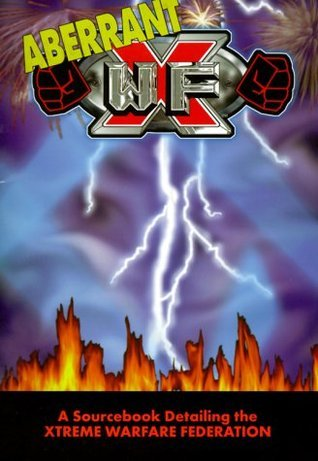
  • Aberrant readthrough: Storyteller Companion and Expose: Aberrants

    Moving on in my first-edition Aberrant readthrough, this week I will talk about the first two supplements released: the Storyteller Companion and Expose: Aberrants.

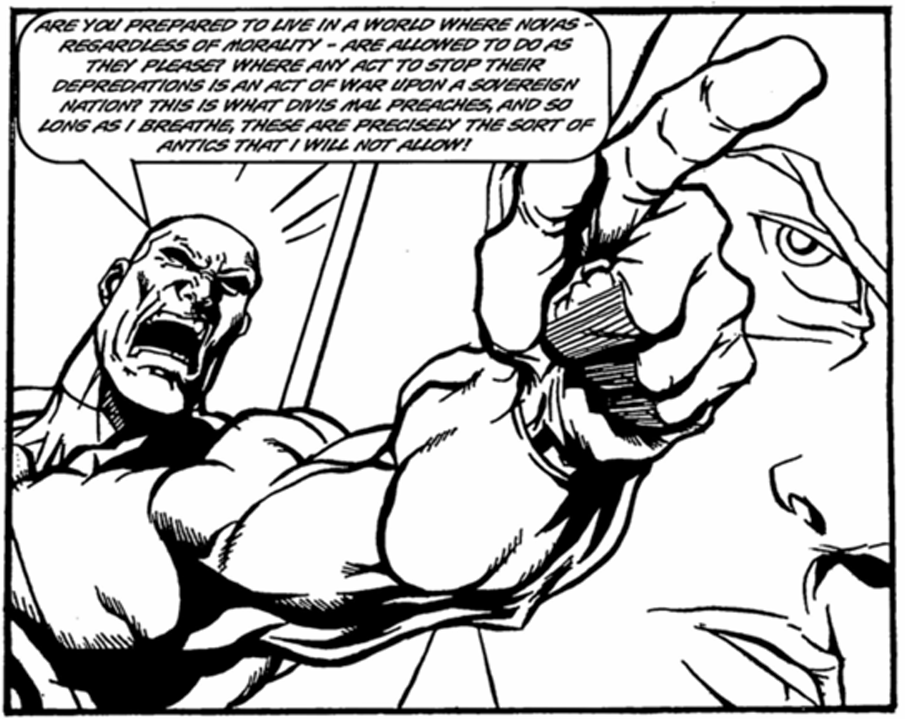
    The Storyteller Companion is divided into two halves, one that provides further worldbuilding and one that is a three-act adventure. The worldbuilding is, as always with Aberrant, composed of a number of in-world documents (and a comic or two), but it can be roughly broken down into two parts: business and religion.

    The business part is mostly forgettable, but it does establish that industrial espionage, and security against the same, are two things that novas are frequently employed for. That’s good, it means that you can run any number of “steal the McGuffin” or “find out who stole the McGuffin” type scenarios.

    The religion part is a little more varied. The Pope has formally declared novas to be human (which maybe kinda totally had less to do with theology and more to do with Mega-Charismatic nova celebrity Alejandra meeting with him just before), and the crustier elements of the clergy are plotting to have him assassinated by hired novas. The Unitarians are super-optimistic and friendly to novas, because of course they are, and American fundamentalists (because remember that we’re back in the 90s, so fundies are of course the epitome of all earthly evil) are bigoted and ignorant and hate novas. Israel is claiming that God hasn’t erupted a single nova in Israel because Jews are too awesome to need them, but they are totally lying and all Israeli novas have just been quietly recruited into the armed forces. Shiite Muslims think novas are the work of the devil (and the fact that a nova set to be executed freaked out and blew up a small town hasn’t made anyone on either side feel better about it), while Sunni Muslims are cautiously open to the idea that maybe novas are blessed by Allah… though there are heretical Sunni sects who think that they can get nova powers by killing novas and eating their “blessed” bodies. Okay, as far as geopolitical tensions that might involve the players go, a lot of those are at least decent.

    Nova cults are also a thing, especially in India, where rural novas are frequently worshipped as avatars of the gods, and in America, because skeevy cults are a hit there. One particular nova makes a habit of eating her cultists and then using Mega-Charisma to get juries to bend over backwards to excuse it as a voluntary religious practice. Ick, but kind of cool. Japan also has a growing Buddhist sect that considers novas to be divine, and some of whom have started bombing subways for no particular reason. Again, this is fairly decent and provides some information for both outright villains and for non-obvious moral questions that the players might weigh in on.

    The adventure in the second half of the book is kind of lousy, to be honest. It does provide some description of Ibiza (and perhaps more importantly its premier nova night club, the Amp Room, which was mentioned in the core book and will become relevant again later), Marrakesh and Monaco in the Nova Age, which might be handy, but the story itself is a bland railroad where the players should preferably do as little as possible because the NPCs will just fix everything on their own if the players don’t do anything as rude as trying to roleplay.

    Briefly, the players are agents of either the Aberrants, Project Utopia, or Project Proteus, and they’ve been sent to find this nova lady who maybe knows some stuff she shouldn’t. Project Proteus has also sent a one-dimensional psychopath named Chiraben after her. Like, I cannot possibly stress enough how flat this character is, he’s basically just some moronic nutcase who enjoys killing people (especially women, because of course especially women) and for some reason he keeps being given Project Proteus’ most delicate assassination jobs.

    The only other significant character is Count Orzaiz, the signature Teragen. He’s just as boring in the other direction – the text just can’t shut up about how dark and lordly and charismatic he is, and how everyone loves him (except Chiraben, because he’s dumb and smells bad). Even his freaking dad is perfect (though I will grant you that I thought it was a little bit funny that his take on Orzaiz’s wholesale adoption of Teragen philosophy amounts to, “oh, he’s acting out for attention with that whole ‘I have evolved beyond base humanity’ thing. Ah, well, boys will be boys, he’ll get over it eventually”). Orzaiz is the one who keeps fixing everything, by the way – the supposed climax of the story is basically just him going up to Chiraben and paying him some money to go away and stop bugging him, whereafter he proceeds to bang the nova the players were sent to capture into joining the Teragen. Yes, really.

    Expose: Aberrant is the splatbook (or as close to this game comes) for, well, the Aberrant faction, but since there is very little to be said about it, it’s just this little 26-page thing. It’s a splatpamphlet, basically. Most of the pagecount is taken up by a lot information about how the inept assassination (by Chiraben, naturally) that set off the metaplot was very unconvincingly covered up, which, since we already know what happened there, it’s terribly uninteresting.

    That said, there is some guidance for how to portray the Aberrants. There are basically three mini-factions among them, the quiet supporters who are trying to infiltrate Utopia to find out the truth, the fugitives who have gone on the run and try to uncover the truth along the way, and the I-Can’t-Believe-It’s-Not-The-Teragen who think they already know as much of the truth as they care to and are just flat out attacking Utopia’s operations.

    Interesting characters, effectively just one named Dr. Worm who’s a hyper-Nietzschean who would be perfect for the Teragen except he thinks even they aren’t hyper-individualistic enough (in fairness, he’s got a point; whether it was intentional or not, Divis Mal comes across as very much the sort of demagogue who preaches radical freedom but has very strong feelings about what people ought to do with their radical freedom once they have it). Interesting plot hooks, about one and a half – there is an example of something Utopia was doing (sponsoring the building of a dam that would drown the property of some people who didn’t want to move) that exemplifies the “serving the greater good, and brushing the cost under the carpet” thing that would actually make Utopia an interestingly grey faction. On the opposite side of things, apparently Project Proteus has secret facilities where they run horrific experiments on captive novas, which… well, it’s something concrete that we’ve been told about them doing, at least.

    What both these books mostly bring home for me is just how… completely uninterested the writers were in the Aberrant movement and Project Proteus, despite those being supposedly their main heroic faction and their main villainous faction, respectively. Even in their own book, the Aberrants get nothing in particular to do except retread points from the core. And Proteus, supposedly the overarching villain of the setting? Well, they are over there doing… like… evil stuff. Or something.

    What do the writers want to talk about? Two things, mostly. Firstly, the moral perfection of Project Utopia, and all the wonderful things they do, and how wonderful they are for doing so many wonderful things, and how wonderful it is that they are so wonderful as to do so many wonderful things. And secondly, the amoral perfection of the Teragen and how they are cool and edgy and totally don’t subscribe to your, like, slave morality, man. Notably, the Teragen are the only people allowed to criticise Utopia without being portrayed as inbred rednecks or unwashed conspiracy theorists who should keep their mouth shut about their betters – the Teragen, in contrast, are allowed to make actual arguments, and instead it’s Utopia who can never muster an argument about them that doesn’t amount to, “duhhhhh, they terrorists, terrorists baaaaad.”

    So no matter what the writers initially intended, what the game actually shaped up to be seems to be a conflict between the people who think that novas can and should make the world perfect, and the people who think that the novas certainly could do that, but why should they demean themselves to do anything for those filthy baselines? And I feel like what’s missing from that duality is any sort of moral agency for the baselines, and any sense that the novas might not have the capacity to “save the world,” to say nothing of whether they have the right. There is a faction called the Directive that’s supposed to be a mostly-baseline organisation that tries to champion baseline nation states against unchecked nova power, but there is a reason why this is the first time I’ve mentioned them, and it’s that they’re just that boring and underdeveloped.

    Honestly, that’s very in character for White Wolf. Everything is always ultimately about the shiny magical people, with everyone else being reduced to either fawning admirers, easily dispatched mooks, or faceless grey masses. It’s kind of especially blatant here, though – I recall at one point, the narration (which is not in character, in this case, but part of the GM instructions) snidely asks you why, if novas aren’t in fact superior to common mortals, you are playing as one. Yeah…

    Ah well. Next up is Year One and Project Utopia. And there, by Jove, I think I actually figured out how to play this game. I’ll warn you, though, the answer a little bit of a anticlimax.

  • Aberrant readthrough: Core

    Aberrant readthrough: Core

    The thought occurred to me that if I’m going to read my way through all of first-edition Aberrant, I might as well post my thoughts here. It’s not going to be a full readthrough, but I’ll go over each supplement in turn.

    So, starting out with the core book. It starts off without preamble with in-universe documents, and get used to that, because that’s going to be most of these books. White Wolf was always fond of that, but I don’t think it works quite as well here as in most of their other lines, for reasons I’ll get into later unless I forget.

    Anyway, to try to summarise a tremendous amount of setting lore, ten years ago (in 1998) the space station Galatea exploded and drowned the world in quantum energies, and as a result about one person in a million “erupted” into a “nova” who can manipulate the quantum forces of the universe in ways that for some reason is completely identical to stock superhero powers. The books even admit that “quantum energies” are just things like gravity and electromagnetics, but novas can still teleport and read minds and change shape and they can do it Because Quantum. Which would be fine, except the book spends long, tiresome sections technobabbling away to try to make it all seem reasonable and sciency.

    Anyway, an NGO called Project Utopia emerged suspiciously quickly to provide guidance for novas and, using a mix of nova powers, technological breakthroughs enabled by nova powers, and public goodwill generated by the above, set about cleaning up the environment, toppling dictatorships, arranging peace treaties, and just generally fixing real-world problems. Not all novas work for Utopia, though, a lot of them have cushy corporate jobs or serve as mercenary “elites” who hire themselves out as superpowered bruisers – indeed, the primary way to wage war has become hiring some novas to fight the novas the other country is hiring.

    There aren’t supervillains per se, but there is a group called the Teragen led by a Magneto-wannabe called Divis Mal who claim that novas aren’t human anymore and therefore they have no obligation to respect “baseline” laws or ethics. Project Utopia considers them a bunch of terrorists, which is not completely true but not completely false either.

    But Teragen aside, there is a loooooot of frankly tiresome in-setting documents outlining how novas have changed fashion, music, the entertainment industry, and how everything is super-great and everyone is happy except maybe a few stupid pootiehead malcontents… and then all of a sudden we learn that ACTUALLY, there is a secret conspiracy inside Utopia called Project Proteus, and it is up to no good and have sterilised every single nova in the world. Yes, all of them. Somehow. And some chick called Slider found out and they killed her, and her layabout bestie Corbin have gone on the run accused of the crime and he’s founded a resistance movement called the Aberrants who wants to put a stop to Proteus.

    And, ugh… this plot hook, man. This freaking plot hook. It’s dead centre in the game, almost everything leads back to it and it’s just – so – STUPID. For one thing, how did Proteus even get to every single nova in the world? And how exactly did they expect this would work out, no one would ever notice that six thousand high-profile people had fertility issues all at once, and none of the super-genius intellects of the setting would ever put two and two together? And thematically, it’s just a mess. Here, have a game about playing a glamourous picture-perfect superhero! Oh, but you’ve been castrated without noticing. Yeah, that doesn’t ruin the power fantasy at all

    Honestly, it feels a bit like the guy who thought of it was very childfree and he thought it’d actually be kind of neat if all his shiny superheroes could be hot, single, and absolutely untouched by the messy business of reproduction. Because while there is some finger-wagging about how forced mass sterilisation is, like, bad and stuff, there seems to be about zero understanding of just how big a deal it would be in the real world and how hard most people would take it. It does kind of feel like the kind of idea I would have had back in my twenties, in fairness…

    But anyway, even aside from that, it’s not even especially useful as a plot hook. It’s simultaneously too big and too tightly defined. If novas are secretly being subject to genocide by the people who are supposed to direct them in building a better tomorrow, then that makes pretty much everything else they get up in the setting look stupid and pointless… but at the same time, the Aberrants-versus-Proteus conflict is just too straightforward to work as a starting point for your own ideas. Proteus isn’t a nebulous evil organisation doing all manner of inventive bad things that the players can get into – it’s doing one particular bad thing, and it’s pretty well-understood right from the start why and how it’s doing it, so all that’s really left is trying to prove it to the public. And yes, you can build a campaign around that, but that’s just it – you can build one campaign around that. It’s not something you can riff on and take in a ton of different directions.

    So, anyway, that’s the setting, and aside from (sigh) THAT THING, it’s not a bad one – certainly it feels vivid and lived-in, and there is some appeal in playing a character with superpowers in a setting where having superpowers doesn’t necessarily make you a superhero but where powers are being put to all sorts of personal, financial and political tasks. My main problem is actually that the core book spreads itself pretty thin over a ton of different parts of the setting that it wants to point to, and the fact that it insists on presenting everything as in-setting documents just make it worse, because making those informative and not just flavourful is pretty hard, and I don’t feel like the writers here were really up to the challenge. There’s a very strong feeling that this book was meant to give you a taste and nothing more. You want to actually use Project Utopia, buy their book! You want to use the Teragen? They’ll get a book! Oh, and there are these massive criminal syndicates who have adapted to nova crime-fighters by joining together, but if you want to know more about those than that they exist, you’ll need to wait for their book.

    After that, there are the rules, and… well… look, it’s the Storyteller System, okay? The rules aren’t meant to actually be used, they’re meant to sit there and look pretty. Suffice to say, you can put a nova together that is on the general level of, say, Spider-Man pretty easily, and just about any common superpower you can think of is represented somewhere. Which does of course mean that most of them is meant for fighting, in a game which keeps reminding you that it’s totally not about going out and punching bank robbers in the face, but whatever…

    The most interesting thing with the superpowers are actually the Mega-Attributes, which are relatively low-key bonuses to your regular human abilities, and the first dot in each of them comes with a free “Enhancement” that is some minor superpower tied to that Attributes. And that feels really cool, because it means that novas are, first and foremost, hyper-competent at their areas of expertise, in a way that has a lot more real-world applicability than the cheesy comicbook stuff.

    Oh, and there is this thing called Taint that you can take in order to gain new powers faster, or that you might get if you strain yourself, because this is White Wolf and there has to be something that’s gradually consuming your very soul. That said, you don’t have to take Taint (or at least not much of it) if you don’t want to, and it does serve as a handy explanation for why novas end up looking and acting a bit funky.

    Stay tuned for the Storyteller’s Companion.

  • Grrrrr! Aaaarrggghhh!

    I got to break out my Werewolf port for the first time in ages (I have one campaign I run for the whole group and one campaign for each player who might be missing… yes, even I think it’s a little OCD, okay? But anyway, the player who needs to be missing for us to run Werewolf is the second-most reliable player in the group, so the Werewolf campaign doesn’t see much use). It was fun, especially since I think the mechanics really clicked for the first time.

    The big thing with Werewolf is supposed to be Rage. You’re a werewolf, you’re going to go berserk, it’s kind of your thing. You’re the Hulk, only furrier. Rage strengthens you but also takes away your control. And a large part of my reason for starting on this port in the first place (which led to my all-around porter madness) was trying to find a way to model that mechanically in a way that wasn’t too fiddly.

    I may have actually worked it out now, at least in a rough fashion. The way it works is, each player has a number of Rage boxes that start out unmarked. Every time a player fails a roll, they mark a Rage box. They can then clear a Rage box to heal wounds, pull off different stunts in combat, fight whole groups at once, and badassery of that nature.

    However! Whenever a player gets taunted too harshly, or fails in a way that feels too humiliating, or gets injured too badly, they have to roll +Rage (that is, 2d6 plus the number of marked boxes). If they roll 10+, they frenzy. If they fail the roll with 6-, conversely, nothing happens, but they mark Rage as usual when failing a roll. So the more Rage you have stored up, the more of an unstoppable killing machine you are in combat, but the greater the risk is of you completely losing your cool and smashing something you didn’t plan on smashing.

    The Rage economy worked out really well in the fight scene we ran tonight – the player used Rage to hit far above his normal weight class, got hurt and had to fight for control, gained Rage from avoiding frenzy, and then used that Rage for more fighting. This player is a relatively feeble little Ragabash (think scout/trickster), and his opponents were two fomori with military-grade rifles and body armour, so it was a tough fight, and I think the Rage mechanic made a lot of difference.

    We never did have to play out a frenzy, which is probably good, because those rules still need some work. Mechanics that take control away from the player are always tricky to formulate – you need players to still have choices, or else you’re just sitting there talking to themselves, but the whole point of Rage is supposed to be that you sometimes lose control. I am sort of considering an approach where I view it kind of like driving a speeding car that you can’t break, only steer – instead of asking, “what do you do?”, I might ask, “do you fight or flee? If the former, who do you attack? If the latter, which direction do you blindly charge off in?” With rolls required whenever they try to do anything that requires hesitation or forethought. I don’t know, though, there are a lot of pitfalls here. I’ll need to think on it.

    But it was definitely fun to try out this part of the rules!

  • Indecesive superheroics

    Indecesive superheroics

    I am happy to report that I am over my Warhammer 40,000 obsession for now. So instead I am geting obsessive about Aberrant instead. Hey, I got to get my OCD on somehow.

    For those who don’t know, and that may be a not insignificant number of people, Aberrant is one of the lesser known White Wolf games from the 90s, one of the ones that weren’t World of Darkness or Exalted. It’s a superhero game where one person in a million has “erupted” into a “nova” who can subconsciously manipulate the quantum energies of the universe, which in practice means that they develop superpowers like flight and nigh-invulnerability and we’re going to pretend that it makes sense Because Quantum. Oh, and though no one knows it yet, all novas are slowly mutating into mad, godlike mutants called aberrants who humanity will fight in a horrible cataclysmic war, because it’s just not White Wolf if your soul isn’t being slowly devoured by something.

    Otherwise, the big schtick of Aberrant is that it tries to be semi-realistic with the existence of superpowers. Most people don’t in fact put on colourful costumes and run around fighting crime – some do, but they’re mostly employed by the government or the UN, and far more novas are out there getting cushy corporate jobs, hiring themselves out as mercenaries in Third World proxy wars, or using their super-charisma to become world-famous celebrities.

    It’s all kind of interesting in theory, but the execution is a little half-hearted. For one thing, it has that problem White Wolf games frequently had whereby it wasn’t exactly clear what you were meant to do. In a regular superhero game you stop bank robberies, but this game is all about avoiding that kind of cliches, and that just raises the question of what you’re meant to do instead. There are all sorts of things you could conceivably do, but since they’re all presented as completely optional, they’re not especially well-supported. Which is a little like writing D&D but just describing the monsters and magic in general terms while mentioning in the passing that some people go looking for treasures in old ruins, but you totally don’t have to be among those if you don’t want to. It leaves the whole thing with a great deal of assembling required.

    It’s also got a major case of the White Wolf metaplot problem. Now, for most of these games, I don’t think the metaplot was ever as much of a problem as people made it out to be – it provided you with some texture and ambience, but the scope of the game would likely be about intrigue within a single city or region anyway, so it was easy enough to stay away from it. Not so with Aberrant. Here, the metaplot is in your face all the time, with the fundamental unimportance of single characters (yes, even the incredibly overpowered ones!) constantly stressed. Oh, this nova is really into Quebec secessionism? Yeah, that’s a ridiculous non-issue that doesn’t even matter now, so I am honestly perplexed as to how I’m supposed to care about it in a setting where physics have been turned on their head.

    And to add to the problem, the metaplot is really kind of… well… bad. Like the rest of the game, it seems to not know what to do with itself. Like, it revolves around the shiny happy UN agency Project Utopia using novas to turn the world into a shiny happy paradise. But it has also managed (somehow! Don’t get me started on how stupid that plot hook is…) to sterilise 100% of all novas without anyone noticing. But it also wants to create a peaceful, enlightened one world government. But it also imprisons unruly novas and vivisects them. But it has also all but eliminated crime and pollution. But it also keeps isolated wars brewing to get novas killed off at a steady rate. But…

    I am getting whiplash just from thinking about it. Like, I think it’s meant to be a case of a shiny happy facade hiding a terrible secret, but the facade is so shiny and happy and the secret is so terrible that it’s impossible to take either one seriously. It doesn’t give you that nice White Wolf feeling of a flawed ideal that it is possible to champion or oppose – it gives you the feeling that the pro-Project Utopia parts were written by a raving Project Utopia fanboy and the anti-Project Utopia parts were written by a foaming-at-the-mouth Project Utopia hater. The one thing that stays the same between them is that anyone who disagrees is clearly some sort of idiot or reprobate. That’s not shades of grey, it’s black and white constantly switching places!

    To make it work, I think you’d need to actually bone down in Project Utopia’s methods and figure out how, realistically, they would be flawed. Crime has been eliminated? Okay, whose civil liberties were trampled to make that happen? A unified world government? Yeah, because stripping away the national sovereignty of poorer places surely won’t lead to them getting exploited even harder by the richer ones! You could make it into a study of why superhero morality (which was, after all, originally intended for small boys, no matter how much latter-day geeks tried to graft mature sensibilities onto it) simply doesn’t work in the real world, why we have tradeoffs and compromises, That’d be really interesting.

    But no, instead we get one character screaming “what’s your sperm count?!” at another.

    All of which means that this is a game that needs some tender loving care. Which is, as it happens, my stock in trade…

  • Where I Read: Daggerheart (part six)

    Where I Read: Daggerheart (part six)

    When we last left our hero, he was blowing his top over the pointlessness of money-counting in a game where nothing has a definite value. This time, we’ll tackle the actual weapons and armour setting. Will it redeem what came before? Time will tell.

    First, though, there’s a page on “player best practices,” essentially finger-wagging pointers to how you should approach the game as a player. Okay, let’s take a look.

    The first one is to embrace danger. Do not make the boring, safe choice, make the interesting but risky one. Eh, I don’t know about this. To some extent, it makes sense to emphasise that if you didn’t want to have an exciting life, you should have become a cobbler like your mom wanted you to instead. But the way this is phrased gives me less of a sense of “you’ve got to be in it to win it” than one of “stop thinking sensibly and walk into the obvious trap already!” I feel like that’s unreasonable – players should do what their characters would do, yes, but their characters can be assumed to want to survive, so you can’t let it break the game if they act prudently and with forethought.

    The second one is “use your resources,” meaning to look at your character sheet, see what points you’ve got laying around, and actually spend them. Mmm, okay. I’m on the fence about this one. On the one hand, I kind of like meta-currencies and subsystems – they’re fun to work out how to make the most of. But on the other hand, I also know that there are a lot of people who absolutely can’t even with those things, who just want to make decisions based on the fictional situation and not bother with a bunch of fiddly mechanics. I also note that this is very much in keeping with the first practice – this is very much a game where you’re not supposed to immerse yourself, where you’re supposed to remember at all time that you’re telling a story. Which is… fine, certainly there is plenty of pitfalls on the opposite end of the spectrum, but it still feels symptomatic of how afraid this game is of actual emotional intensity. I am starting to conclude that “epic” means something very different to the designers than it does to me.

    Third one, appropriately enough, to tell the story. Most of that I have no issue with – it’s about things like detailing aspects of the game world so that the GM doesn’t have to, and letting them know if there is something in particular you want your character to get a chance to do. But then it goes back to lecturing about how you should make tactically suboptimal choices if that makes for a better story, and, uhm… Thing is, any story is about people trying to accomplish something, whether that’s saving the world or finding some treasure, and they’ll absolutely be trying to make the choices that brings them closer to that goal. They won’t always succeed, but then, players won’t always be tactically brilliant either, so it evens out. In fact, all this hectoring about “think of the story, you philistine, the story!” just feels to me like a fundamental insecurity about your own mechanics, because good mechanics create the incentives for telling a certain type of story.

    The last practice is to discover your character over time. I… actually have no problem with that at all. Huh.

    Levelling up! Levelling up happens when the GM says it does, but preferably no more commonly than once every third sessions or so, and it happens to every character at the same time. Level translates into tier, with level 1 being tier 1, levels 2-4 being tier 2, levels 5-7 being tier 3 and levels 8-10 being tier 4. Every time you advance a tier, you increase your proficiency (which determines how many dice of damage you roll), and you get a new Experience. You can also only raise each core attribute once per tier, so a new tier means that you can get your minmaxing on some more.

    In addition, you can choose a two of a number of other mechanical options to improve, like extra hit points, extra damage, more Stress, higher Evasion… All pretty basic stuff, but it seems to be intended to let you build your character in roughly the direction you want to. You also get the option to multiclass, in which case you get the foundation card of one of the new class’ subclasses and access to one of its domains.

    When levelling up (not just when switching tiers), you also increase your damage threshold by one and you get to pick a new domain card at your current level or lower. You may also, if you like, switch out one of your existing domain cards for another one of equal level or lower. Okay, nice touch, makes it harder to get stuck with suboptimal builds.

    Inventory! You can only use weapons and armour that you have equipped, and you can only carry two weapons (and no armour) in addition to what you have equipped. You can switch weapons in mid-fight by taking Stress. Weapons can be “primary” and “secondary” which seems to be mostly about which one you hold in your dominant hand – a shield is a “secondary” weapon, for instance. You can attack with either weapon if you have two equipped, and some secondary weapons also give extra perks.

    You can also throw weapons, in which case you make a regular attack with them using Finesse, and do damage upon hit. After that you can’t attack with that weapon again until you reclaim it. Uhm, duh? That should go without saying – I recall something about “rulings, not rules” quite early on, and I’m pretty sure that most GMs can figure out that you can’t hit people with a sword that you just flung away…

    There are some notes on what different stats of a weapons means, nothing terribly surprising there. The only thing I’d note is that there’s a distinction between physical and magical damage, and some enemies may be resistant or immune to one or the other.

    Armour – okay, let’s see if we can get some clarity here. Armour comes with a base score, which determines how many armour boxes you get in it, and two base thresholds, which determine whether a hit inflicts 1, 2, or 3 hit points on you upon taking damage. When you’re hit, you can also mark an armour box to reduce that amount by one. Okay, that’s… a little finicky, but I guess it’s straightforward enough.

    If you’re wearing no armour at all, your damage thresholds are correspondingly low – anything that inflicts as much damage as your level takes away 2 hit points and anything that inflicts as much damage as twice your level takes away 3. And of course you have no armour boxes at all.

    There’s a note that you can reflavour armour as you like – a wizard might wear heavy armour, for instance, but it’ll actually be a variety of protective rings and amulets, and the reason why he can’t move around as fast in it is that he’s always preoccupied with maintaining the magic. Fair enough.

    Weapons are listed in tiers. I’m not sure if there is any rules significance to those, or if they’re just guidelines for when the GM should leave some of them around? Either way, there is a variety of magical ones of every tier, but at least on the lower tiers the magical ones mostly differ in what stat you use to attack with them, though there are some exceptions like the Returning Blade, that returns to your hand if you throw it. Higher up, among a ton of weapons that are just the lower-tier ones with “Improved” or “Advanced” in front of the name, there are also things like the Ego Blade, which can only be used by characters with a Presence stat of 0 or lower. Heh.

    Blackpowder weapons are a thing, they require you to mark Stress to reload them after every shot.

    Then there is a section on combat wheelchairs – nope, nope, not touching that with a ten-foot pole – and after that it goes into secondary weapons. A lot of it is simple stuff like shields (add to armour score) and short blades (add to damage of the primary weapon), but there are also some standouts like whips (can be used to force every enemy to back away from you) and grapplers (which can be used to pull enemies close).

    Armour, finally, is pretty much what we just described – they have a static threshold and a depletable number of boxes, and the heavier ones give you penalties to evasion. Higher-tier armour seems to mostly be magical and have some special widgets associated with it, though I’d kind of wish it described how it works. Like, Rosewild Armour lets you mark an armour box instead of spending Hope, so does that mean that Rosewild Armour… steels your resolve in some way? That might be nice and flavourful if it was actually commented on. You know, like it would be in a game that was actually all about the story, man, where you weren’t supposed to care about those boring mechanical bits.

    I mean, this is really what it comes down to, and why I am growing to hate this game with a considerable passion. It’s not mechanics-focused or narrative-focused, it’s got mechanics and narrative forcibly kept apart to keep the one from inconveniencing the other in any way. It’s not a single game, it’s two different games that you’re meant to play at the same time! Insofar as there is a mission statement here, it seems to be the exact opposite to the sort of down-in-the-dirt, zero-narrative, let-the-dice-tell-the-story dungeon-crawler that crusty grognards tend to espouse.

    And in fact, I think that might, in a final analysis, be what the writers mean with “epic.” They don’t mean “sweeping and mythic with high stakes,” which is what I naively assumed back in part one. They just mean “absolutely not in any way gritty or realistic.” And while I don’t always want my games gritty and realistic, any game – or any other form of expression, really – that defines itself solely as being “not that, ew!” is pretty much doomed to suck.

  • Grimdark puttering

    Grimdark puttering

    No major progress on anything important this week – I’ve been two steps away from a nervous breakdown most of the time. Still, puttering around on this and that has, surprisingly, gotten me most of the way through outlining Rank 5 of the Dark Heresy port. And that’s kind of neat, because Rank 5 is honestly where the game actually starts to happen. That’s when you get to play around with power swords and big-boy psychic powers and cybernetic implants that lets you levitate.

    The entire first half of the game is you working your way up from “Imperial Guard draftee” or “underhive scum” to actually becoming one of the people the setting tends to really focus on. Which makes senes in theory – zero to hero is a thing for a reason, right? The problem is that it cuts you off from most of the source material – not all of it, by any means, there is the occasional piece of media that follows the people way down on the ground, but still, the pickings there are a bit slim. And I think the game designers did realise that, since they went on to release special rules for playing as an Inquisitor (even if they mostly amounted to, “just start by spending a gazillion points of XP”) and all the other games in the line were about being some kind of badass.

    I don’t know. I guess I’m not that much of a fan of zero-to-hero in general. It can be cool if you’re playing a really long campaign, but most campaigns don’t last for years of real life – whatever level you start on, you’re probably not going to be moving that far from it, so I think it makes sense to put at least a decent amount of cool stuff on it.

    I’m kind of looking forward to starting to adapt the other games in the series, because there I’ll find out if the system I’ve worked out can be adjusted to higher power levels and plenty of authority. That’s honestly what I enjoy running more – not games where the players are all-powerful or anything, but games where they have juuuuust enough power to get to make demoralising hard decisions. Being powerless means freedom from responsibility, and as my players could tell you (usually with a lot of long-suffering sighs), I do so love to inflict responsibility on them.

    In other news, today’s Mummy: the Resurrection session went well. It was the thirtieth one in the campaign, proving that sometimes they really do go on for a long time (so it’s kind of a shame that this is a system where character progression is a lot more plot-dependent and thus the players still aren’t that far from where they started out). It’s odd, it’s a pretty obscure and unloved game running on a glorified set of house rules, but somehow it just clicked. I kind of feel like I should change to a different campaign soon, because Lord knows there are plenty of other games I want to try, but at the same time, it seems a shame to stop when it’s going so well. Oh well, we’ll see.

  • Battle in the void

    Battle in the void

    Having continued my obsession with Warhammer 40,000, this week I sat down and wrote up some basic rules for void ship combat, drawing on the Battlefleet Gothic table top game and the Battlefleet Gothic: Armada video game. I ran a test session with those of my players who could make it this week, and it actually worked out pretty well.

    SHIP TYPES

    First off, I cavalierly ignored all the finicky rules about different hull types, at least as far as NPC ships go. Instead, I’ve divided ships into these categories:

    • Battleship: Hull 15, Shields 10, Armour 4, Turrets 4, Damage 2d10
    • Battlecruiser: Hull 12, Shields 8, Armour 4, Turrets 3, Damage 1d10h
    • Cruiser: Hull 10, Shields 6, Armour 2, Turrets 3, Damage 1d10 damage
    • Light Cruiser: Hull 8, Shields 4, Armour 2, Turrets 2, Damage 1d10l
    • Frigate/Destroyer: Hull 5, Shields 2, Armour 1, Turrets 2, Damage 1d5
    • Transport/Raider: Hull 3, Shields 2, Armour 0, Turrets 1, Damage 1d5l

    WEAPONS

    Secondly, there’s weapons. There are three kinds that I’ve outlined so far:

    • Lances: ignore Armour, but shields absorb them well. When a lance weapon hits a vessel, reduce the damage by the current Shield value, then reduce Shield by 1, to a minimum of 0. The remaining damage, if any, is subtracted from the ship’s Hull.
    • Macrobatteries: struggle against Armour, but can batter down Shields. When a macrobattery hits a vessel, roll the ship’s Damage, reduce the result by the current shield value, then reduce the Shield value by the same amount, to a minimum of 0. The remaining damage, if any, is further decreased by the ship’s Armour before being applied to the ship’s Hull. The Damage roll is also adjusted by the following considerations:
      • Targeted ship is at boarding range: +1 damage.
      • Targeted ship is at augury range: -1 damage.
      • Targeted ship is moving towards you: +1 damage.
      • Targeted ship is moving on a parallel trajectory: -1 damage.
      • Target vessel is a transport or raider: -1 damage.
      • Target vessel is a cruiser or battleship: +1 damage.
    • Torpedoes ignore Shields but can be shot down by Turrets. When a torpedo swarm hits a vessel, roll the weapon’s Damage and inflict it on the ship’s Hull, reduced by Armour+Turrets. If there is anything behind or right next to the target, roll the weapon’s damage again, minus the damage rolled the first time, subtracted by Turrets but not by Armour. If the result is positive, the object behind the target takes that much Hull damage, reduced by its own Armour+Turrets. Torpedoes can be fired at any range, even beyond augury range as long as the location of a target is known. Torpedoes must be reloaded in between each shot. The damage from torpedoes is adjusted in the following ways:
      • Targeted ship is moving towards you: +1 damage.
      • Targeted ship is moving on a parallel trajectory: -1 damage.
      • Target vessel is a transport or raider: -1 damage.
      • Target vessel is a cruiser or battleship: +1 damage.

    Ranged are boarding (up close and personal), artillery (at the maximum range of most guns), and augury (at the edge of what a ship can perceive).

    Weapons must be fitted somewhere, either as broadside weapons, prow weapons, or dorsal weapons (which can be used either as broadside or prow weapons). You can only fire a weapon at an enemy if it is correctly aligned according to the fiction.

    CRITICAL DAMAGE

    A ship that takes damage in excess of its remaining Hull suffers Critical Damage. That means that one of the following conditions get marked (the GM decides which one):

    When the players’ ship suffers Critical Damage, the GM marks one of the conditions below:
    [ ] Weapon offline (choose one) – the weapon can’t be fired.
    [ ] Shield generator offline – Shields drop to 0 and can’t be reignited.
    [ ] Enginarium damaged – the ship can’t come to a new heading or indeed turn in any direction; it can still speed up or slow down, though.
    [ ] Thrusters disabled – the ship loses forward traction and can only maneuver, poorly, by navigational thrusters; it can’t fire thrusters.
    [ ] Bridge destroyed – the command staff is driven from the bridge; take -1 ongoing to all void moves.
    [ ] Fire – a fire is spreading through the compartments. Until it has been put out, the GM can inflict 1d5 Hull damage, bypassing armour and shields, as a GM move.
    [ ] Augury array disabled – the ship is blind to anything beyond boarding range; it can not make an augury sweep or lock on target.
    [ ] Crew in disarray – the crew are rioting or panicking; the ship cannot fight in a boarding action, brace for impact, or refit and reload until order has been restored.

    VOID MOVES

    The following moves can be performed by any player taking a command position on a void ship. Void moves are primarily executed through dashing leadership and taking decisive charge of a situation, so any player can make any void move, irrespectively of whether it falls within their theoretical authority or not.

    When you fight in a boarding action, roll +Weapon Skill. 10-14, you inflict a Critical Damage on the enemy ship before being pushed back, or push boarders off your own ship before they can do any harm. 15+, you have the option to push onward. If you choose to do so, you either harry the enemy back to their own ship, inflicting a Critical Damage on it before retreating, or you gain a beachhead on the enemy ship; the fight will continue as a regular field battle, with the ships themselves playing no further part. If you do not choose to push onward, see result of 10-14.

    When you bring fire into the void, roll +Ballistic Skill. 10-14, you inflict damage by one weapon you have facing the enemy, and that enemy inflicts damage on you by one weapon it has facing you. 15+, the same, and you may also inflict a Critical Damage on the enemy struck, even if you don’t cause any Hull damage.

    When you fire thrusters, roll +Strength. 10-14, choose 1 option below, but you deplete your fuel stores; take -1 ongoing to this move and the come to a new heading move until you’ve had a chance to feed the engine. 15+, choose 1 option below.

    • You come to a sudden stop or power past a danger coming at you from the side.
    • You escape a pursuer or catch up to a quarry.
    • You ram another ship. You both deal damage to each other, reduced by Armour, and the other ship is knocked off course; if you have any broadside weapon, you may use it to deal damage on the victim on your way past.

    When you brace for impact, roll +Toughness. 10-14, hold 1 that can be spent on negating the effects of a hit. However, while you have any hold at all from this move, take -1 ongoing to all other void moves. 15+, the same, but hold 2 instead.

    When you come to a new heading, roll +Agility. 10-14, you change your heading to another one of your choosing, possibly aiming you away from a danger or getting a particular weapon facing an enemy. If there is an enemy, then he, at least for now, is sufficiently surprised by your deft maneuvering that it will take him precious time to adjust. However, you deplete your fuel stores; take -1 ongoing to this move and the fire thrusters move until you’ve had a chance to feed the engine. 15+, the same, but your fuel gauge remains comfortably stocked.
    Note: This move represents a sharp turn that puts serious stress on the ship and crew. Coming around in a wide, leisurely circle does not require rolling to come to a new heading.

    When you lock on target, roll +Intelligence. 10-14, you identify a weakness in an enemy vessel. Hold 1 that can be spent at a successful roll to fill the void with fire. If that roll is a result of 10-14, you can spend the hold to inflict a Crippling Injury. If the roll is a result of 15+, you can spend the hold to get +2 on the damage roll. 15+, the same, but hold 2 instead.

    When you make an augury sweep, roll +Perception. 10-14, you get a detailed analysis of everything that is currently with augury range of your ship and isn’t trying to hide itself, as well as being told if there is anything hidden or obscured (such as a ship running on silent or within a gas cloud or meteor swarm) within it. 15+, the same, and your excellent data makes planning easier. Take +1 forward to any other void moves within the same scene.

    When you command the ratings to refit and reload, roll +Fellowship. 10-14, choose 1 option below. 15+, choose 2 options, or apply the same option twice.

    • You reload a torpedo tube.
    • You prepare a new squadron.
    • You remove 1 point of penalties to come to a new heading and fire thrusters.

    When you order emergency repairs, roll +Willpower. 10-14, choose 1 option below. 15+, choose 2 options, or apply the same option twice.

    • You restore 1d5l lost points of Shield.
    • You undo 1 Critical Damage.
    • You restore 1 lost point of Hull.

    NPC SHIPS

    NPCs, of course, can’t make moves, and a lot of Critical Damage conditions don’t apply to them. They can be assumed to have a broadside macrobattery and either another macrobattery, a lance, or a torpedo tube in the prow. NPC ships will normally only fire torpedoes once in a fight. They have Shields, but they won’t normally reignite shields once they’ve been depleted.

    They also only have the following Critical Damage conditions that are normally marked in order:

    [ ] Shields disabled – the Shields drop to 0. If the Shields are reduced to 0 by being depleted by damage, this is also automatically marked; it exists as a condition to make it possible to drop shields prematurely (in the test session today, the players manage to bring down the enemy shields with a 15+ result on a torpedo barrage, without ever having to chip away at them).
    [ ] Weapon systems offline – the ship can’t fire any weapon. It almost certainly starts trying to flee or, failing that, shut down all systems and run on silent while performing frantic repairs.
    [ ] Enginarium damaged – the ship can’t navigate but drifts helplessly. The crew likely readies itself for a desperate last stand against boarders, though it might also activate the warp engines (likely resulting in a giant explosion if it’s still within the gravity well of a star system).
    [ ] Core meltdown – the ship explodes in a giant fireball, leaving a cloud of debris.

  • More 40K (now with space battles)

    More 40K (now with space battles)

    I just had to open my big mouth and declare that I was done, didn’t I? Cue me working just as obsessively this week to add in more rules to cover Rank 4. I am almost done with that now, at least. I just have like 30 more Psychic Powers to translate. And a ton of stuff to proofread, of course. Then I’ll get down to something else. Honest.

    I’ve also started consuming as much Warhammer 40,000 media as I can find, which may not be a good sign. But, well, it does have one considerable benefit: there’s a lot of the stuff. Like, a never-ending sea of it. If for whatever deranged reason I suddenly want to immerse myself in grimdark, Games Workshop certainly has me covered.

    One thing I am particularly studying is the main game’s lesser-known cousin, Battlefleet Gothic, since that’s where Rogue Trader cribbed its space combat system from, and I do want to port Rogue Trader at some point (it was actually the one I started out trying to port; it just turned out to be too demoralisingly impossible, partly because of those same space combat rules). Rogue Trader‘s space combat is famously horrible, but the original seems like fun. So it seems like the roleplaying line again took a good thing and destroyed it completely.

    The problem for porting it, though, is that Battlefleet Gothic combat is all about positioning – where your ships are in relation to other ships, where they will both be a turn from now. Which makes sense on a table top, but doesn’t translate well into a fiction-first design. I’ll need to redesign a lot of stuff.

    I guess the thing to do is to break down the whole thing into fiction. Isolate what different stuff happens during a fight – torpedoes launched, systems going offline, sharp turns, shields being knocked out – and trying to internalise it. Never mind a set of distinct moves for now, what I need is to be able to freeform a whole scenario for some players, putting them through a space battle while tutoring them as we go about what their options are and what the risks and rewards for each might be.

    Yeah. That’s what I’ll need to do.

  • Aaaand it’s done!

    Aaaand it’s done!

    I am pleased to report that my recent bout of mania has produced a semi-finalised version of my Dark Heresy port to Powered by the Apocalypse. It can be found on the downloads page, or if you’re too lazy to go there, you can just click here.

    Well, that was a lot of work for something that no one but me is likely to ever find much use for… but, well, at least it’s keeping my brain active. Better than doing crossword puzzles, I’m sure.

    And it’s certainly been a deep-dive in all things Warhammer 40,000. I think I’m starting to get the general gist of it, you know? The key thing is, you have to shut down any sense of tender-heartedness or even of basic self-preservation and really get in touch with your ghoulish side. You have to cultivate an attitude of, “incredibly awful things are happening all around – and that is SO COOL!”

    Possibly this is not so good for my always-shaky connection to normal humanity and I should go work on my Blue Rose port for a bit now to balance it out… Either way, I definitely do need to take a break from this one for a bit now. Work on some other project – possibly even one of my original ones, heaven forbid…

  • Where I Read: Daggerheart (part five)

    Where I Read: Daggerheart (part five)

    We’re into a new chapter, and this one is about how you actually play the game. It starts out by explaining that the basic flow of the game is that the GM describe what’s up, then the players and GM talk about it so that everyone really understands what’s up, then the players do stuff and the GM resolves the stuff they do. Fair enough, that is more or less how it usually works, but I still feel like it’s a pretty clunky way to explain it.

    I mean, the Powered by the Apocalypse influence is pretty noticeable in how they try to distil the flow of play into something you can describe accurately instead of just going with the grand old roleplaying tradition of, “eh, it works at our table, you’ll figure it out.” And I’m technically all for that, but, well, some things really are pretty self-explanatory and every bit of wordcount you spend on explicitly describing them just takes time and attention away from the actually complicated parts.

    … if you’re reading this from a point in the future where I’ve finally gotten around to publishing my magnum opus Monstrous Mishaps and you want to point out that I’m pretty frequently guilty of said over-explaining myself, then I can only say… yes, okay, okay, but don’t do as I do, do as I say!

    There’s a piece of example play about a thief running away after stealing from a noble, nothing very exceptional there.

    Next we’re introduced to the concept of “spotlight,” and this actually gets my attention, because it sounds halfway clever: whichever character is acting has the spotlight. Usually the GM just lets it wander around the characters present, but there are also mechanics that can decree things like, “an enemy gets the spotlight.” A sort of narrative approach to initiative, huh? Interesting, interesting… Let’s see how it works in practice.

    Anyway, there is explicitly no such thing as a turn order or a limit to how many actions you can take at once, it’s up to the GM to decide what is reasonable. Being used to PbtA, I can testify that this works a lot better than it sounds like it should. There’s also the mention that not being “locked into combat” makes it easier to contemplate non-violent actions like running away, which I have also found to be true.

    A player acts by making “player moves” that describe what their character is doing, and a GM acts by making “GM moves” which describe, well, just about anything the GM wants to happen, really. GM moves are usually made when a player either fails a roll or rolls with Fear. Ah, so there is some universal effects to the Fear mechanic. Okay, that might work. The GM can also spend Fear to make additional GM moves if he’s starting to feel bored. NPCs or environments might also have unique “Fear moves” that can be activated by spending Fear.

    We are reminded once again that players roll with a d12 “Hope Die” and a d12 “Fear Die,” and when the Hope Die is higher you “rolled with Hope” and when the Fear Die is higher you “rolled with Fear.” If you rolled with Hope you gain Hope even if you failed, and if you rolled with Fear the GM gains Fear and makes a GM move even if you succeeded. Yep, that’s clear enough. If you roll the same number on both dice, you get a critical success, which means that you succeed with Hope regardless of what the result was. You also clear a point of Stress and, if it was an attack roll, do extra damage.

    Hope can be spent to assist allies with their rolls, to get the bonus from an Experience, or activate a Hope Feature. There are apparently two different ways to assist allies, “Help an Ally” and “Initiate a Tag Team Roll.” We’ll get both described in more detail later. You can only have 6 Hope at any given time, so you’re expected to spend it freely.

    Evasion gets another mention, and apparently it’s not just physical defence, it’s what an enemy rolls against for any sort of hostile effect against you. Hmm, okay.

    Hit Points and Damage Thresholds! Okay, here it gets complicated… But basically, you have a certain number of Hit Points, and you also have two Damage Thresholds, one Major and one Severe. If you take some damage, but it’s less than your Major Threshold, you lose 1 HP. If you take damage between your Major and Severe Thresholds, you lose 2 HP. And if you take damage at or above your Severe Threshold, you lose 3 HP. That… seems like a complicated way of doing it, but okay then. Lose all your Hit Points, and you have to make a “death move.”

    Stress is basically mental Hit Points. You can mark Stress as part of a special ability, as we have seen in several places already, or the GM can inflict it on you when things go badly, or require that you mark Stress to succeed at something you otherwise might have failed at. When you’ve marked all your Stress, you become “vulnerable,” which we’ll find out more of later, and also any further Stress you would have marked gets transformed into Hit Points instead. Fair enough.

    There’s a fairly long and unnecessary description of how to make a roll that just goes over everything we’ve already covered, but it does specify that rolling with Hope and Fear does change the outcome of success and failures. Essentially, success with Hope is “yes, and,” success with Fear is “yes, but,” failure with Hope is “no, but” and failure with Fear is “no, and.” And I guess a critical success is something like, “yes, and even more stuff,” but you get what I mean. Somewhat charming, and I can see the appeal, but my experience with trying to come up with layers of success and failure for Storyteller games have made me a bit weary of that much granularity. Oh well.

    There is a sidebar clarifying that there is no such thing as a roll with no consequences – the story always changes in some way, for the better or the worse or a little of both. That much I can get behind, yes.

    Okay, here is the “Tag Team” roll. Basically, once per session you can spend 3 Hope and explain how you and another player perform some kind of combo move. You both roll, and then you choose which roll you want to keep and have apply to both of you. If the action was an attack and you succeeded, you both roll damage and add it up. There is also a more standard “Group Action roll” where someone takes the lead and everyone else can make separate rolls that provide bonuses for the leader’s roll if they succeed.

    There’s a whole lot of text about how to make a attack roll, but it’s all stuff we’ve seen before. The attack gives you which die to roll, your proficiency tells you how many dice of that type to roll, and you add any bonuses to the result. It’s noted again that damage isn’t subtracted straight from Hit Points in Daggerheart, it’s compared with Thresholds to calculate the number of Hit Points lost, and armour and resistances also factor into it in some way that is yet to be revealed.

    Reaction rolls are a special sort of roll that are done when someone else is in the spotlight – mainly, to resist some action of theirs. They don’t generate Hope or Fear, but otherwise work as normal.

    Advantages and disadvantages on rolls… just mean that you add 1d6 or subtract 1d6. Okay.

    The style of play during battle is described, and here I get a bit confused, because now it seems like the spotlight always shifts to the GM whenever a player fails or rolls with Fear (or when the GM spends Fear to take the spotlight). Is that specific to combat, because I feel like this was described differently earlier? But okay, I guess that works.

    Domain cards! You can hold five cards in your “hand” at any given time, while the rest are going to be in your “vault.” The ones in your hand you can use normally, the ones in your vault are inaccessible for now but can be moved back into your hand when you rest or if you’re willing to spend Stress to get them. You might also permanently lose cards, in which case they are removed from play. When you level up, you also get to switch out one card, presumably so you can start using your cool new tricks immediately.

    Conditions! There are three universal conditions that can affect play: Hidden, Restrained, and Vulnerable. Hidden means that you’re out of all foes’ immediate sight, so they have a disadvantage on any rolls against you. Restrained means that you can’t move, but you can still take actions that don’t require you to move from the spot. Vulnerable  (that’s the one that happens when you’re all Stressed out, you might recall) means that you’re somehow off balance or on the spot, so all rolls against you have an advantage.

    The GM decides how a player can get out of a condition, and it may or may not require a roll. An NPC can always free themselves from a condition when they have the spotlight without needing to roll or spend for it, but then they have to pass the spotlight back to a player.

    Countdowns are mentioned as being a way to keep track of when something bad is going to happen, and they can tick down based on whatever criteria the GM sets – any time an action gets made, for example, any time there’s downtime, or any time a player rolls with Fear. We’ll learn more about countdowns later, apparently.

    There is a section on ranges. Apparently this game mixes the lackadaisical modern approach, where ranges come in a few loose categories like “within arm’s reach” and “within a stone’s throw,” and the grognardy old-school approach where ranges are carefully measured up and woe betide anyone who gets an inch wrong. Specifically, each category is given a precise number of inches on the tabletop. This… seems like the absolute worst of both worlds, frankly. And again, what happened to being all about Teh Story?! I should not have to break out the measuring tape for a game where it’s all about the fluffy feelz!

    Muttermuttermutter… anyway, you can move anywhere that’s Close to you as part of another action, but if you want to move further than that you need to succeed at a roll and the GM decides how hard it will be. Enemies can likewise move within their Close range freely, or can move within their Very Far range by using up their spotlight but without needing to roll for it.

    There are rules for cover (disadvantage to rolls against you) and for targeting groups (all members of the group has to be within Very Close range of whatever you aim for) and line of sight and I swear that there is something about all of this that makes me see red. There shouldn’t be all these fiddly rules! Not in a game where everything in the setting itself (what there is of one) is so fluid and undefined! The rules and setting are meant to match, guys! They’re meant to reinforce each other! If you want to go loosey-goosey that’s fine, and if you want to nail down every stray variable that’s also fine, but pick one!

    Aaaarrrrgghh. Isn’t this chapter done yet?

    Gold! Gold is counted in handfuls, bags, and chests, with 10 handfuls to a bag and 10 bags to a chest. But, it also notes, there aren’t actually any prices set for anything in this book, so it’s up to each GM how much gold to hand out and how much to charge for anything.

    But.

    But.

    Buuuuuuut.

    BUT THEN WHY EVEN BOTHER WITH AAAARRGGGGGH AAAARRGGGGGH AAAARRGGGGGH AAAARRGGGGGH AAAAAAAAAAAAAAAARRGGGGGH!!!!!!

    Sorry, sorry, I think I just marked my 6th Stress box and became Vulnerable… But I can do this. There’s just downtime and death left in this part of the chapter.

    Downtime! You can take a short rest or a long rest, but once you’ve taken three short rests the next one has to be a long’un. Each option gives you access to different downtime moves, of which you can perform two during each downtime. They involve things like regaining Hit Points, clearing Stress, repairing armour, and gaining Hope. The downtime moves for long rests are, naturally, a little stronger than the ones for short rests – more Hit Points regained, more Stress reduced, etc. However, whenever you stop moving, the GM also gains Fear, 1d4 at a short rest and 1d4+the number of players for a long rest. Works for me. You can also work at some project, like crafting a weapon or something.

    Death! When you mark your last Hit Point, you have three choices. You can go out in a “blaze of glory”: choose to perform one action of your choice that automatically gets a critical success, then you die. You can “risk it all,” in which case you make a roll and if you roll with Hope you regain some Hit Points and can continue, but if you roll with Fear you die. Or you can “avoid death,” in which case you get knocked unconscious and maybe permanently get your maximum amount of Hope reduced by 1.

    Okay, I have nothing to complain about in the last two sections. But man, this isn’t getting any easier.