Tag: rpg

  • Aberrant readthrough: Core

    Aberrant readthrough: Core

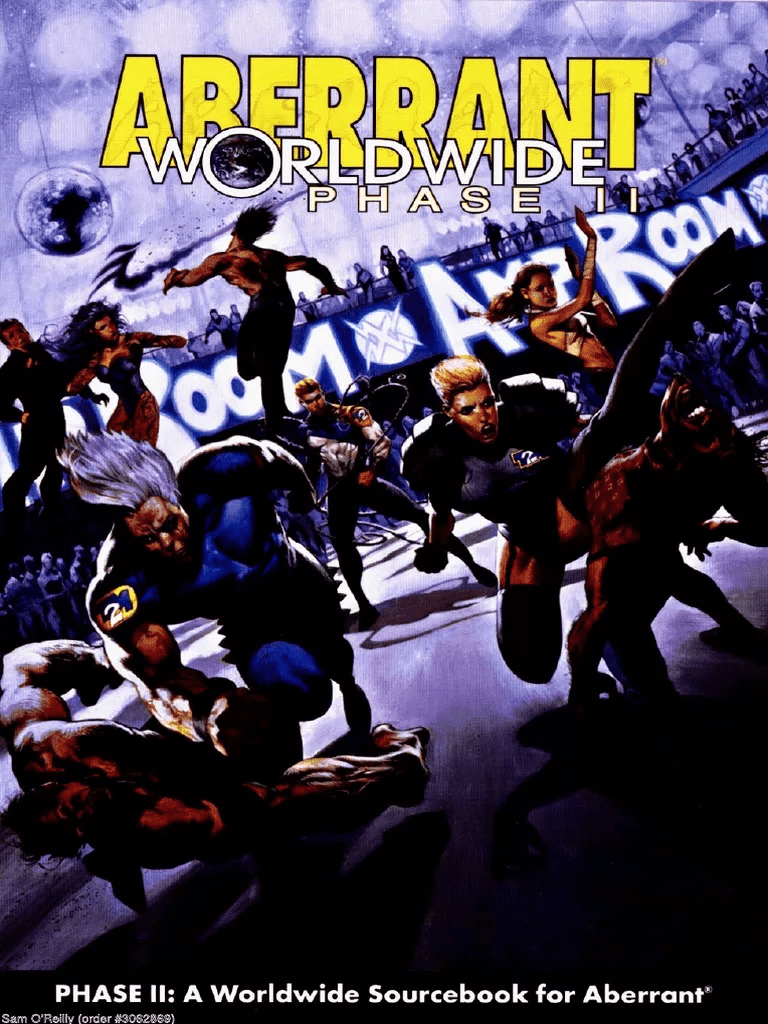
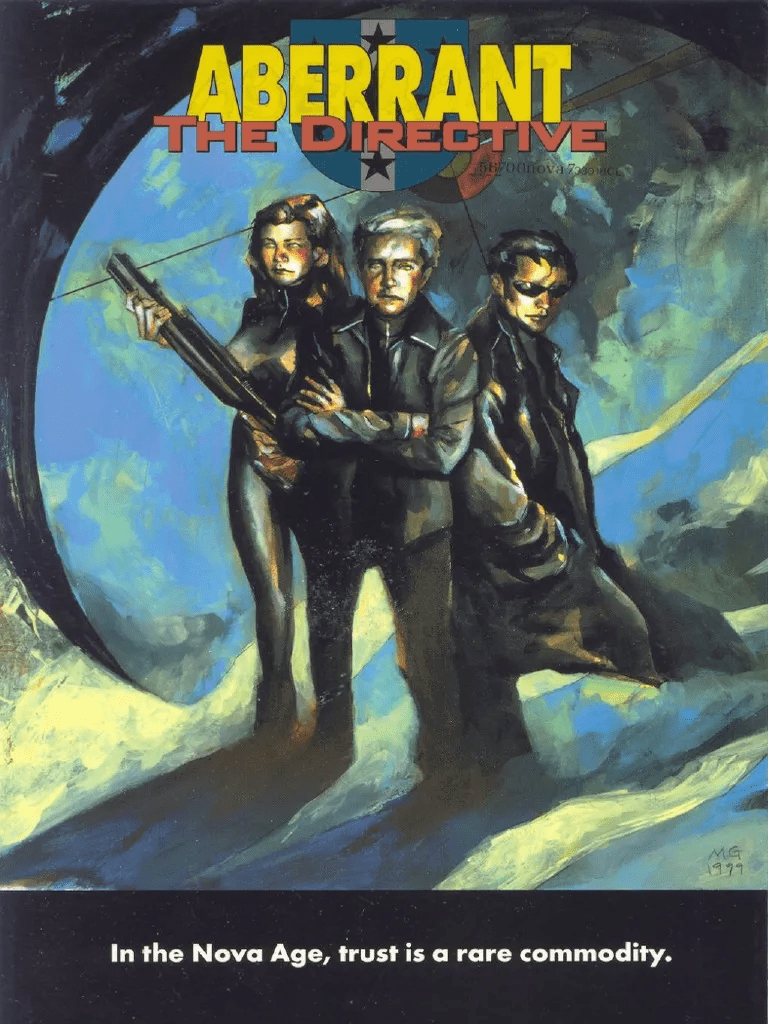
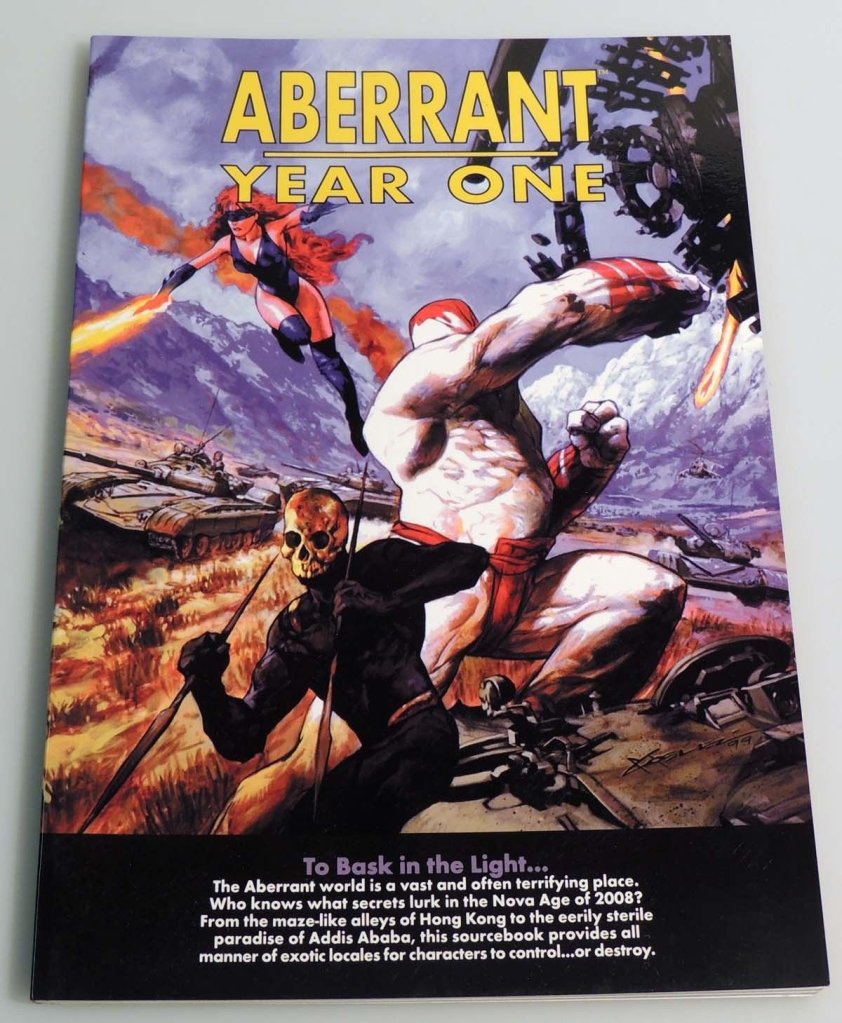
    The thought occurred to me that if I’m going to read my way through all of first-edition Aberrant, I might as well post my thoughts here. It’s not going to be a full readthrough, but I’ll go over each supplement in turn.

    So, starting out with the core book. It starts off without preamble with in-universe documents, and get used to that, because that’s going to be most of these books. White Wolf was always fond of that, but I don’t think it works quite as well here as in most of their other lines, for reasons I’ll get into later unless I forget.

    Anyway, to try to summarise a tremendous amount of setting lore, ten years ago (in 1998) the space station Galatea exploded and drowned the world in quantum energies, and as a result about one person in a million “erupted” into a “nova” who can manipulate the quantum forces of the universe in ways that for some reason is completely identical to stock superhero powers. The books even admit that “quantum energies” are just things like gravity and electromagnetics, but novas can still teleport and read minds and change shape and they can do it Because Quantum. Which would be fine, except the book spends long, tiresome sections technobabbling away to try to make it all seem reasonable and sciency.

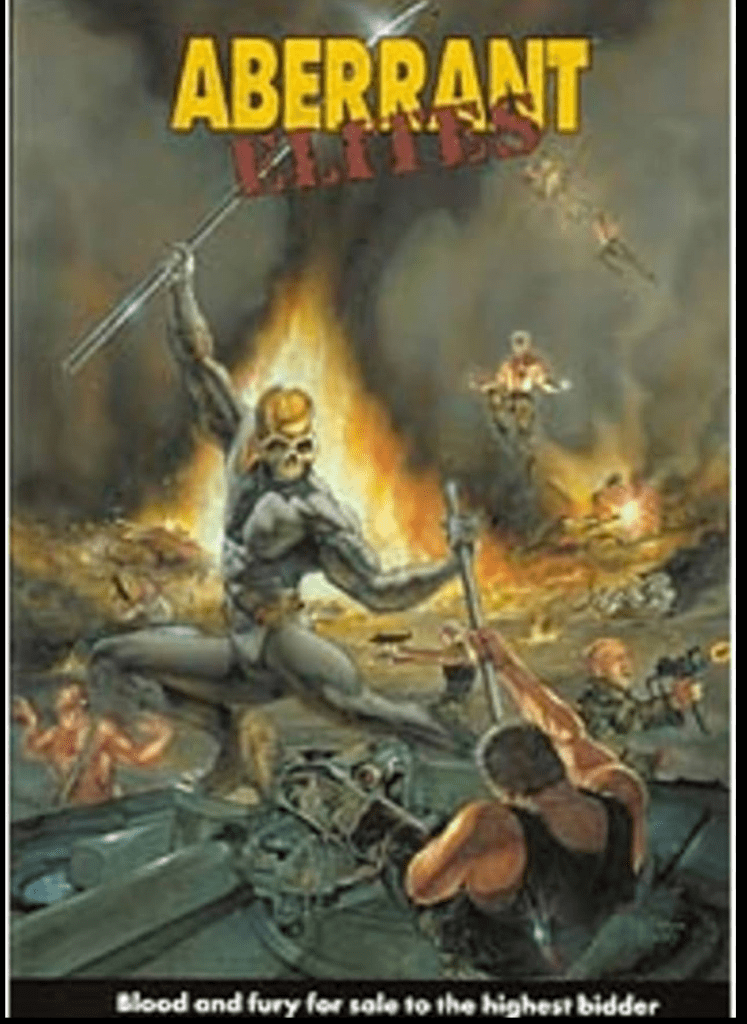
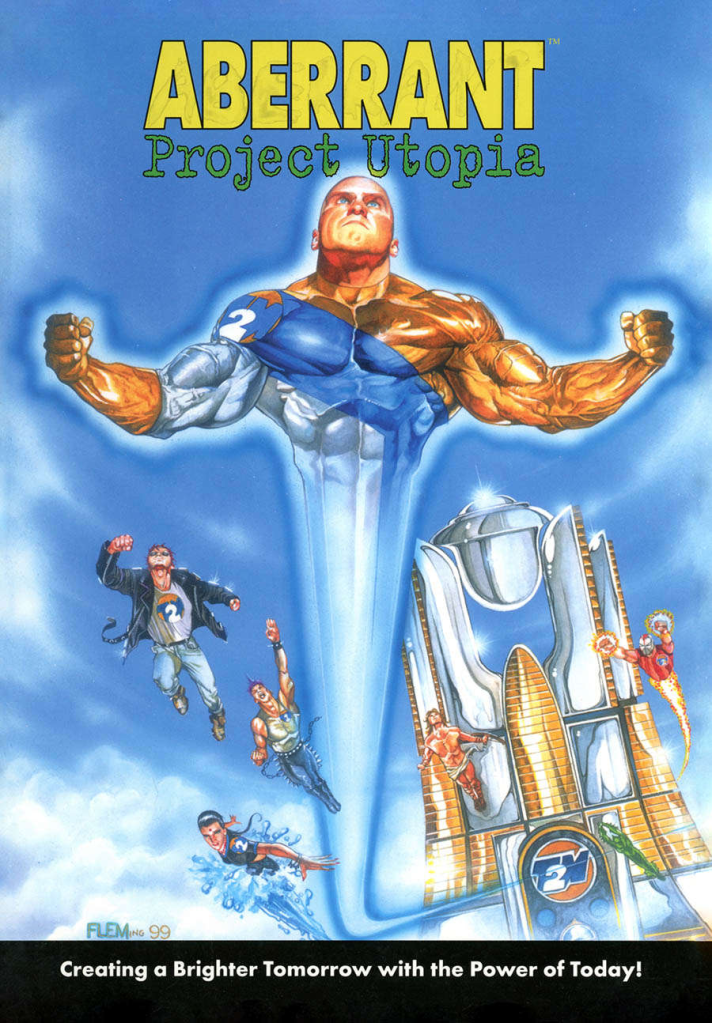
    Anyway, an NGO called Project Utopia emerged suspiciously quickly to provide guidance for novas and, using a mix of nova powers, technological breakthroughs enabled by nova powers, and public goodwill generated by the above, set about cleaning up the environment, toppling dictatorships, arranging peace treaties, and just generally fixing real-world problems. Not all novas work for Utopia, though, a lot of them have cushy corporate jobs or serve as mercenary “elites” who hire themselves out as superpowered bruisers – indeed, the primary way to wage war has become hiring some novas to fight the novas the other country is hiring.

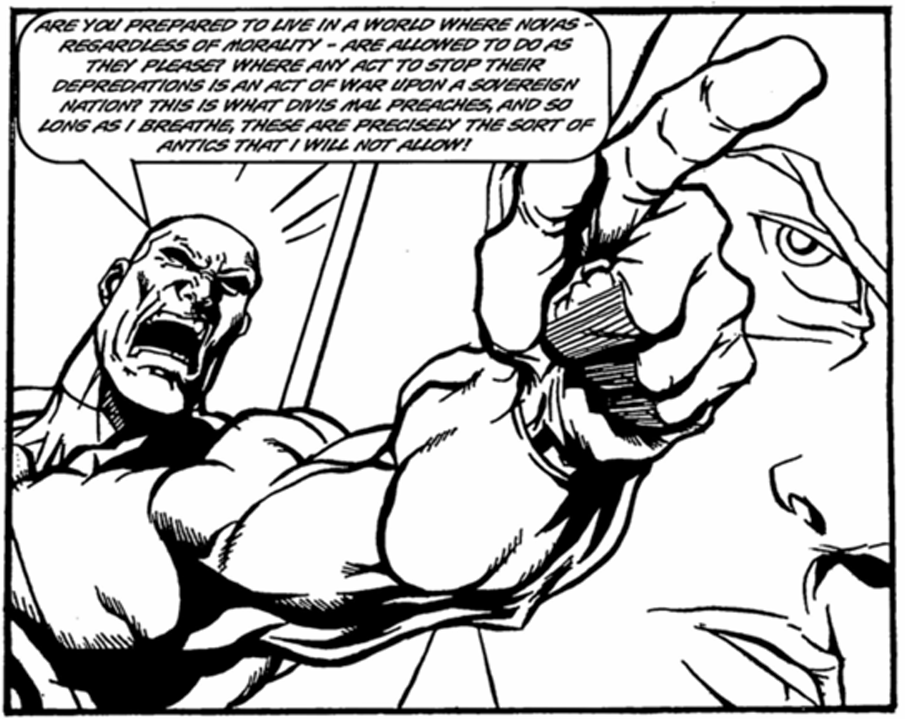
    There aren’t supervillains per se, but there is a group called the Teragen led by a Magneto-wannabe called Divis Mal who claim that novas aren’t human anymore and therefore they have no obligation to respect “baseline” laws or ethics. Project Utopia considers them a bunch of terrorists, which is not completely true but not completely false either.

    But Teragen aside, there is a loooooot of frankly tiresome in-setting documents outlining how novas have changed fashion, music, the entertainment industry, and how everything is super-great and everyone is happy except maybe a few stupid pootiehead malcontents… and then all of a sudden we learn that ACTUALLY, there is a secret conspiracy inside Utopia called Project Proteus, and it is up to no good and have sterilised every single nova in the world. Yes, all of them. Somehow. And some chick called Slider found out and they killed her, and her layabout bestie Corbin have gone on the run accused of the crime and he’s founded a resistance movement called the Aberrants who wants to put a stop to Proteus.

    And, ugh… this plot hook, man. This freaking plot hook. It’s dead centre in the game, almost everything leads back to it and it’s just – so – STUPID. For one thing, how did Proteus even get to every single nova in the world? And how exactly did they expect this would work out, no one would ever notice that six thousand high-profile people had fertility issues all at once, and none of the super-genius intellects of the setting would ever put two and two together? And thematically, it’s just a mess. Here, have a game about playing a glamourous picture-perfect superhero! Oh, but you’ve been castrated without noticing. Yeah, that doesn’t ruin the power fantasy at all

    Honestly, it feels a bit like the guy who thought of it was very childfree and he thought it’d actually be kind of neat if all his shiny superheroes could be hot, single, and absolutely untouched by the messy business of reproduction. Because while there is some finger-wagging about how forced mass sterilisation is, like, bad and stuff, there seems to be about zero understanding of just how big a deal it would be in the real world and how hard most people would take it. It does kind of feel like the kind of idea I would have had back in my twenties, in fairness…

    But anyway, even aside from that, it’s not even especially useful as a plot hook. It’s simultaneously too big and too tightly defined. If novas are secretly being subject to genocide by the people who are supposed to direct them in building a better tomorrow, then that makes pretty much everything else they get up in the setting look stupid and pointless… but at the same time, the Aberrants-versus-Proteus conflict is just too straightforward to work as a starting point for your own ideas. Proteus isn’t a nebulous evil organisation doing all manner of inventive bad things that the players can get into – it’s doing one particular bad thing, and it’s pretty well-understood right from the start why and how it’s doing it, so all that’s really left is trying to prove it to the public. And yes, you can build a campaign around that, but that’s just it – you can build one campaign around that. It’s not something you can riff on and take in a ton of different directions.

    So, anyway, that’s the setting, and aside from (sigh) THAT THING, it’s not a bad one – certainly it feels vivid and lived-in, and there is some appeal in playing a character with superpowers in a setting where having superpowers doesn’t necessarily make you a superhero but where powers are being put to all sorts of personal, financial and political tasks. My main problem is actually that the core book spreads itself pretty thin over a ton of different parts of the setting that it wants to point to, and the fact that it insists on presenting everything as in-setting documents just make it worse, because making those informative and not just flavourful is pretty hard, and I don’t feel like the writers here were really up to the challenge. There’s a very strong feeling that this book was meant to give you a taste and nothing more. You want to actually use Project Utopia, buy their book! You want to use the Teragen? They’ll get a book! Oh, and there are these massive criminal syndicates who have adapted to nova crime-fighters by joining together, but if you want to know more about those than that they exist, you’ll need to wait for their book.

    After that, there are the rules, and… well… look, it’s the Storyteller System, okay? The rules aren’t meant to actually be used, they’re meant to sit there and look pretty. Suffice to say, you can put a nova together that is on the general level of, say, Spider-Man pretty easily, and just about any common superpower you can think of is represented somewhere. Which does of course mean that most of them is meant for fighting, in a game which keeps reminding you that it’s totally not about going out and punching bank robbers in the face, but whatever…

    The most interesting thing with the superpowers are actually the Mega-Attributes, which are relatively low-key bonuses to your regular human abilities, and the first dot in each of them comes with a free “Enhancement” that is some minor superpower tied to that Attributes. And that feels really cool, because it means that novas are, first and foremost, hyper-competent at their areas of expertise, in a way that has a lot more real-world applicability than the cheesy comicbook stuff.

    Oh, and there is this thing called Taint that you can take in order to gain new powers faster, or that you might get if you strain yourself, because this is White Wolf and there has to be something that’s gradually consuming your very soul. That said, you don’t have to take Taint (or at least not much of it) if you don’t want to, and it does serve as a handy explanation for why novas end up looking and acting a bit funky.

    Stay tuned for the Storyteller’s Companion.

  • Grrrrr! Aaaarrggghhh!

    I got to break out my Werewolf port for the first time in ages (I have one campaign I run for the whole group and one campaign for each player who might be missing… yes, even I think it’s a little OCD, okay? But anyway, the player who needs to be missing for us to run Werewolf is the second-most reliable player in the group, so the Werewolf campaign doesn’t see much use). It was fun, especially since I think the mechanics really clicked for the first time.

    The big thing with Werewolf is supposed to be Rage. You’re a werewolf, you’re going to go berserk, it’s kind of your thing. You’re the Hulk, only furrier. Rage strengthens you but also takes away your control. And a large part of my reason for starting on this port in the first place (which led to my all-around porter madness) was trying to find a way to model that mechanically in a way that wasn’t too fiddly.

    I may have actually worked it out now, at least in a rough fashion. The way it works is, each player has a number of Rage boxes that start out unmarked. Every time a player fails a roll, they mark a Rage box. They can then clear a Rage box to heal wounds, pull off different stunts in combat, fight whole groups at once, and badassery of that nature.

    However! Whenever a player gets taunted too harshly, or fails in a way that feels too humiliating, or gets injured too badly, they have to roll +Rage (that is, 2d6 plus the number of marked boxes). If they roll 10+, they frenzy. If they fail the roll with 6-, conversely, nothing happens, but they mark Rage as usual when failing a roll. So the more Rage you have stored up, the more of an unstoppable killing machine you are in combat, but the greater the risk is of you completely losing your cool and smashing something you didn’t plan on smashing.

    The Rage economy worked out really well in the fight scene we ran tonight – the player used Rage to hit far above his normal weight class, got hurt and had to fight for control, gained Rage from avoiding frenzy, and then used that Rage for more fighting. This player is a relatively feeble little Ragabash (think scout/trickster), and his opponents were two fomori with military-grade rifles and body armour, so it was a tough fight, and I think the Rage mechanic made a lot of difference.

    We never did have to play out a frenzy, which is probably good, because those rules still need some work. Mechanics that take control away from the player are always tricky to formulate – you need players to still have choices, or else you’re just sitting there talking to themselves, but the whole point of Rage is supposed to be that you sometimes lose control. I am sort of considering an approach where I view it kind of like driving a speeding car that you can’t break, only steer – instead of asking, “what do you do?”, I might ask, “do you fight or flee? If the former, who do you attack? If the latter, which direction do you blindly charge off in?” With rolls required whenever they try to do anything that requires hesitation or forethought. I don’t know, though, there are a lot of pitfalls here. I’ll need to think on it.

    But it was definitely fun to try out this part of the rules!

  • Where I Read: Daggerheart (part six)

    Where I Read: Daggerheart (part six)

    When we last left our hero, he was blowing his top over the pointlessness of money-counting in a game where nothing has a definite value. This time, we’ll tackle the actual weapons and armour setting. Will it redeem what came before? Time will tell.

    First, though, there’s a page on “player best practices,” essentially finger-wagging pointers to how you should approach the game as a player. Okay, let’s take a look.

    The first one is to embrace danger. Do not make the boring, safe choice, make the interesting but risky one. Eh, I don’t know about this. To some extent, it makes sense to emphasise that if you didn’t want to have an exciting life, you should have become a cobbler like your mom wanted you to instead. But the way this is phrased gives me less of a sense of “you’ve got to be in it to win it” than one of “stop thinking sensibly and walk into the obvious trap already!” I feel like that’s unreasonable – players should do what their characters would do, yes, but their characters can be assumed to want to survive, so you can’t let it break the game if they act prudently and with forethought.

    The second one is “use your resources,” meaning to look at your character sheet, see what points you’ve got laying around, and actually spend them. Mmm, okay. I’m on the fence about this one. On the one hand, I kind of like meta-currencies and subsystems – they’re fun to work out how to make the most of. But on the other hand, I also know that there are a lot of people who absolutely can’t even with those things, who just want to make decisions based on the fictional situation and not bother with a bunch of fiddly mechanics. I also note that this is very much in keeping with the first practice – this is very much a game where you’re not supposed to immerse yourself, where you’re supposed to remember at all time that you’re telling a story. Which is… fine, certainly there is plenty of pitfalls on the opposite end of the spectrum, but it still feels symptomatic of how afraid this game is of actual emotional intensity. I am starting to conclude that “epic” means something very different to the designers than it does to me.

    Third one, appropriately enough, to tell the story. Most of that I have no issue with – it’s about things like detailing aspects of the game world so that the GM doesn’t have to, and letting them know if there is something in particular you want your character to get a chance to do. But then it goes back to lecturing about how you should make tactically suboptimal choices if that makes for a better story, and, uhm… Thing is, any story is about people trying to accomplish something, whether that’s saving the world or finding some treasure, and they’ll absolutely be trying to make the choices that brings them closer to that goal. They won’t always succeed, but then, players won’t always be tactically brilliant either, so it evens out. In fact, all this hectoring about “think of the story, you philistine, the story!” just feels to me like a fundamental insecurity about your own mechanics, because good mechanics create the incentives for telling a certain type of story.

    The last practice is to discover your character over time. I… actually have no problem with that at all. Huh.

    Levelling up! Levelling up happens when the GM says it does, but preferably no more commonly than once every third sessions or so, and it happens to every character at the same time. Level translates into tier, with level 1 being tier 1, levels 2-4 being tier 2, levels 5-7 being tier 3 and levels 8-10 being tier 4. Every time you advance a tier, you increase your proficiency (which determines how many dice of damage you roll), and you get a new Experience. You can also only raise each core attribute once per tier, so a new tier means that you can get your minmaxing on some more.

    In addition, you can choose a two of a number of other mechanical options to improve, like extra hit points, extra damage, more Stress, higher Evasion… All pretty basic stuff, but it seems to be intended to let you build your character in roughly the direction you want to. You also get the option to multiclass, in which case you get the foundation card of one of the new class’ subclasses and access to one of its domains.

    When levelling up (not just when switching tiers), you also increase your damage threshold by one and you get to pick a new domain card at your current level or lower. You may also, if you like, switch out one of your existing domain cards for another one of equal level or lower. Okay, nice touch, makes it harder to get stuck with suboptimal builds.

    Inventory! You can only use weapons and armour that you have equipped, and you can only carry two weapons (and no armour) in addition to what you have equipped. You can switch weapons in mid-fight by taking Stress. Weapons can be “primary” and “secondary” which seems to be mostly about which one you hold in your dominant hand – a shield is a “secondary” weapon, for instance. You can attack with either weapon if you have two equipped, and some secondary weapons also give extra perks.

    You can also throw weapons, in which case you make a regular attack with them using Finesse, and do damage upon hit. After that you can’t attack with that weapon again until you reclaim it. Uhm, duh? That should go without saying – I recall something about “rulings, not rules” quite early on, and I’m pretty sure that most GMs can figure out that you can’t hit people with a sword that you just flung away…

    There are some notes on what different stats of a weapons means, nothing terribly surprising there. The only thing I’d note is that there’s a distinction between physical and magical damage, and some enemies may be resistant or immune to one or the other.

    Armour – okay, let’s see if we can get some clarity here. Armour comes with a base score, which determines how many armour boxes you get in it, and two base thresholds, which determine whether a hit inflicts 1, 2, or 3 hit points on you upon taking damage. When you’re hit, you can also mark an armour box to reduce that amount by one. Okay, that’s… a little finicky, but I guess it’s straightforward enough.

    If you’re wearing no armour at all, your damage thresholds are correspondingly low – anything that inflicts as much damage as your level takes away 2 hit points and anything that inflicts as much damage as twice your level takes away 3. And of course you have no armour boxes at all.

    There’s a note that you can reflavour armour as you like – a wizard might wear heavy armour, for instance, but it’ll actually be a variety of protective rings and amulets, and the reason why he can’t move around as fast in it is that he’s always preoccupied with maintaining the magic. Fair enough.

    Weapons are listed in tiers. I’m not sure if there is any rules significance to those, or if they’re just guidelines for when the GM should leave some of them around? Either way, there is a variety of magical ones of every tier, but at least on the lower tiers the magical ones mostly differ in what stat you use to attack with them, though there are some exceptions like the Returning Blade, that returns to your hand if you throw it. Higher up, among a ton of weapons that are just the lower-tier ones with “Improved” or “Advanced” in front of the name, there are also things like the Ego Blade, which can only be used by characters with a Presence stat of 0 or lower. Heh.

    Blackpowder weapons are a thing, they require you to mark Stress to reload them after every shot.

    Then there is a section on combat wheelchairs – nope, nope, not touching that with a ten-foot pole – and after that it goes into secondary weapons. A lot of it is simple stuff like shields (add to armour score) and short blades (add to damage of the primary weapon), but there are also some standouts like whips (can be used to force every enemy to back away from you) and grapplers (which can be used to pull enemies close).

    Armour, finally, is pretty much what we just described – they have a static threshold and a depletable number of boxes, and the heavier ones give you penalties to evasion. Higher-tier armour seems to mostly be magical and have some special widgets associated with it, though I’d kind of wish it described how it works. Like, Rosewild Armour lets you mark an armour box instead of spending Hope, so does that mean that Rosewild Armour… steels your resolve in some way? That might be nice and flavourful if it was actually commented on. You know, like it would be in a game that was actually all about the story, man, where you weren’t supposed to care about those boring mechanical bits.

    I mean, this is really what it comes down to, and why I am growing to hate this game with a considerable passion. It’s not mechanics-focused or narrative-focused, it’s got mechanics and narrative forcibly kept apart to keep the one from inconveniencing the other in any way. It’s not a single game, it’s two different games that you’re meant to play at the same time! Insofar as there is a mission statement here, it seems to be the exact opposite to the sort of down-in-the-dirt, zero-narrative, let-the-dice-tell-the-story dungeon-crawler that crusty grognards tend to espouse.

    And in fact, I think that might, in a final analysis, be what the writers mean with “epic.” They don’t mean “sweeping and mythic with high stakes,” which is what I naively assumed back in part one. They just mean “absolutely not in any way gritty or realistic.” And while I don’t always want my games gritty and realistic, any game – or any other form of expression, really – that defines itself solely as being “not that, ew!” is pretty much doomed to suck.

  • Grimdark puttering

    Grimdark puttering

    No major progress on anything important this week – I’ve been two steps away from a nervous breakdown most of the time. Still, puttering around on this and that has, surprisingly, gotten me most of the way through outlining Rank 5 of the Dark Heresy port. And that’s kind of neat, because Rank 5 is honestly where the game actually starts to happen. That’s when you get to play around with power swords and big-boy psychic powers and cybernetic implants that lets you levitate.

    The entire first half of the game is you working your way up from “Imperial Guard draftee” or “underhive scum” to actually becoming one of the people the setting tends to really focus on. Which makes senes in theory – zero to hero is a thing for a reason, right? The problem is that it cuts you off from most of the source material – not all of it, by any means, there is the occasional piece of media that follows the people way down on the ground, but still, the pickings there are a bit slim. And I think the game designers did realise that, since they went on to release special rules for playing as an Inquisitor (even if they mostly amounted to, “just start by spending a gazillion points of XP”) and all the other games in the line were about being some kind of badass.

    I don’t know. I guess I’m not that much of a fan of zero-to-hero in general. It can be cool if you’re playing a really long campaign, but most campaigns don’t last for years of real life – whatever level you start on, you’re probably not going to be moving that far from it, so I think it makes sense to put at least a decent amount of cool stuff on it.

    I’m kind of looking forward to starting to adapt the other games in the series, because there I’ll find out if the system I’ve worked out can be adjusted to higher power levels and plenty of authority. That’s honestly what I enjoy running more – not games where the players are all-powerful or anything, but games where they have juuuuust enough power to get to make demoralising hard decisions. Being powerless means freedom from responsibility, and as my players could tell you (usually with a lot of long-suffering sighs), I do so love to inflict responsibility on them.

    In other news, today’s Mummy: the Resurrection session went well. It was the thirtieth one in the campaign, proving that sometimes they really do go on for a long time (so it’s kind of a shame that this is a system where character progression is a lot more plot-dependent and thus the players still aren’t that far from where they started out). It’s odd, it’s a pretty obscure and unloved game running on a glorified set of house rules, but somehow it just clicked. I kind of feel like I should change to a different campaign soon, because Lord knows there are plenty of other games I want to try, but at the same time, it seems a shame to stop when it’s going so well. Oh well, we’ll see.

  • Aaaand it’s done!

    Aaaand it’s done!

    I am pleased to report that my recent bout of mania has produced a semi-finalised version of my Dark Heresy port to Powered by the Apocalypse. It can be found on the downloads page, or if you’re too lazy to go there, you can just click here.

    Well, that was a lot of work for something that no one but me is likely to ever find much use for… but, well, at least it’s keeping my brain active. Better than doing crossword puzzles, I’m sure.

    And it’s certainly been a deep-dive in all things Warhammer 40,000. I think I’m starting to get the general gist of it, you know? The key thing is, you have to shut down any sense of tender-heartedness or even of basic self-preservation and really get in touch with your ghoulish side. You have to cultivate an attitude of, “incredibly awful things are happening all around – and that is SO COOL!”

    Possibly this is not so good for my always-shaky connection to normal humanity and I should go work on my Blue Rose port for a bit now to balance it out… Either way, I definitely do need to take a break from this one for a bit now. Work on some other project – possibly even one of my original ones, heaven forbid…

  • Grimdark Principles

    Grimdark Principles

    Woo! I have been hard at work with my Dark Heresy port – which I realise is all that I ever talk about lately, but when I get manic about something I need to ride it until it starts boring me again, at which point I can get manic about something else – and I’m actually pretty close to having it ready as a playable game. There is some fine-tuning, but most of it is in sorting the rules into a more easily accessible format. The actual function of them I think I can more or less stand by at this point.

    For this week, have a look at my Principles. Principles are one of my favourite parts of Powered by the Apocalypse – they’re specific assumptions and elements of playstyle that goes with the particular setting and genre of a particular game. I had to rewrite these about a million times, but now I think they actually work for the sort of game I’ve been running. Here they are:

    • Never whisper when you can roar. The forty-first millennium has no room for subtlety. Everything about it is oversized, overwrought, overwhelming, and not least of all loud. There are no genteel duels on sunlit streets, only frantic no-holds-barred chainsaw-wielding brawls fought atop the broken stained glass of ruined cathedrals; no calm discussions between dispassionate parties, only furious demands shouted over the thunder of enemy gunfire. Whenever you frame a scene, ask yourself: how could this be more operatic and baroque?
    • Fill the world with brooding ruins; afflict everything with slow rot. The galaxy is old, its decadent empires stubbornly clinging to life even as they are dragged, inch by inch, towards oblivion. Nor is anything replacing them – those that manage to prosper in this time of fire and blood are those that have no interest in building anything of their own, only in tearing down or consuming what already exists. The decay isn’t fast, but it’s omnipresent, visible in the blasted skylines of bombed-out cities and the jagged scars of grizzled veterans. Everything is either old and worn out, or new and crudely inferior.
    • Spin webs of baffling complexity. Nothing is simple and elegant. Everything is covered with unnecessary details and slathered in adjustments, caveats, reworkings and contradictory purposes. Every culture has a convoluted history that has given rise to bizarre practices, and every piece of machinery has been jury-rigged from components originally meant for something else. Things that are meant to be covert are even more so; whatever part of a secret plan you manage to unravel is probably a diversion designed to cover a deeper agenda, or else it was meant to go down a whole different way but was sabotaged by unplanned events or a third faction. If something seems straightforward and common-sensical, it means that you haven’t added enough detail and contradiction to it yet.
    • Beneath every demoralising appearance, hide an even more awful truth. Things always seem pretty bad, and they’re invariably even worse than that. If you think that you have a predator on your trail, there is probably a second one lying in ambush ahead of you. If you’re tracking a skeevy underhive cult, it will turn out to be only the smallest part of a vast, powerful conspiracy reaches into the highest spires. Whomever you most rely on will either stab you in the back or die right before your eyes. Show plenty of problems and threats to the players, and for each one secretly ask yourself: how might this be worse than it seems?
    • Hoard knowledge and spread deceit. Knowledge in the Imperium is at once tightly controlled and rapidly decaying. No one has a complete picture – the real facts are either strictly classified, distorted by propaganda, or simply forgotten or misfiled. As acolytes of the Inquisition, the players have a duty to separate the truth from the lies, but they should have their work cut out for them; even the most trifling pieces of accurate data are furiously protected and once acquired, turn out to have large holes in them.
    • Show that humanity is fleeting. The Imperium is fighting for mankind against all that would see it end, against the alien xenos and the mutating powers of the Warp. However, the way it fights invariably eats away at the humanity of its people in turn. Imperial Commanders accept, or initiate, horrific widespread atrocities because it’s the only way to keep the system going, turning the strong into sadistic monsters and the weak into whimpering animals. Psykers invite the Warp into their own minds for the power to meet it on the battlefield. Tech-priests replace their bodies with metal out of loathing for human weakness. Even Astartes, supposedly the ultimate champions of Man, have turned themselves into lumbering, brainwashed killing machines that have little resemblance to the men they once were. On every side, show human nature suppressed or corrupted, stolen away or abandoned.
    • Let there be no innocence, only degrees of guilt. No one is pure, no matter how impeccably they present themselves. The seemingly noblest of people are still driven to acts of petty spite and hubristic arrogance by the strain of their position. Lesser souls, realising that there is little justice in the galaxy and that their ultimate fate will likely be a grim one, sell out their integrity for a slightly more bearable life here and now. Some people are worse than others – there are depths of depravity in the galaxy that the common, everyday sinner could barely even imagine, much less partake in – but no one is both completely sane and completely righteous, and most are some combination of crazy and corrupt.
    • Explore the brutal power of faith. Faith in the Imperium is not about gentle comfort and community; it is a thing of cleansing fire and blood-soaked martyrdom, of baying mobs and dungeons echoing with screams. Faith can turn a crowd of cowering peasants into a conquering army, can move planets on their axis, can spit in the face of Hell itself. Terrifying, psychotic certainty is a weapon as powerful as any bolter, and as volatile as a promethium refinery. Let the players try to use it to their advantage, but also put them to the risk of finding themselves on the wrong side of someone’s crusade.
    • Make every victory pyrrhic. Victory is always possible even in the grim darkness of the far future. After all, if there was no reason to fight, how could there be war? However, victory is rarely uplifting or hopeful. Rather, it never comes without losses, casualties, and the dismal knowledge that this can’t go on much longer. Never let a victory completely restore the status quo. Every triumph has a too-heavy cost, and entropy always increases, whether from the collateral damage of the fight or from the ever-accumulating injuries and mental scars of the fighters.
    • Treat technology as magic. The Imperium uses advanced technology while being almost wholly ignorant of science. The oldest and most powerful devices are relics that no one knows how to build anymore, and even machines and tools that come off the assembly line are constructed by rote, according to ancient instructions that are treated with religious awe. As far as Imperials are concerned, their weapons and vehicles work by the will of the machine-spirits, who are appeased through maintenance rituals; accordingly, any high-tech device will be decorated with fanciful engravings and colourful prayer rolls to keep it in a good mood. This also means that “high” and “low” technology exists side by side, with waxen candles burning atop cogitor banks and the instructions for operating a mechanic walker being scribbled on vellum. Whenever technology is mentioned, add some detail to hint at how completely its wielders misunderstand it.
    • Relish the players’ fight against impossible odds. The players may be tiny insects struggling against the vagaries of an uncaring cosmos, but the story is nevertheless about that struggle. They are the antiheroes of this tragedy, destined to ultimately fall but compelling for their desperate struggle against their dark fate. Push them to the brink, because that’s where they have the chance to shine; cheer their temporary victories and relish the Heavy Metal brutality of their inevitable defeats. Don’t go easy on them, but always give them a way to fight back, to prove their manful defiance of the odds stacked against them.
    • Portray visceral realities, not abstract rules. Never treat the numbers and the rules like they have an existence of their own. Mechanical effects – injuries, penalties, moves – come from the fiction and have consequences in the fiction. If you’re down a few Wounds, then you have a specific injury; if you’ve gained a few Insanity Points, then some past event still haunts your mind. Never apply a rule without noting what part of the grimdark reality it represents.
    • Demand immediate action. Things in Dark Heresy happens quickly, relentlessly, and often brutally. Threats are always escalating, the chrono is forever running out. Whenever you stop talking, demand to know what the players are doing about what you just said, and then build off of their actions to a new dilemma. Keep the situation ever-changing and the players engaged in it.

  • Remaining DH problems

    Remaining DH problems

    I am still working on my Dark Heresy port. It’s come a long way, but I’m still not satisfied. The main problem I still see are:

    1. The weapon rules, or rather, the way they’re organised. The way I’ve written them, certain weapon types rewrites the attack moves – adding some options, removing others. Rewriting the attack move every time a player makes it is turning into a slog. I need to think of some more convenient way to structure, for instance, the difference between single-shot, semi-auto and full-auto attacks.
    2. The basic moves in general still don’t add up to the full array of things a player might do for me, even though there are a lot of them, 24 in all. For my WoD ports I “only” have 16 basic moves, but I still never find myself without a move to trigger when I want one. I need to have, e.g., the Agility move cover everything that an untrained person could possibly attempt and potentially succeed at involving Agility. Right now, the list is effectively Run, Sneak, Duck and Hide (yourself or something else). Which is fine, but I can think of several other scenarios – balancing on a narrow foothold, for instance. Dunno.
    3. The move for psychic power use is kind of boring. A partial success means that the player gets to choose between gaining Insanity Points, gaining Corruption Points, or letting the GM declare that some unwanted supernatural effect happens. That’s kind of bland, especially given how flavourful the list of psychic phenomena and perils of the Warp are in the original game. Not sure how to fix that.
    4. The GM moves need to be rewritten from the rather generic and boring ones I have right now into something that more brings forth the experience of being an out-of-your-depth agent for a ruthless, all-powerful organisation bent on rooting out plots and schemes in a universe where everything is always ten times worse than it seems. This one I feel the most optimistic about – I should be able to manage it, given some time and effort, it’s more a matter of flavour than of mechanics.

  • More warhammering

    Today’s session turned out to be Dark Heresy, which reminded me that that port may have come a long way, but it’s still in an unfinished state. The basic moves work well enough, but they just don’t feel comprehensive in the way I want – I can usually find one that fits, but not always. I don’t have that problem with the WoD ports, despite them having half the number of basic moves. I don’t know. Maybe I need to think a little more broadly. For instance, today I ended up jury-rigging a move that’s really meant for communicating across language barriers and use it for getting across to someone in an agitated state – making it more generally a move to make someone listen and understand who would otherwise be unlikely to do either. That might be a way to approach it.

    Combat could use some fine-tuning, too. For one thing, I need to do something to make grenades less tempting to break out for everything. They do a ton of damage, but that’s supposed to be offset by them being awkward to use at close range and expensive to stock up on – I think I may need to try a little harder to enforce both those things.

    Also, copy-pasting together the actual options faced by a player whenever they succeed at throwing a grenade (as a Blast weapon) is still getting old. I don’t know, should I just write up separate combat options for each major type of ranged attack (Blast, single-shot, semi-auto and full auto)? That sounds awkward, but it might be a step in the right direction.

    Need some more flavourful GM moves, too. I’ve been using the regular, game-agnostic set (deal damage to them, take away their stuff, give them a tough choice, etc), but they’re not terribly inspiring. I’m thinking some more like:

    • Confront them with brutality and oppression, with them on the receiving end or not. The Imperium isn’t a nice place to live. Terrible things happen to perfectly ordinary people on a regular basis, ranging from merely being worked to death in a fabricarum to being hunted for sport by degenerate nobles. With this move, play up some routine horror, either as a background event (which they might try to stop, if they’re feeling foolhardy) or something that affects them directly.
    • Show them that they’re small. It’s a vast universe, and even the most accomplished human is only qualified to deal with a small part of it. With this move, reveal that the players are completely out of their depth, dealing with a situation far more complicated (and perhaps deadly) than they can even begin to address. Something as simple as finding your way through a labyrinthine hive city can be daunting, and once poorly understood technology and convoluted organisations get involved, things may simply be beyond your ability. For obvious reasons, this move must be used with care, to not cause the players to just stop trying. However, it’s integral to the setting that some problems just aren’t solvable.
    • Have something go terribly wrong on a large scale. Industrial accidents. Natural disasters. Entire swaths of space stations losing life support. When things go wrong in the Imperium, they tend to go wrong in a downright operatic way. With this move, smash something up that changes the entire environment the players are in. They should still have a reasonable chance to survive, of course, but they will likely need to start running.

    Something like that. I’ll need more of them, but that’s a little more fitting for the setting.

  • Houston, we have a resurrection!

    Houston, we have a resurrection!

    Today marks an occasion for my Mummy: the Resurrection campaign. We actually got to the resurrection part. The players finally returned from the Underworld, returning to life in the city morgue. Now let’s see them deal with the various parties who have developed an interest in them. And how long it takes before they stand before the Judges again, of course.

    We ended up spending a little more time in the Underworld than I intended. I’m not exactly sure what to blame that on. On the one hand, I grumble a lot about how my players keep hyper-focusing on whatever is right in front of them and ignoring the overarching situation, but in all due honesty… part of it is also that I set them to too ambitious a task while in the Underworld, having them rescue prisoners from a spectre stronghold. Which required them to first get hold of a Hierarchy cache so they wouldn’t have to do it bare-handed. And then they ran into trouble along the way, because the Shadowlands are dangerous.

    So yeah… in retrospect, I shouldn’t have gotten quite so ambitious with something I just intended to be filler. I do have this tendency to assume that things can get polished off in a session or two, but of course I also don’t want to rush through it without giving the situation proper gravitas, and then I sit there six months later and wonder why we never got to my super-cool “real” plot.

    Part of it is the nature of the World of Darkness, too. It’s supposed to be, if not “realistic,” then at least grounded in some sort of internally consistent setting. Everything is supposed to come from somewhere, everything is supposed to have context. That’s what I love about it. But it does mean that there aren’t much in the way of simple encounters – you can’t just go, “suddenly, you’re attacked by zombies!” because each individual zombie has to have its own angsty backstory or it feels like you’re phoning it in.

    Funny thing? Out of the WoD games I’ve tried, the one that runs the most smoothly is Mage: the Ascension, once I figured out how to manage it. There are still no simple encounters, but the game does encourage you to just throw more mismatched intrigues and general weirdness at the players, and then let them figure it out as best they can. Mummies and werewolves are supposed to be fighting a war. Mages are just meant to “reach enlightenment,” and the nice thing about that is that just about anything can be framed as another Very Important Step On Your Personal Journey. And of course, when the players get really interested in something random and start examining it from every angle, they are acting exactly like the sort of erratic geniuses they are meant to be.

    But yeah, as far as mission-centric games go, I probably should learn to break the missions down into smaller pieces.

  • Where I Read: Daggerheart (part three)

    Where I Read: Daggerheart (part three)

    Okay, so classes. First there’s a page repeating a lot of what we’ve already learned, but it also mentions a few new things. For instance, every class has a Class Hope Feature which lets them spend Hope to do something. Each subclass also has a Foundation Feature, Specialisation Feature, and Mastery Feature, though you don’t get those for free, you have to take them as a card when you level up. Okay then.

    First up is the Bard. They’re charismatic and slightly bitchy arteeeests, and their domains are Grace and Codex – so they know mysterious lore and can express it really prettily, basically. Their Hope Feature is that they can spend Hope to distract an enemy, and their Class Feature is that once per session they can give the party a rah-rah pep talk that grants each other PC a d6 that they can roll, once, to add to another roll or to reduce Stress.

    They can also choose to start the game with either an unsent letter (ooooh) or a… romance novel. Okay, so again I’m noticing that the cutesy postmodern humour kind of clashes with the stated intention of making the game feel epic and evocative… though that is, I will admit, a problem I have with a lot of modern fantasy. The Dragon Prince, I’m looking at you!

    Bards can be Troubadours or Wordsmiths. Troubadours have some abilities related to healing and bestowing Hope, while Wordsmiths have some advantages in terms of boosting actions and reducing Stress. So basically the one is about getting people to chill, and the other is about getting them to excel.

    Next up are Druids, who are your basic nature nuts. Their domains are Arcana and Sage, so they practice natural magic of the forest. They can turn into animals by taking Stress, or by using their Hope Feature that lets them spend Hope to do it instead. They can also pull off minor cosmetic acts of nature-magic, like making flowers bloom.

    They can be Wardens of the Elements, in which case they can channel one of the elements in combat for some perks, like doing damage to anyone who strikes them for fire or raising their resistance to injury with earth. Any Warden of the Elements can channel any element, but only one at the time. Alternatively, they can be Wardens of Renewal, who can restore Hit Points and clear Stress in people.

    There are a couple of pages of animals you can turn into, along with special rules for them. It all looks kind of fiddly, but it certainly makes Druids pretty adaptive – even sticking to just the ones you have access to at level one, that’s a pretty big bag of tricks.

    The Guardian! As mentioned before, this dude’s into Valour and Blade. He protects people, and his Hope Feature is that he can spend Hope to clear out Armour Slots. I guess that means they can take more of a beating. Their Class Feature is that they can turn themselves Unstoppable, during which time they take less damage and do more damage. Each time they do damage, they increase the amount of extra damage they do, but once that reaches a maximum, they drop out of Unstoppable again. Okay, so that’s kind of cool.

    Guardians can be Stalwarts or Vengeances. Stalwarts can tank even better, while Vengeances have higher Stress tolerance and can also spend Stress to cause people who attack them take some damage in return. On higher levels, Vengeances can also select a target to prioritise, and on attacks on them they can swap the results of their Hope and Fear Dice (so they gain Hope no matter what the roll is, I suppose).

    Rangers are cunning hunters and outdoorsmen who use the wilderness to their advantage and fight pragmatically, as showed by their domains of Bone and Sage. Their Hope Feature is that they can spend Hope to make a successful attack hit three different enemies at once. Their Class Feature is that they can mark an enemy for takedown, which means that that enemy suffers Stress when struck and also that the Ranger can turn a failed attack into a successful one, though at the cost of unmarking them.

    Rangers can be Beastbounds and get an animal companion, who levels up as they do, our they can be Wayfinders, giving them more bonuses on hitting things and some extra skill in, well, finding their way to places. There’s a page of rules just for the animal companions, who need to be fleshed-out characters in their own rights…

    … I’m trying to keep an open mind here, but I’m increasingly feeling like this game was written by people who felt like D&D 5E wasn’t fiddly enough. Which, okay, if that’s what floats your boat then more power to you, but… how does that fit in with the whole “focus on the story more so than the mechanics”?

    Rogues… well, they’re what you’d expect. They sneak around and stab people in the back. Their domains are Midnight and Grace, for hiding and lying. Their Hope Feature lets them spend Hope for a bonus to Evasion, and their Class Feature lets them remain hidden even from enemies who should be rights be able to spot them, right up until they attack.

    Rogues can be Nightwalkers or Syndicates. Nightwalkers can teleport from one shadow to another and hit harder when they’re Vulnerable (which we don’t know what it means yet, but I guess it’s meant to give them a “cornered rat fights twice as hard” style), while Syndicates automatically know someone in every new town they come to who they can ask for a favour.

    Next up is Seraphs, our holy warriors. They have Splendour for the healy-healy and Valour for protecting the innocents. Their Hope Feature is a limited healing, and their Class Feature is that they get a bunch of bonuses per session that they can use to boost allies’ rolls, reduce incoming damage, or give them Hope. They can be Divine Wielders, in which case they can fling their melee weapons at enemies and then cause them to return to their hands, or Winged Sentinels, in which case they can, well, fly.

    Sorcerers we have already dealt with in the form of that sample character. They are people with inherent magic that runs in their family. Their domains are Arcane (for inherent magic) and Midnight (for illusion). Their Hope Feature lets them reroll damage dice for damage-dealing spells, and their Class Features lets them sense magic, create minor illusions, and discard a domain card to gain Hope or enhance a damage-dealing spell. They can have an Elemental Origin, in which case they can do some tricks with the elements, or a Primal Origin, in which case they can enhance magic (mostly magic that deals damage – yeah, I’m sensing that Sorcerers are very much meant to be a DPS class).

    Warriors are more big fighty types, though they have a bit more of a “swordsmaster” or “warrior philosopher” vibe than just “I hit people onna head.” Their domains are Blade, for the swording, and Bone, for the intelligent swording. Their Hope Feature is a bonus to attack, and their Class Feature is that they get an attack of opportunity when their enemies try to retreat from them.

    Warriors can have the Call of the Brave or the Call of the Slayer. The Call of the Brave gets Hope and Stress-relief when failing a roll with Fear or when performing a ritual before engaging a superior opponent. So basically, you’re at your best when you’re doing something that’s clearly a bad idea but you’re going to do it anyway because it’s HONOURABLE!!! Heh. I kind of like that, to be honest. The Call of the Slayer can build up bonuses every time they roll with Hope that they can then spend for a powerful strike. Hiyah! Okay, I’ll grant you that I like this class a good bit better than the standard D&D Fighters…

    Wizards, finally! They are nerds who can do magic because they’ve done their homework. Their domains are Codex (for magic books) and Splendour (for healing, since in this game they’re the ones who do that, too). Which makes sense, honestly – like I’ve said before, I don’t really get the whole D&D convention whereby wizards can’t heal. Curing diseases is, like, the first thing that people expect from a wizard! After that it’s love potions, fertility, and putting curses on people you don’t like, in no particular order.

    Anyway, the Wizards’ Hope Feature is, somewhat interestingly, the ability to make an enemy reroll an attack or damage roll. Their Class Feature is that they can do minor magic tricks and that whenever they roll a particular number on their Hope and Fear Dice, they gain Hope or lose Stress, since they’ve spotted an auspicious sign. That’s sort of neat.

    Wizards can be of the School of Knowledge, in which case they can draw additional domain cards and can use their Experiences by gaining Stress instead of by spending Hope. Or they can be of the School of War, in which case they get extra HP and when they succeed at an attack while rolling with Fear they do extra damage.

    Next up is ancestry. There’s a lot of frankly tiresome hand-waving about how everyone is a unique individual first and foremost and yay the brotherhood of sentient beings and look, we’re totally not racist, honest! Yes, yes… Anyway, each ancestry gets two features, so let’s dive right in.

    Clanks are robots or golems – some sort of manufactured creature, either way. They can look pretty much like anything. Their Ancestry Features are that they were built for a purpose that aligns with one of their Experiences, so they get an additional bonus when using that Experience. Also, they rest up faster than feeble organic creatures.

    Drakona are humanoid dragons. They can look more draconic or more humanoid – from just being people with scales and sharp teeth to having tails, snouts, back ridges, and vestigial wings. They have protective scales and can breathe some element, like fire, lightning, or ice.

    Dwarves are… well… Dwarves. They can embed gemstones in their skin, though, for extra sparkliness. Also, their nails are tough and stonelike, and dwarves like to polish them and carve them into facets. Their features are about taking damage really well.

    Elves, likewise, nothing much to see here. They do develop a “mystic form” when they devote themselves to the protection of the natural world, though, which can manifest as them having freckles that twinkle like stars or ivy growing in their hair. I’ll give the game this much, there has been a considerable effort spent on impressive visuals… Anyway, Elves can get an advantage on initiative and can perform an extra “downtime move” while resting.

    Fairies, on the other hand, are a little different from their usual depiction. Here, they are actually insectoid to varying extents – much like the Drakona, how much varies between “pretty girl with chitin instead of skin” to “big humanoid beetle.” They all have some variety of insect wings, though. They also range in size from two feet to seven feet. They can spend Hope to reroll their own or an ally’s action.

    Fauns are goat-men with powerful legs and stately horns. In much the same way as the Fairies and Drakona, they range from “human with horns and hooves” to “goat that inexplicably walks around on two legs.” They can jump and kick really well.

    Firbolgs are honestly pretty similar to Fauns, in that they’re half human and half horned animal, only the animal part is usually something a bit more dignified than a goat.  Firbolgs who look like half-bulls are also known as minotaurs. By any name, they have a 1 in 6 chance of shrugging off Stress gain and also get a bonus to charging enemies.

    Fungril are… okay, I think I’m spotting the theme here. They’re mushroom-people. They grow elaborate caps on their heads that they can decorate in various ways. Their Features are that they can speak telepathically (through their “mycelial array”) to speak with other Fungril, and by touching a corpse they can extract one memory from it.

    Galapa are turtles. Okay, I think this is getting a little old now, and I’m not even halfway through the list… They have shells that offer them protection from injury, and they can retract into them to be even safer (though then they can’t move). Galapa shells can be carved into decorative shapes or reinforced with metal, though it’s a slow and painful process.

    Giants are big dudes, though maybe not as big as you’d expect – they’re somewhere between six and nine feet tall. They are born without any eyes, and new ones may appear or disappear on their faces throughout their childhood, with them finally ending up with between one and three of them. They get extra HP and reach.

    Goblins are little dudes with great big eyes and ears. They also come in every colour of the rainbow. They are good at keeping their balance and spotting danger. Gotta admit that the picture of the little Goblin witch on this page is kind of adorable…

    Halflings are small people with prominent ears, noses, and feet. The fluff text mentions them possessing acute hearing and smell, but that’s not part of their Ancestry Features – instead, they may reroll a 1 on their Hope Die. Also, at the start of extra session, everyone in a party who has a Halfling in it gains 1 Hope, because halflings are good luck. Heh. That’s kind of nice.

    Humans are maybe not quite Humans as you know them – they apparently regularly live to be a hundred, so I guess Daggerheart Humans are supposed to be one of those older and nobler races that modern man is but a fallen remnant of, sort of thing. Otherwise they are what you’d expect – they can take more Stress, because of the good ol’ human spirit, and they can reroll failed Experience rolls, because they adapt well to new situations.

    Infernis are humanoids with horns… Seriously? Another kind? That’s three now. Okay, I am definitely starting to feel like this game has a clutter problem. Save some for the supplements, guys, that’s where the money is! Oh well. Infernis are descendants of demons from the Circles Below. Aside from horns, they also have fangs, and occasionally forked or arrow-shaped tails. They look demonic, and when they get angry they start looking extra demonic, enough to get a bonus to intimidate. They can also take Stress to turn a roll with Fear into a roll with Hope, because they fear nothing.

    Katari are cat people. You know the drill by now, they can look more like cats or less like cats, they can look like different sorts of cats, bla bla bla. I mean, I do approve of this approach from an ease-of-play standpoint, because it means you don’t have to internalise a ton of specific lore – you can just say that Katari are cat people, and whatever people picture when they hear “cat people,” that’s perfectly correct. I’m just kind of losing interest in all these ancestries that are all “human mixed with something else” and carefully avoiding specifics. Oh well… Katari are very agile and have retractable claws.

    Orcs have tusks and green, grey, blue or pink skin. Some have no body hair at all, while others are giant fur balls. They get extra resistant to attacks when they’re down to their last HP, and they can gore people with their tusks.

    Ribbets are the frogs. See, I was all set to be excited about them, but the game sort of ran the formula into the ground before we could get here… Variations include webbed fingers, warty or smooth skin, and any number of vibrant skin colours and patterns. They have a long prehensile tongue and can breathe underwater.

    Finally, Simiah! They’re monkeys or apes. They’re good at dodging blows and climbing. I refuse to spend more words on them than that.

    There are also rules about being a mix of two ancestries, because Lord knows we don’t have enough choices as it is… It’s pretty basic, though, you just pick one Ancestry Feature from each of your two ancestries. So if you really want to be a walking fungus with a turtle shell, that’s a character you can play here.

    Next part is communities. Which I seem to recall there are at least not that damn many of.