Tag: gaming

  • Where I Read: Daggerheart (part two)

    Character creation! You start out by first choosing a class and a subclass (of which each class seems to have two to choose from). Bards can be Troubadours or Wordsmiths, depending on whether they sing healing songs or engage in “clever wordplay.” Hmm. Weaponised punning, huh? I am cautiously intrigued… Druids can be Wardens of the Elements and throw elemental magic around, or Wardens of Renewal and heal people.

    Guardians seem to be your basic big guys with swords, except they’re different from Warriors, who are further down. They can be either Stalwarts or Vengeances, I guess depending on whether they’re pure tanks or leaning towards damage-dealers. Rangers can be Beastbounds (you get a pet) or Wayfinders (you get to hunt and kill things). Rogues can be Nightwalkers (who can sneak) or Syndicates (who know a guy).

    Seraphs are another class that’s not quite standard D&D, though the closest analogue seems to be paladins. They can be Winged Sentinels, in which case they fly, or Divine Wielders, in which case they get a legendary weapon. Also, the Winged Sentinel seems to be the flying knight chick from the cover.

    Sorcerers can have an Elemental Origin and “channel the raw power” of an element, or a Primal Origin and focus on “versatility.” So brute force versus finesse, I guess? Also, the picture for the Elemental Origin Sorcerer is the frog dude from the cover. Aw yeah. Still calling dibs on playing a frog!

    Warriors can have the Call of the Brave or the Call of the Slayer. The former “[uses] the might of [their] enemies to fuel [their] own power,” while the latter strike with “immense force.” So I guess maybe the Call of the Brave gives you some kind of bennies for being hit, maybe? Not sure. Finally, Wizards can have the School of Knowledge to be super-nerds, or the School of War if they basically just want to throw fireballs.

    I don’t know about this, to be honest. I feel sort of like I’m drowning in options here, and some of them are really kind of samey-sounding. I mean, that’s a problem I have with D&D to start with, and they’ve made it even worse here. But we’ll see, perhaps the classes are more distinctive in their actual writeups.

    Having chosen a class, you get a Class Feature, which is on your sheet. You may need to choose one of several available Features. Hmm, okay.

    Next you choose your Heritage, which is made up of ancestry (what species you are) and community (what your folks did for a living, basically). Your ancestry gets you two features, and your community gets you one. There are eighteen different ancestries (including the regular spread of Human, Elf, Dwarf and Halfling, some more unorthodox ones like Giant, Orc and Faerie, and some that I have no idea what they are, like Clank, Fungril and Katari) and nine different communities, but they’re not described here. One of the ancestries is the Ribbet, which I assume are the frog guys. Ribbet, huh? I take it that for all the talk of epicness, this isn’t a game we’re supposed to take entirely seriously? I mean, don’t get me wrong, I’m all for that, but I’ m sensing some tonal mismatch.

    Next is your Traits, which are Agility, Strength, Finesse, Instinct, Presence, and Knowledge. It’s basically the regular D&D ones, except they’ve broken Dexterity into two and mashed Strength and Constitution into one – both of which are, to be honest, excellent ideas. You assign an array of +2, +1, +1, +0, +0 and −1 among your Traits, in best Powered by the Apocalypse spirit.

    You also get some fixed values. Your Evasion and Hit Points are both based on your class, and everyone starts with 6 Stress and 2 Hope. Stress is Hit Points for your brain, basically – you lose them when you start cracking under the pressure. You gain 1 Hope every time your Hope Die shows a higher number than your Fear Die, while the GM gains 1 Fear every time the opposite happens. In both cases they can be used to power some not-yet-described effects. Evasion is what it sounds like – it’s your defense stat. It’s noted that it’s up to you how you describe your defenses, so for instance a wizard might describe as a magical force field that attacks shatter against. That’s a nice touch.

    You get to choose either one two-handed weapon or two one-handed weapons to start the game with, from the Tier 1 list. The weapon you’re wielding determines the type of dice you roll for damage, while the number of dice is determined by your Proficiency (which starts at 1).

    Likewise, you can choose one set of a Tier 1 armour. Armour is mentioned as having a “damage threshold” which determines how much damage you can take before you lose HP. That’s phrased a little ambiguously, and it’s kind of implied that it’s not as simple as “roll damage, subtract armour, lose that many HP,” so that’s another thing we’ll see how it turns out. Armour also has something called “Armor Score” which I think gives you a limited number of times when your armour can reduce how badly a hit hurts you – essentially, the armour takes some of the impact, but it breaks a little from it at the same time. Okay, cool, cool…

    You also get a basic set of adventurin’ supplies, a bit of gold, a Health or Stamina Potion (restores HP and Stress respectively) and one special item from your class. That’s another detail I approve of, buying gear is my least favourite part of chargen in any game.

    Next you get to choose two Experiences, which are kind of like FATE-style Aspects – they’re ideas that describe your character’s background, talents or approach, and if you can argue that one is relevant to a roll, you can spend a Hope point to get +2 on that roll. I’m not sure I see why it’s necessary to spend something to make use of a trait that’s always supposed to be true, but then, I have pretty much the same gripe about FATE… Either way, there are some guidelines about making Experiences both specific and flavourful, all decent stuff but nothing out of the ordinary.

    Your class, it turns out, is composed of two different “domains” that it shares with some other classes – for instance, the Bard class has Grace (being quick on your feet) and Codex (magical study), while the Rogue class has Grace and Midnight (shadows and secrecy). You start out with two “domain cards” taken from your available domains, with each card giving you certain skills and abilities. Interesting approach, and it does somewhat justify why there are so many classes – they really are meant to overlap a little.

    Finally, you are supposed to describe your connections to the other PCs, which you can do with questions provided by your class. Another bit of PbtA-ing there, I guess, though not a bad one.

    Next follows an example character, the Elven Sorcerer Marlowe Fairwind. Her Experiences are “Royal Mage” and “Not On My Watch.” As a Sorcerer, her Class Features apparently include sensing magic, creating illusions, and doing something very crunchy called “Channel Raw Power” that apparently lets her surrender one card to gain Hope or empower a damage-dealing spell. Her backstory is that she’s in the King’s service and she’s apparently the only one who can save him from some mysterious danger, but he refuses to tell her what that danger is. Okay, that’s kind of cool.

    There’s a list of the domains, some of which are more intuitively named than others. They are: Arcana (inherent magic), Grace (charisma), Blade (weapons), Midnight (shadows and secrecy), Bone (bodies and combat… yeah, I don’t know, I think this is going to turn out to be a “monk” thing, but I’m not sure), Sage (knowledge of nature), Codex (scholarly magic), Splendour (healing and necromancy) and Valour (protection).

    There’s a flashy image that shows how the classes overlap in terms of domain, though it’d be easier to follow if the names of the domains were written out instead of represented by images… but okay, I see here that the Guardian is poised between Valour and Blade, while Warrior is between Blade and Bone. So I guess Guardians protect people with weapons, while Warriors are more about just kicking ass. Well, that’s a distinction… I guess… A Seraph lies between Valour and Splendour, so yeah, they’re paladins, basically. Wizards, perhaps a little more unusually, are between Splendour and Codex, so it looks like they’re healers in this game and there’s no such things as Clerics. Fair enough, I never did get the whole “arcane casters can’t heal” thing that D&D insists on. Also somewhat interestingly, Sorcerers share Midnight with Rogues, so apparently they’re supposed to be a bit sneaky in this game.

    There’s also an example of a domain card and some explanations of how to read it. Every domain card has a level and a domain, and you can only choose cards you have the right domain for and are of an equal or higher level than. There are also some rules for “recalling” domain cards, since apparently after level five you will have more cards than you can hold at any one time, so you need to choose a loadout whenever you rest. There are three types of cards, abilities (which are non-magical), spells (which are magical) and grimoires (which are bundles of small spells). Other than that, it seems you just follow the rules written down on the individual card. Okay then. Next up is the list of classes.
  • Where I Read: Daggerheart (part one)

    Where I Read: Daggerheart (part one)

    Hello and welcome to my readthrough of Daggerheart, one of those new-fangled roleplaying games who turned up while I wasn’t looking. I figure giving it a thorough look might be a good way to find out where things are at the moment, so here we go.

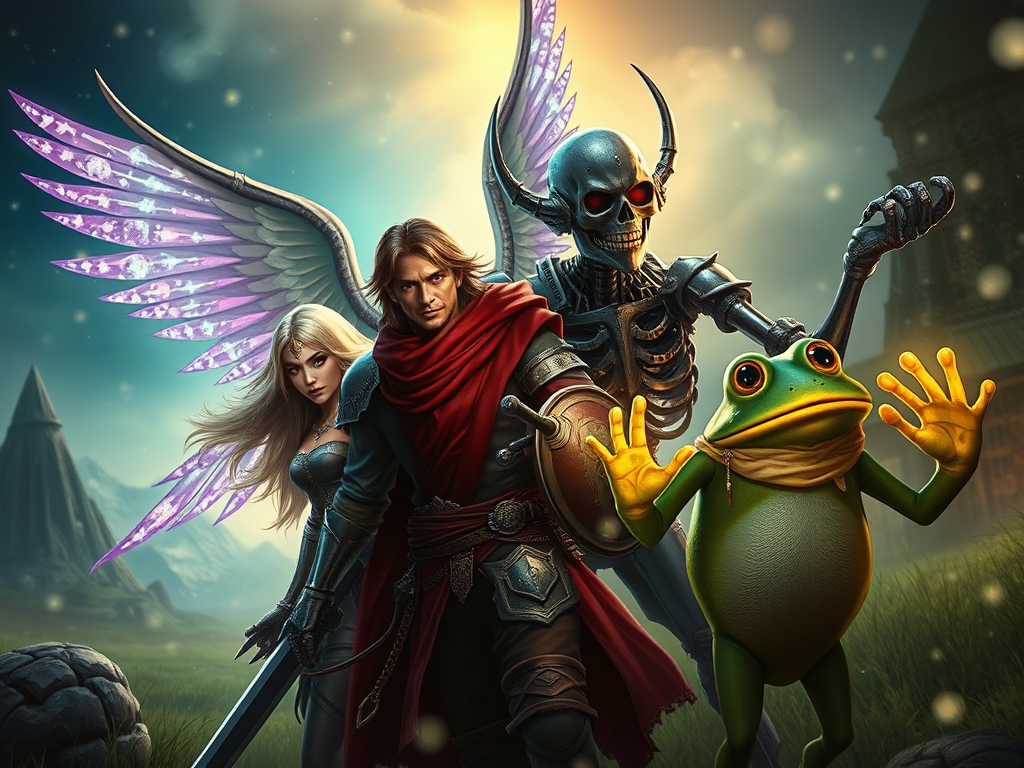
    First off, the cover. It’s very shiny. It portrays a whole bunch of fabulous-looking characters – there’s a knight chick with wings, a dude who seems to be all mouth and no face, a mechanical Necron-looking skeleton with a staff, and what seems to be a humanoid frog with a glowing hand. Huh. Okay, if I can play a magic frog, I’m totally gonna, just for the record.

    We’re on to the introduction. Daggerheart is a game of fantasy adventure where you explore exotic locations and save the day. It “provides the tools to tell a story that is both heartfelt and epic.” All right, so we’re definitely aiming for the flash and sizzle more so than the grime and gore, then. Fair enough. It also “takes a fiction-first approach” and “focus on the story [it’s] telling rather than the complexity of the mechanics.” Oh dear, that gives me a sense of foreboding, but it might just be my emotional scars from spending my formative years with Storyteller games that tended to combine over-complicated mechanics with a snotty contempt for anyone who wanted to actually use them… We’ll see, maybe this one will be better with 30 years of extra wisdom to draw on.

    More emphasis on “epic battles and emotional narratives.” Okay, I’ll grant you that I like both those things. Well, to be exact, I like kicking ass and looking really pretty doing it, and so far the game seems like it supports that.

    There’s a long list of inspirations (or “touchstones,” as it calls them). The roleplaying games include a couple of Powered by the Apocalypse ones, along with Lady Blackbird and Shadowrun. Under literature, we have A Song of Ice and Fire, Sabriel, A Wizard of Earthsea, Lord of the Rings and The Wheel of Time. Okay, that does suggest fantasy worlds where magic is a little more mystical and semi-spiritual, rather than just being a matter of flinging energy around.

    The video games session includes Elder Scrolls, Dragon Age, and… Borderlands. Okay, the last one is an interesting choice. Let’s see if I can spot the connection as we go on.

    The core mechanic is that you roll 2d12+modifier against a Difficulty. There is a special wrinkle, however, in that one of your d12s is your Hope Die and the other one is your Fear Die, and things can happen depending on which one rolled higher, irrespectively of whether the roll succeeded or not. Interesting. You also roll damage dice when you hit someone, to see how much you ruined his day.

    There’s a note on the Golden Rule (that is, you can change any rule you don’t like), and Rulings Over Rules (which here means that rules only apply when it makes sense for them to apply). Sure, sure…

    There is a rundown of what’s in the book. The first three chapters are called, respectively, “Preparing for Adventure,” “Playing an Adventure” and “Running an Adventure.” Heh. I do like the symmetry of that. The fourth chapter is the antagonist section, though it also seems to include environments (which can, to be sure, be plenty adversarial in their own right). The fifth is about “campaign frames.” Not sure I understand what that’s supposed to be, I guess we’ll see when we get there.

    What do you need to play? Well, 2-5 players and a Game Master for a start, and also the usual pile of dice. It notes that you need a d100, which I sincerely hope is just a mistake and d100s will be simulated by two d10s as usual, because I dread to think what one of those would actually look like…

    You also need tokens, which are “small objects that represent the look and feel of your character.” Hmm? Like some sort of miniatures? No, apparently not, because it’s mentioned that you’re going to need to place tokens on cards or character sheets to use certain abilities. Starting characters need about seven tokens, more powerful ones may need as many as 15.

    Okay, hang on, here it explains that tokens can really just be any kind of small objects used to keep track of stuff – paper clips are fine, for instance. But you’re supposed to pick something that expresses your character’s unique aesthetic. Ooooookay, that’s a little too precious for my taste, but oh well.

    You also need game cards, which represent your character’s “ancestry, community, subclass, and domain.” So… it’s basically just a cheat note for keeping track of your special abilities and so on? Finally, you need character sheets, and the game recommends getting the class-specific ones from the game’s website. Hrmpf. In myyyyyyy day we got a single one-size-fits-all character sheet, and we had to photocopy it ourselves so it was always smudged, and by Jove, that was how we liked it!

    (okay, no, we hated it, but still…)

    Maps and miniatures can be used but aren’t mandatory. Too bad, these days, what with Roll20 and the likes, I actually have an easier time playing with maps than I have playing with all those other kinds of handouts.

    There are a set of principles for play, which seem to be strongly inspired by Powered by the Apocalypse. Well, I’m all for those. They are:

    • Be a fan of your character and their journey.
    • Spotlight your friends.
    • Address the characters and address the players.
    • Build the world together.
    • Play to find out what happens.
    • Hold on gently.

    I do like “spotlight your friends,” which means to find ways that the other players can show off and get their moment to shine. It’s something I try to do when I play, and I don’t think I’ve ever seen it put into words like this before, so that’s nice. I also like “hold on gently,” meaning to think in terms of what would be interesting and evocative if it happened, but not be so married to it that you try to brute-force it. Again, that’s more or less my own philosophy too.

    The full-page picture before chapter one appears to be a anthropomorphic tiger with a monocle, which I admit does bring a smile to my face. So, Chapter one: Preparing for Adventure! We start with a brief description of the setting, or at least the underlying metaphysics (I am going to go out on a limb and guess that this is one of those games that has an implied setting in the form of classes and races and stuff, but the actual geography and history are up to you).

    Apparently the world consists of the Mortal Realm, the Hallows Above, the Circles Below, and the Realms Beyond. The universe used to be ruled by the Forgotten Gods, but they were overthrown by the New Gods and cast into the Circles Below. The New Gods now rule from the Hallows Above, and they have made it so that it’s hard to cross between planes, mostly to keep the Forgotten Gods from coming back for a rematch. There are also the Faint Divinities, who are a sort of demigod servitors of the greater gods. Some hang out in the Mortal Realm, others were banished with their makers into the Circles Below to become demons.

    The New Gods can see what’s happening in the Mortal Realm from the Hallows Above, but to actually go there they need to sacrifice something of great importance. Hmm, that’s interesting – usually it’s mortals who sacrifice something to get a god’s attention. It does say that it goes two ways, though, so mortals or demons can theoretically enter the Hallows Above through some great personal sacrifice. Also, arcane magic used in great acts of evil can open a portal to the Circles Below.

    The Realms Beyond are a catch-all term for every other dimension that’s not one of the three main ones – examples are “the Elemental Lands,” “the Astral Realm,” and “the Valley of Death.”

    There is a section on magic, and here’s where it gets complicated – apparently magic takes the form of cards, and every time you level up, if you’re a magic-user of whatever sort, you get more cards. Does this mean that I’m going to have to read through the cards too? Honestly, you’d think with 400 pages in this thing it would cover it all, but I guess not. Oh well. Guess I’ll just have to consider when to go over them.

    Anyway, there is another section that explicitly allows you to “re-flavour” your spells and abilities, as long as it makes no mechanical difference. Well, that’s nice, I know there was at least once when I was playing a 4E Druid in Dark Sun, and I felt that it was kind of off that my spells included damage-dealing “cold winds.” “Tearing sandstorms” felt more setting-appropriate… Anyway, there is also a reference to armour having “Armor Slots you can spend to reduce damage,” which sounds interesting, so let’s see what that’s all about when we get there.

  • Naming moves

    Naming moves

    This week, I’ve been taking another crack at my Mage: the Ascension port. In particular, I’ve tried to get something done with the move names.

    See, I use the same basic moves for all my WoD ports, or near enough – I figure that what a person can accomplish without superpowers in the World of Darkness is pretty consistent. But since each game has a very different tone and focus, I try to make the names of the moves imply it. Asking a player to roll to show your teeth feels very different than telling them to roll to swear holy retribution, even when the mechanics are exactly the same.

    Here is the same list of moves for Werewolf:

    1. Melee attack (Strength): Rend and tear
    2. Feats of strength (Strength): Perform a mighty feat
    3. Ranged attack (Dexterity): Take aim
    4. Feats of speed (Dexterity): Seize an opportunity
    5. Overcome injuries (Stamina): Relentlessly push on
    6. Diplomacy (Charisma): Deal honourably
    7. Manipulation (Manipulation): Cunningly manipulate
    8. Intimidation (Manipulation): Show your teeth
    9. Seduction (Appearance): Rely on animal magnetism
    10. Style (Appearance): Prowl fearlessly
    11. Knowledge (Intelligence): Display your wisdom
    12. Technology/Craft (Intelligence): Use the tools of man
    13. Perception (Perception): Sniff the air
    14. Self-control (Wits): Stay in control
    15. Pathfinding (Wits): Follow a trail

    And for Mummy:

    1. Melee attack (Strength): Smite the wicked
    2. Feats of strength (Strength): Strain your mighty thews
    3. Ranged attack (Dexterity): Let fly your vengeance
    4. Feats of speed (Dexterity): Seize the moment
    5. Overcome injuries (Stamina): Relentlessly push on
    6. Diplomacy (Charisma): Preach the truth
    7. Manipulation (Manipulation): Engage in intrigue
    8. Intimidation (Manipulation): Swear holy retribution
    9. Seduction (Appearance): Beguile with your beauty
    10. Style (Appearance): Appear haughty and regal
    11. Knowledge (Intelligence): Display wisdom and learning
    12. Technology/Craft (Intelligence): Practice artifice and craft
    13. Perception (Perception): See beneath the surface
    14. Self-control (Wits): Master your soul
    15. Pathfinding (Wits): Make the journey

    You get the idea. Werewolf is about pre-medieval tribal warriors who live half their lives as animals. So their move names are meant to invoke a primal, savage feel. Mummy, meanwhile, is a little more civilised, but still ancient – it’s faintly Biblical, about proud warrior kings and wise prophets trying to walk the righteous path.

    And then we have Mage, which I keep trying and failing to come up with something similarly flavourful for. I think a large part of the problem is that it’s harder to come up with a distinct theme for mages. Each Tradition effectively inhabits a genre all of its own, and there’s just not much overlap between a serene Akashic warrior-philosopher and an angry Virtual Adept anarchistic hacker.

    This is my attempt for this week:

    1. Melee attack (Strength): Fight for your beliefs
    2. Feats of strength (Strength): Push your limits
    3. Ranged attack (Dexterity): Strike from afar
    4. Feats of speed (Dexterity): Act with swift purpose
    5. Overcome injuries (Stamina): Endure the cost
    6. Diplomacy (Charisma): Speak for those with ears to hear
    7. Manipulation (Manipulation): Shape the narrative
    8. Intimidation (Manipulation): Make them fear your power
    9. Seduction (Appearance): Weave a sensual enchantment
    10. Style (Appearance): Come and go as you will
    11. Knowledge (Intelligence): Recall esoteric truths
    12. Technology/Craft (Intelligence): Place things in their proper alignment
    13. Perception (Perception): Spot the subtle signs
    14. Self-control (Wits): Master your inner turmoil
    15. Pathfinding (Wits): Blaze a trail

    I dunno. It’s a little better than my last effort, I think. Still not sure about some of them, especially the technology one and the diplomacy one.

  • Fiddling with Talents

    Fiddling with Talents

    This week, I have been working on my Dark Heresy port. I’ve decided that I’m mostly satisfied with how the rules work, but they need to be easier to look up. Since the system is so based on slight upgrades to existing abilities, it leads to a lot of flipping back and forth through files to figure out what a character is even capable of. That won’t do.

    The approach I decided on is to make each player’s character sheet less of a copy-paste from the rules and more something you build up according to the rules. That way, you can ignore all the rules that don’t affect that particular player, and concentrate on what applies to them, personally.

    So I’ve been writing the basic moves up like this:

    When you show healthy paranoia, roll +Perception. 10-14, you achieve a Minor Success. 15-19, you achieve a Basic Success. 20+, you achieve a Major Success.
    • Minor Success: if you are in some sense in danger at the moment, you sense an eerie feeling of menace, but no details of the nature of the threat.
    • Basic Success: the same, but if you are in fact in danger, the GM also gives you a hint as to how and why.
    • Major Success: you learn precisely what the danger is.
    • Absolute Success: you not only learn what danger is threatening you, but also the most promising way of avoiding it.
    Examples: Stopping to smell the air, glancing behind you, thinking back on what danger signs you might have missed.

    Then a player will start out with a move that looks like this:

    When you show healthy paranoia, roll +Perception. 10-14, if you are in some sense in danger at the moment, you sense an eerie feeling of menace, but no details of the nature of the threat. 15-19, the same, but if you are in fact in danger, the GM also gives you a hint as to how and why. 20+, you learn precisely what the danger is.

    Examples: Stopping to smell the air, glancing behind you, thinking back on what danger signs you might have missed.

    Then, if that player takes the Awareness (Known) Talent (which bumps up the results of a successful move to show healthy paranoia), the move gets altered to this:

    When you show healthy paranoia, roll +Perception. 10-14, if you are in some sense in danger at the moment, you sense an eerie feeling of menace, and the GM also gives you a hint as to how and why. 15+, the same, but you learn precisely what the danger is.

    Examples: Stopping to smell the air, glancing behind you, thinking back on what danger signs you might have missed.

    And if the player further takes the Awareness (Trained) Talent, which adds an additional result on a roll of 20+, the move again gets rewritten to this:

    When you show healthy paranoia, roll +Perception. 10-14, if you are in some sense in danger at the moment, you sense an eerie feeling of menace, and the GM also gives you a hint as to how and why. 15-19, the same, but you learn precisely what the danger is. 20+, you not only learn what danger is threatening you, but also the most promising way of avoiding it.

    Examples: Stopping to smell the air, glancing behind you, thinking back on what danger signs you might have missed.

    You see what I mean. At every turn, the player’s sheet only contains the information that will apply to that player themself. This would absolutely not work if we were still using pen and paper like some sort of savages, but of course these are modern times and everything is stored in easily edited .txt files.

    I do worry that this will make it more troublesome for the players to choose new Talents, since now the information on what a move actually does and the information on how it is altered by a Talent will exist in two different places. But I’ll see what happens when I have a chance to run a session with the new PDF.

  • Honour to the Administratum

    Honour to the Administratum

    This week, my players ended up exploring the byzantine bureaucracy of the Imperium of Man. Maybe it’s fitting, then, that most of my thinking this week has been about bookkeeping.

    Character bookkeeping, I mean. It’s not an especially sexy topic, but it’s something that really makes a difference for how easy it is to run a roleplaying session. You want to be able to tell, at a glance, just what rules apply to a character – what their abilities are, what modifiers are affecting them, what they can and can’t do. Because having to stop all the time and flip through the rulebook is freaking annoying.

    One of the charms of Powered by the Apocalypse style games is that they seek to make bookkeeping easy. Rules are kept as modular as possible, so that you usually just deal with one paragraph of text at the time, not three or four different ones that are spread throughout the book. When that isn’t possible, information is often repeated so that it appears everywhere it needs to be, even if that means adding to the page count. It’s part of what makes these games so smooth to run.

    As I’ve mentioned before, when porting Dark Heresy I eventually had to admit that I couldn’t make it quite that nice. I’ve tried my hardest to not make rules depend on other rules that depend on still other rules, but it’s still a big, sprawling, messy game set in a big, sprawling, messy world.

    For example, one thing that I struggled with in today’s session was constantly having to adjust the options available for fighting for the particular weapon the players were using. You see, my rules for ranged combat go like this:

    When you unleash the fire and fury, roll +Ballistic Skill. 10-14, choose 1 option below. You may spend Righteous Fury to choose additional options, 1 for each Righteous Fury spent. Each option can only be chosen once. 15-19, choose 2 options. 20+, choose 2 option, and hold Righteous Fury.

    • You manage to disengage from melee and get onto at least a range of reach to the nearest enemy.
    • You hit a single enemy within range of your weapon and inflict weapon damage on them.
    • You inflict 1 damage on an enemy Horde within range of your weapon.
    • A single enemy who has you within range of their weapon does not hit you and inflict weapon damage on you.
    • An enemy Horde who has you within range of their weapons does not hit you and inflict weapon damage on you.
    • You are not forced to retreat or to take or stay in cover.
    • You cause a single enemy within range of your weapon to find or stay in cover.
    • You establish overwatch; the first single enemy within range of your weapon to leave cover (including to fire a shot of their own) takes 1d10 damage, reduced by Armour.
    • You do not need to reduce your Ammo by 1. This can not be chosen for an Ammo-S weapon.

    Examples: Firing a lasgun, throwing a knife, sniping from ambush.

    But when you’re wielding a weapon with the Blast tag (such as the frag grenades my players were flinging around), the following extra rules apply:

    When you unleash the fire and fury with a weapon with the blast tag, you may also choose the following options:

    • You inflict 1d10 damage on an enemy Horde within range of your weapon.
    • You hit every character in a group standing closely together (such as enemies engaged in melee, allies covering each other’s sides, etc) within range of your weapon and inflict weapon damage on them.

    However, when you unleash the fire and fury with a weapon with the blast tag, you may not choose the following options:

    • You hit a single enemy within range of your weapon and inflict weapon damage on them.
    • You cause a single enemy within range of your weapon to find or stay in cover.
    • You establish overwatch; the first single enemy within range of your weapon to leave cover (including to fire a shot of their own) takes 1d10 damage, reduced by Armour.

    So while I can normally just copy-paste in the list of a player’s options as they succeed at something, neat as you please… here I have to edit the whole thing on the fly every time (okay, so after the first time I guess I should have saved the edited list, but I didn’t think of that at the time). And there seems to be no easy solution to it, beyond writing up the full list of options for every single weapon in the book… and that seems a little much even for PbtA.

    And then there are all the things that players can do, which are adjusted when they take certain Advances, and the things they implicitly can’t do because there are other Advances that allow you to do those things… It’s a lot.

    I think maybe I should restructure the port into a more traditional format. Man, Warhammer 40,000 fights back hard against being PbtA-ified! Possibly it thinks that it’s heretical or something…

  • A matter of time

    A matter of time

    I’ve gotten a bit more work in on my Monstrous Mishaps quickstart. I’ve been thinking, too, that perhaps I’ve been looking at it wrong. Instead of feeling like I’m just writing the same game again but with less stuff in it, I should take it as an opportunity to identify the parts that are important and the parts that aren’t? God knows, I threw in everything but the kitchen sink when I wrote this thing. It might not be the worst thing in the world to consider whether I actually need all of it.

    For example, the Interval rules. Now, in theory I think those are pretty solid. They are essentially a way to manage time-keeping in game, and let different things take different amounts of time without too much nitty-gritty counting of seconds and minutes. And taking significant extra time with a task – as in, spending hours instead of minutes of it, for instance – gives you a big boost to your action, because it should.

    But when I think back to my playtesting… I’m not sure I’ve actually used the system terribly much? Maybe it’s the players I have, but no one ever did say, “okay, I just spend as long on this as it takes.” They usually wanted to be done in a reasonable time or not at all. Likewise, I like the idea of putting events on a timer and counting down to when things happened, but the game actually ran better those times I didn’t do that but let things happen more or less as I felt like.

    Maybe I should be on the lookout for things that should quite frankly be simpler. I’m not going to edit the whole game all over again, because I don’t think I’d ever finish if I did, but still… it might be handy to have a simpler version available. And if nothing else, there’s always the second edition.

  • The Challenge System

    The Challenge System

    I didn’t really do much this week, so let’s talk about something I’ve had almost finished for years now: the resolution system for my great work-in-progress, Monstrous Mishaps. I call it the Challenge System, for lack of a better name.

    The thing that stands out with the Challenge System is that it’s entirely free from randomisers – not just “diceless” (a term people keep applying to games that rely on alternate randomisers, like card draws or coin flips, to my constant annoyance) but completely deterministic, with no randomness except the GM’s whimsy and the players’ refusal to stick to the plot. Because let’s be honest, those two are more than enough!

    The Challenge System gives each character a set of Abilities, twelve Primary Abilities that are bought and raised individually, and twelve Derived Abilities that are each calculated as the average between two Primary Abilities. For example, your Score in Bullshitting (telling lies) is the average between your Score in Schmoozing (charm and charisma) and your Score in Mindgames (psychology).

    Each Ability has a Score that usually goes from 1 to 15. The Score translates into a Level, as such:

    Score 1: Minimal Level, the sort of thing anyone can do just by being a healthy adult.

    Score 2-3: Limited Level, the equivalent of a natural talent or passing interest.

    Score 4-7: Basic Level, the equivalent of professional skill; the I-do-this-for-a-living sort of competence.

    Score 8-15: Advanced Level, the peak of consistent human performance.

    There are three more Levels: Heroic (Score 16-31, anything Batman could do), Epic (Score 32-63, anything Superman could do), and Godlike (Score 64+, anything no one could possibly do), but Player Characters can’t have those in their Abilities. So why do I bring them up? Stay tuned, I’ll get to it.

    When the players try to do something, the GM assigns it a Challenge Score (and associated Challenge Level) equal to the Ability Score it would reasonably take to accomplish it. So anything a seasoned professional might do within an Ability would be a Basic Challenge for that Ability. Advantages come in categories of +1, +3, +5, +10 and so on. They matter the most in Contests (where one character matches one of their Abilities against one of another character’s) since for regular Challenges you can just set the Challenge Score to anything you want to start with.

    Finally, you can apply Upshifts and Downshifts. Those can come from any source that dramatically change the parameters of the Challenge, such as drastically extending or shortening the time the character has to work in, but the most common source of Upshifts is from paying Grit Points (of which a character has a fixed amounts). Paying 1 Grit Points gives one Upshift, while paying 3 Grit Points gives two Upshifts. An Upshift multiplies the Ability Score (after adding Advantages) by 2, and thus also increasing the Ability Level by one step. Downshifts do the same to Challenge Scores.

    If, after all this, the Ability Score is equal to or higher than the Challenge Score, the character succeeded. Otherwise they failed.

    I’ve playtested the system extensively, and it’s actually really smooth once you get used to it. When it comes right down to it, it’s just about deciding whether it would make sense for a character to succeed at something. And it’s nice, sometimes, to always get a result that fits the scene, instead of having come up with ways to justify the swinginess that comes from die rolls.

  • Gear Porn

    Gear Porn

    I ended up spending this week working on the Dark Heresy port, particularly on the gear section.

    I have to admit, I’m not really a fan of gear in roleplaying games. It just feels anal-retentive to have to list every fiddly little implement your character carries around, and to have creative ideas that you can’t implement because you just didn’t bring the right tool. I’m more about the skills and inherent properties, the things that are always true about your character. But of course this is Warhammer 40,000, and running Warhammer 40,000 without drooling over the badass toys is just making a complete mockery of the whole thing.

    I did try to streamline it a bit, though. I assigned every weapon, armour and doodad a Req value between 1 and 10, and then assigned every Career a starting amount of Req. In between every mission, your Req refills and you can spend it on requisitioning new equipment. And the effects of different items have been simplified to the point where it’s hopefully easier to remember – a lot of things just give a +1 bonus to some particular move.

    I note, not for the first time, that it’s very unclear who this port is even for. I mean, I’m pretty sure that anyone who likes Powered by the Apocalypse games is going to think it misses the point entirely by having so many over-specific rules, and anyone who likes Dark Heresy the way it is is of course not going to see the point of my converting it to an entirely different format. I guess in the end, it’s just for me, to make it possible to at some point run games in the Warhammer 40,000 universe that don’t feel quite so painful.

    Of course, disliking pain might also be missing the whole point of Warhammer 40,000…