I’ve been too listless to finish another character this week, so let’s take another nostalgic dive into the past instead. This time, let’s look at another grand old game, Mike Pondsmith’s Cyberpunk from back in 1988. For one that was never in the big leagues, it’s actually doing pretty well for itself even today – there’s been a big-budget video game that seems to be pretty well-liked (once they fixed all the bugs, at least) and an anime Netflix show. It ain’t Shadowrun, but that’s the price you pay for taking yourself halfway seriously when your target audience are all about making a complete mockery of everything.
Here’s how old this game is: it came in a box.
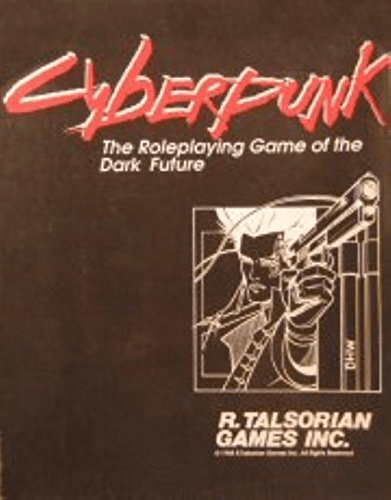
In the box are three slender little volumes: one for rules, one for settings, and one for combat rules, though all three are honestly spread sort of haphazardly through all three books.
RULES: VIEW FROM THE EDGE
The rules book, View From the Edge, starts out with a cursory description of the setting (see whatI mean) and what it means to be a cyberpunk. Basically, it’s the distant future of 2013 and technology has taken such a huge leap that most people can’t keep up – cybernetics, human/machine interfaces, artificial tissues and orbital stations are commonplace, and that has made most people so overwhelmed that they just sit back and let governments and corporations (insofar as there is a difference anymore) have their way with them. But not you, for you are a cyberpunk! You embrace the metal! You charge full thrust into the future! And you’re probably going to die horribly in a futile bid to make your mark on an uncaring world, but by golly you’ll look awesome doing it!
So that’s basically the mission statement here. Look cool, stand up and be counted, and never ever play it safe. Heh. That might just be the exact opposite to my personal way of life, but okay, I can dig it in theory.
We’re also given the nine basic character classes right away: rockers, solos (who are assassins or mercenaries), netrunners (hackers), techies, medias (journalists), cops, corporates, fixers (wheelers and dealers) and nomads (your rootless bikers roaming the land). The presentation of them all felt a little confusing to me the first time I read it, since they all seem framed to be idealistic crusaders of one sort or another, while the game seems to be more about an amoral quest for getting more money. But, knowing a little more of the genre now, I think I get it – you’re supposed to have some ideals that you want to chase, but you also have to keep yourself fed, and you’re meant to be angsty and tormented about the conflict between the two. I think in a modern game that would have been better explained, but this was ’88 and the unspoken assumption was still that you were going to get most of your narrative direction from fiction.
Having chosen your class, you then roll for how many character points you get and distribute them over your nine main stats: Intelligence, Reflexes, Cool, Technical Ability, Luck, Attractiveness, Movement Allowance, Body Type and Empathy. You also get skills, but those are gained through a quirky lifepath system where you choose and roll for various parts of your upbringing and background, and get to pick up some skills depending on what you end up with – for instance, if you grew up on the street, served a stint in the military, got a formal education, and so on. You also roll for a special incident for every year of your adult life, which can result in you gaining enemies, connections, extra money, heartbreaks, and such things.
I like it in theory – you can see how it’s meant to set up a checkered past with lost loves, friends in unexpected places, simmering resentments, and all the sort of things that a cyberpunk character definitely ought to have. I do feel it’s a little barebones, though. It kind of assumes you’re really familiar with the setting, so that you can come up with characters and situations in it on the fly. Great if you’re very into the genre or if you’ve played the game before, but a bit harder if you’re me and you’ve read maybe one or two William Gibson books and watched Johnny Mnemonic and that’s about it.
Then, of course, there’s the main event: cybernetics! You’ve got a bunch of gear you can bolt onto your feeble human form. Cybernetic eyes for seeing into the infrafred spectrum, reflexes boosters that pump up your all-important REF stat, chipware that lets you gain the basics of a skill you don’t naturally have, interface plugs that lets you become one with your gun or your car… You’re limited partly by your starting funds (which you can double by selling your soul to a crime syndicate, corporation, or the army!), partly by the fact that each piece of cyberware adds to a tally that permanently reduces your EMP stat, with EMP 0 resulting in “cyberpsychosis” and needing to make a new character. Which does, funnily enough, make EMP something you need lots of if you want to play a stone-cold cyborg – not because you’ll be using it, but because the amount of cyberware you can handle is capped by how high it started out.
I do feel a little like cyberware is underpowered, both compared to how powerful it tends to be in fiction, and how much the game is meant to center on it. Is it really worth crippling your stats for a +2 to some very specific rolls? But then, I guess I’m probably just not being cyberpunk enough. Form over function, attitude is everything, live on the edge – you’re supposed to rip out parts of your living brain just so that you can take phone calls in your head, because that’s how you show that you’re a complete badass who don’t give a shit, man!
Next up are rules for running around the Net. You basically have a program that interprets the stuff you run into when hacking a database or whatever, so that you see it as a fantasy dungeon, a Noir city, or a glowy Tron-style virtual universe. You go in carrying a selection of programs that you can throw out like spells to do things like smash through a door or defeat defensive software. You’re limited to five programs, but you can cheat by loading a bunch of them into a “demon” which counts as a single program but gradually deteriorates every time you use it. Pretty cool and flavourful, though I don’t know if it’d work well as a mini-game – a lot of the rules feel like you just roll repeatedly to pass an obstacle until you succeed. But I guess you could probably spice it up with enemy netrunners and the likes.
Also, the text notes breathlessly that a haul from a netrunning operation might consist of… an entire Megabyte of data!!!! Which, considering that my folder of roleplaying PDFs has reached 85 Gigabytes from my obsessive hoarding is… a little bit funny, I feel.
Last part of the rules are about medicine. Most notably, a sensible professional will sign up for a Trauma Team subscription! That means that whenever you flatline, a flying ambulance shows up and scoops you up to try to revive you, if necessary gunning down whomever caused you to flatline in the first place. That’s… kind of awesome. There are also some notes on street drugs, but it’s kind of anemic given how much drug use is part of the genre – I think they were worried about moral guardians if they seemed to promote it.
SETTING: WELCOME TO NIGHT CITY
The world book, Welcome to Night City, starts out with a timeline, which is… honestly so forgettable that I have trouble even grasping enough of it to describe here. But basically, there have been a couple of South American wars with cybernetically enhanced super-soldiers, Europe is back on top of the world and America is in the crapper (mua ha! Mua ha! I smirk over my over-priced cappuccino!), the Middle East is a radioactive wasteland and most cars run on alcoholic fuels created from genetically engineered super-crops, there are lunar colonies and space stations, and corporations have their own militaries who sometimes go to war against each other.
Funnily enough, every part of the world that isn’t the US seems to be doing pretty well – as near as I can tell, the writers felt like it made the future more depressing if all us other riffraff were thriving while the Land of the Free collapsed… The Soviet Union has made a comeback, Europe is going strong, Africa and South America are getting their act together, Japan and China are coming into their own. Of course, those places are presumably also run by ruthless megacorporations, so it ain’t that rosy, but still.
In America, though, cities are divided into the corporate-controlled business areas and suburbs, which have a private police force and things are relatively quiet, and the Combat Zones, where poor people live, violent crime is omnipresent, and everything is generally kind of crap. Outside the cities are mostly a lot of ghost towns and corporate-run farmland, and nomadic caravans are traveling around trying to scratch out a living by means fair and foul.
Laws have gotten a lot more rough-and-tumble. The cops can and will gun you down. On the other hand, you can gun down anyone who tries to mess with you. Lots of gunning down going on. Old-fashioned drugs are illegal, but genetically engineered crop failures have mostly destroyed the production of them anyway, and the sort of designer drugs that corporations sell are, conveniently, not considered “drugs” drugs and therefore legal. Prisons are overcrowded and prisoners are mostly crammed into cryo-tanks for the duration of their sentence, meaning that they spend all that time semi-conscious and having nightmares. Okay, that’s genuinely sort of horrifying.
Vehicles are stil mostly regular cars, but short-distance flying cars exist, mostly as emergency vehicles. Trains run on “maglev” tracks, hovering on a cushion of magnetic force to remove friction.
Communications is where the game shows its age. The fax machine is still state of the art, and people read newspapers by having the pages they are interested in faxed to their home or to a public outlet (futuristic!). Cell phones exist but are of course giant bricks with antennas at the end.
Game Master advice! Cyberpunk is meant to have a ton of grim ambience, so make sure that it features a lot of garbage-strew back streets, bodies in the gutter, deranged down-and-outs, and brutal firefights. Also, it’s always raining. Always. Or at the bare minimum, it should look like it’s about to.
Of course, the rich don’t live like that – they dwell in disgusting opulence, with armed guards standing ready to throw out anyone who they don’t want to look at anymore. Play up the contrast.
Furthermore, morality should be shady. Sworn enemies might get thrown together. Getting anywhere requires cutting some corners and compromising your values. This is the part that I think could have used a little more squaring with the assumption in the rules book that players will be heroic crusaders against the evil corporate tyrants, but okay, I think I get it. There are bad guys, but in order to have a chance to get at them, you’re going to have to give up a lot of that moral high ground. Everyone gets a little muddy just from wading through the muck.
The book acknowledges the problem with the classes, which is that they don’t really fit naturally together – a cop on the edge, a nomadic biker, a corporate sell-out and a rebellious rock star aren’t just going to naturally form an adventuring party. It suggests a few combinations that might work, but basically, you need to center the team on one kind of scene, then play fast-and-loose with the classes that don’t really fit into it so they do. E.g., if the team is a police squad, then the “fixer” might be the shadier sort of cop who’s in bed with half the criminals he’s supposed to be stopping. Since your class doesn’t actually influence which skills you can take (all it really gets you is one particular special skill), that works out fairly well.
There’s a map of Night City, which is the default setting for the game. A lot of landmarks are written out, but the only ones who get any sort of description are the seedy bars. That possibly tells you something about where the focus of the game is meant to be…
There is a short story to demonstrate the setting, called Never Fade Away, which concerns a Rocker (Johnny Silverhand, who is effectively the face of the franchise) whose Netrunner girlfriend gets kidnapped by a corporation so she can build a brain-frying Net program for them. So he recruits a crusading Media, his Solo ex-girlfriend and her Nomad partner to launch a rescue, but in the end all they manage to accomplish is sabotage the Netrunner’s own plan to free herself so that she ends up with her brain uploaded in the Net and no way to return to her body. It offers some helpful stats for the various characters, with the implication that you can run this as a sample adventure. I guess it’s flavourful enough. Oh, and they apparently really liked the picture of a cyborg girl in lingerie, because they reused the same one to mark the start of the next chapter.
There’s a chapter on how corporations work, most of which is pretty unexciting stuff about corporate structure and what the different positions mean. That’s… probably something you need to know if you’re running a game in a world where corporate executes are effectively royalty, yes, but it’s not really sexy. Anyway, the corporations can do pretty much whatever they want now, the governments have given up on controlling them. Also, they have private armies, and ninjas. Because it’s 1988, and conventional wisdom is that Everything Needs More Ninjas.
There’s a looooong list of major corporations and their exact military assets. Again, good to know, definitely would be using this as setting detail, but none of it really stands out.
The book closes with a random sprinkling of flavour – information on a couple of different bands (all of which are POLITICAL!!!, because again, it’s 1988 and being angry about stuff is considered edgy and rebellious. As opposed to today, when it’s just considered mandatory… Sigh. I make myself sad), a couple of different nomad caravans (the Crazy Quilts are disgruntled combat vets, who came back from the wars to find nothing waiting for them; the Huskers are farmers who have been driven off their land by corporations), a copule of different street gangs (the Blood Razors are mad, bad and crazy and big on cybernetic claws; the Iron Sights are patsies for the Arasaka Corporation). There is also a deranged cult who go around killing cyborgs. Finally, there are some kind of funny reports from a Trauma Team operative, which includes things like resuscitating a client, charging him for it, have him violently object to the price tag, needing to take him down in self-defense, resuscitating him from said take-down, and adding the extra cost to his bill. Heh!
COMBAT: FRIDAY NIGHT FIREFIGHT
The combat book is called Friday Night Firefight. The rules are apparently modified from a game called Mekton which seems to be about giant robots punching each other. Sounds kind of cool, but I hadn’t heard of it before – I guess it didn’t stand the test of time as well.
It starts out with telling us that this system is super-gritty and deadly! Try to be a hero, and you’ll get stuck with a Trauma Team bill. I feel like there is a bit of tension between a high-lethality system and the expected playstyle of never playing it safe because that’s not the cyberpunk way… I mean, I get that what they mean is that you should take insane risks even though you might die, because you’re a complete badass who don’t give a shit, man, but I think players would probably get less committed to that ethos after losing a character or three.
Anyway, combat is played in rounds, every round has four phases, and you get to act in between one or four of them depending on how high your REF is (four actions require you to have near-maximum REF and also to have a cybernetic reflex booster). When you shoot at someone, you roll REF+weapon skill and the target rolls REF+Athletics, and if you roll higher you hit and roll damage. The shooter gets a bonus for the accuracy of the gun and for spending extra actions aiming, the target gets a bonus for range (which ranges are relevant depends on the gun as well), and for things like being in cover or in motion. Hit and you roll damage depending on the range and caliber of bullets, adding the amount by which you exceeded the defender’s roll. From that, you subtract armour, and then you compare what’s left to a table that depends on your Body Type, and it determines whether you scored a Flesh Wound (which effectively does nothing), a Serious Wound (which might cramp your style), a Critical Wound (which is going to hurt), a Mortal Wound (puts you down and you’re dying) or an Instantly Mortal Wound (puts you down and you’re dead, dead, dead). Each type worse than Flesh Wound gradually worsens to the next level if left unattended for a certain amount of time, so you’ll want to get some first aid. Also, if you take a wound worse than a Flesh Wound when you already have a wound worse than a Flesh Wound, the wounds add up to one that’s worse than both.
Okay, that’s… going to take a lot of flipping back and forth. Also, is this actually as lethal as all that? I feel like if you’re wearing body armour, you’re going to be wading through handgun fire without a care in the world and it’ll take a high-caliber rifle to put you down. Not sure if that is realistic or not, but it does mean that in certain situations the system becomes irrelevant – it will just consistently spit out the same result. Also, certain characters are going to be impossible to hit for certain other characters, even at point blank range, since the sum of your dodge bonus can easily rise so high that a poor marksman can’t hit even with the best possible result.
Automatic weapons have their own rules variation, and they are terrifying. Like, hefty penalty to dodge, one hit per point that the attack roll exceeds the dodge roll terrifying. Once those come into play, things have indeed taken a turn for the gory… though again, a high-level Solo can probably dance right through a machine gun burst from a raw recruit.
Healing, finally, takes time. The advanced medical technology of the futuristic year of 2013, which has fancy tricks like cloned transplant organs and spray-on skin, does speed things up a little, though you’re still looking at weeks of convalescence.
SO, WHAT DO I THINK?
Well… I must admit myself a bit charmed. It’s all very rough, very much a game in the early tradition of “scribble down our personal notes all willy-nilly, then package it as a game.” But it’s got a raw appeal to it, precisely because it feels like something that’s meant to work rather than look pretty (even if I suspect that there are some things that don’t work especially well). As near as I can tell from my admittedly shallow knowledge of cyberpunk, it does present the genre fairly effectively, with its ever-shaky balance between raging against the machine and wanting to join with it, between wanting to be superhuman and fearing to become inhuman.
I don’t know. I do plan to keep reading, though. I’ve just had to take a break before the first published supplement, because it was a conversion to Walter Jon Williams’ Hardwired setting. So now I have to read that 520-page novel so I can properly understand that 98-page roleplaying supplement. Yes, sometimes I do think I’m a bit weird.
 Mister Monster's Workshop