This week, I’ve somehow ended up messing around with some nostalgia. I did say I was going to occupy myself with something that wasn’t actively painful, though this wasn’t quite what I had in mind…
So, let’s go back to even before the sanctimonious edginess of the late 90s. It’s 1982. For the past eight years, Dungeons & Dragons has been doing the Lord’s work in socialising mildly autistic teenage boys. Not only does it dominate the field, but it very nearly is the field; a thousand flowers have yet to bloom. The World of Darkness is not even a twinkle in Mark Rein-Hagen’s eye. Kevin Siembieda has yet to decide that the problem with D&D is that it’s too restrained and thematically coherent and create Rifts to fix it. MIke Pondsmith won’t be replacing wizards and dragons for hackers and evil corporations in Cyberpunk for quite a few years yet, and of course that means that it’ll be even longer before someone decides, “hey, what if we had wizards and dragons and hackers and evil corporations?” and Shadowrun is born.
Still, there are always people who look at the trailblazer and go, “hmm, pretty cool, but I think I could do it better.” RuneQuest appeared a few years ago, and it’s already spawned regular runners-up Stormbringer and Call of Cthulhu. And in Sweden, a bunch of cheerful amateurs whose experience is entirely with making board games realise that there are tons of mildly autistic Swedish boys who’d probably go gaga for roleplaying games if they weren’t written in a foreign language. So they license the RuneQuest rule system, and they release… this.
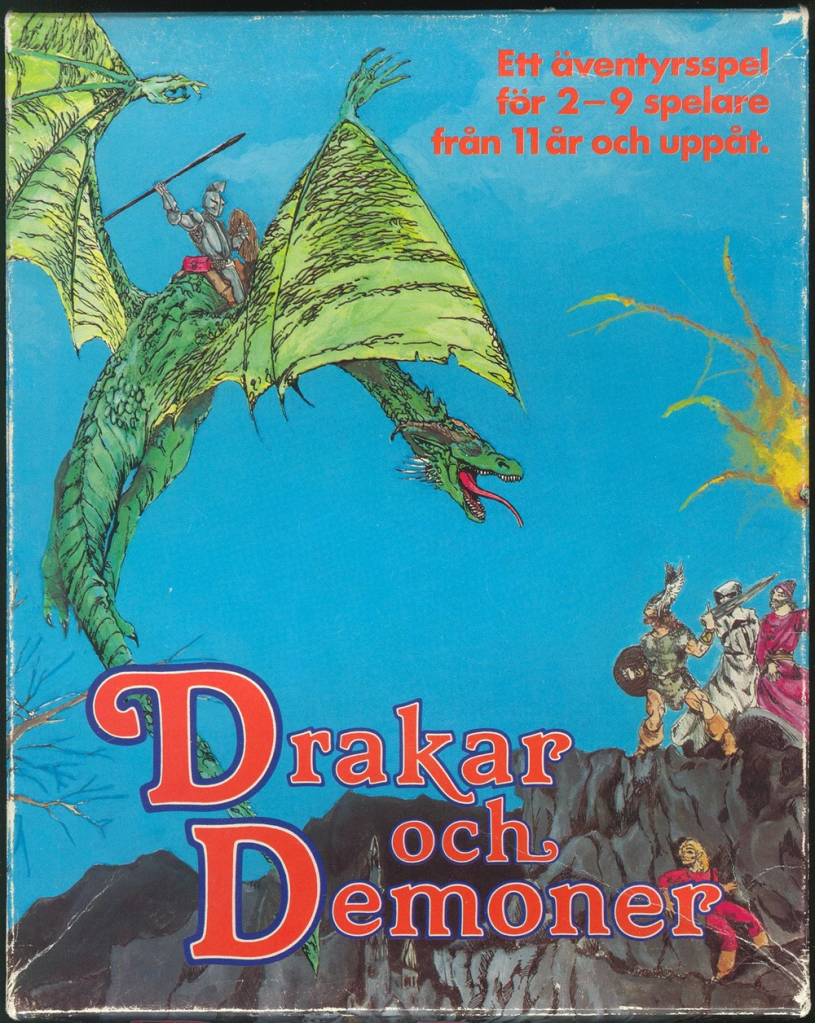
Drakar & Demoner (“Dragons & Demons”; these days known as Dragonbane in its English translation, presumably to make it less confusing) has arrived. Swedish dorkdom will never be the same.
The rulebook is a slender little 54-page booklet, including the sample adventure Among Goblins and Trolls. Precisely how much of it is original is something I’m still not clear on, but apparently a big chunk of it is just a (decidedly shaky) translation of RuneQuest’s more generic version, Basic Roleplaying. Well, keeping in mind that I’m not sure who to credit, I’ll just tell you my impressions.
The start is quite charming, being a short description of how an unassuming farmhand makes a journey to a nearby village, hears some interesting rumours of haunted ruins and the like, and faces a few limited difficulties, with the narration frequently discussing the different ways they might deal with them. It’s nice and flavourful, giving a sense of low-key, whimsical setting that evokes the peaceful Swedish countryside. It’s also kind of completely different from anything you’ll encounter in the game, giving the impression that the whole thing is more of a pastoral slice-of-life affair than a gritty dungeon-crawler. Oh well.
The rules are… quite decent, as far as they go, but they’re presented in a jumble that takes some time to figure out. The system is d100 roll-under, and you get a base chance in most everyday skill (climbing, sneaking, listening, etc) in about the 40% to 60% range. Anything racier than that, like weapons, tend to start at 20% or less, with clubs having the highest base chances, axes somewhat lower, and swords pretty much hopeless to hit with without training. You also roll 3d6 for seven different core stats, which decide your hit points, your carrying capacity, your spell points, and your percentage chance at a bunch of non-skill abilities like dodging and persuasion.
You may attempt to roll to start the game as a Warrior, a Magician or a Scholar, with the first being relatively easy (the percentage chance is the sum of all your stats) and the latter two being a bit trickier. If you can’t make the roll for any of them, or you choose not to make it, you can start as an Outlaw instead.
Warriors start with a horse, armour, and a couple of different weapons, and they get skill with those weapons as well as riding and jumping (for… some reason?). Outlaws start with a shortsword and dagger and skill in those and in a whole bunch of non-combat-related skills, including pickpocketing and lockpicking. They both also get a comfortable amount of starting cash, having looted or stolen it, respectively.
Scholars start with a decent chance at knowing stuff in one particular academic area, a poor chance of knowing something in any other academic area, and one close combat weapon. I would strongly advise against playing one of these, having the power of Knowing Stuff is fun in theory, but in practice, you’re just not going to get much mileage out of being well-versed in Astronomy when dungeon-crawling. At most, I could see a scholar working as a poor man’s healer, since they get first aid skills, but only in a party that didn’t have a magician with a healing spell.
Magicians start with a weapon of their choice and four spells at somewhat unimpressive success chances. The spells can be pretty cool, though, if not earth-shaking – turning invisible, seeing into the past, and lifting small objects with your mind are all possibilities with a lot of utility, and of course you can take the healing spell, which is a game changer in this game given how slow hit point recovery is and how scarce healing potions are (they can be store-bought, a fact that is hidden at the end of a paragraph somewhere in the gear section, but they cost a freaking fortune, so unless the GM is kind enough to leave plenty for you to find, you won’t be able to rely on them).
The book mentions that magic is divided into “ceremonial magic” and “sorcery,” with the latter being the sort of quick-casting spells that adventurers have access to, and the former being the explanation for magical items, potions, demons, undead hordes, and other stuff that adventurers will run into a lot. It takes ages to use and requires extensive training – ceremonial magicians might have been adventurers at one point, but they’ve since retired to pursue their studies. Okay, that’s a nice touch that I wish had made it into later editions, it answer the question of, “but why can’t I do all that stuff that the NPCs can apparently do?” pretty satisfactorily.
Notably, you don’t necessarily have to be a magician to learn spells, it’s just a lot easier that way. Again, something that I feel is quite charming and that unfortunately didn’t last – as the editions went on, the gatekeeping around magic just got more and more determined, I am sorry to say.
Spells can be cast in levels of effect, but everything over the first level imposes a cumulative -10% penalty to your chance to get it off. Which, given that you start out at 45% if you’re lucky and will pretty much never get as high as 100%, would seem to ensure that you’ll always be casting at near level one, but that doesn’t stop the text from slapping on a lot of restrictions to how high a degree you can use as if that is ever going to be a problem. Yeah, I don’t know, really. Oh, and you have to spend as many spell points as the levels of the spell, even if you fail the casting, so you’ll get winded pretty fast if you try to spam a low-probability casting.
Magic items exist. If you have one, and you know how to trigger it (there is a spell that lets you discern how to trigger a particular object, and you can hire an NPC magician to cast it for you if you can’t pull it off yourself), you get a chance to cast the spell at 5 x your Power stat, at whatever level the item is set for. There are also demonic items which have minds of their own and can cast one or more spells for you if you manage to bend them to your will, but if you botch with it the demon breaks loose. Oooooh, pretty cool. I’m guessing that’s probably taken from Stormbringer,
Combat! Everyone go in strict order of their Skill stat (renamed “Dexterity” in later editions). You can attack or parry once per round, and you have to decide whether to parry before an opponent’s attack is resolved, so if you’re fighting someone with higher Skill than you and not carrying a shield, you’re at a definite disadvantage – you can’t just wait for him to miss so you can take a swing of your own, you have to bet on him missing or accept some damage every time. All of which of course means that heavy armour is king – if you’re a knight in full plate, you scoff at most regular weapons and can swing your claymore around without even bothering to parry. The second best thing is to have a shield, because then you can parry with that and attack with your weapon in the same round.
Parrying an attack from a slashing (like an axe) or bashing (like a club) weapon damages the parrying weapon, and so does failing an attack against an opponent who succeeds at a parry with a slashing or bashing weapon – as in, these things have a shockingly low survival rate and you shouldn’t get too used to them. Parrying with a shield doesn’t damage it, but instead of flat out deflecting the attack, it “only” subtracts a lot of damage from it.
Impaling weapons (like spears) have a low chance (like, one to five percent) of doing a ton of extra damage, though if they do they become stuck in the enemy and have to be yanked out. Heh, that’s kind of cool, and offers at least some limited hope of poking through a knight’s armour when all you have is a dagger or something. I kind of feel like there should be some mention of the effects of fighting with a spear sticking out of you, mind…
Hit points are limited, and will rarely if ever get higher no matter how experienced you get – a couple of hits with a regular sword will kill you. Recovery is slow, you’ll be laid up for months. Wear armour! More is better! None of that Errol Flynn crap, we’re being gritty and medieval here. And again, try very hard to have a magician with the healing spell in the party so you don’t have to go on extended sick leaves after every adventure.
There is a limited monster manual consisting of two semi-benevolent humanoids (elves and dwarves), two semi-malevolent humanoids (trolls and goblins), two undead (skeletons and ghosts), two monsters (manticores and chimeras), two regular animals (horses and wolves) and, to justify the titles, dragons and demons. Both of the latter two, by the way, are way way way too tough for you to ever want to fight them with these super-gritty rules.
The humanoid races are all playable, and there are hasty additions that explain what chances that makes to the character creation process. Elves are cheaty bastards who start with a bunch of spells without needing to be magicians. Trolls are likewise kind of overpowered, and are not stupid brutes but actually have better long-term memory than other races, but they make up for it by being unable to stand sunlight.
Then, finally, there is the starting adventure which is stated to be for the use of 3-6 starting-level characters. Absolutely no experienced parties, it fussily admonishes you, or it won’t be challenging enough! Well, I rolled up a couple of characters and made a solo game of it, and…
DEAR FREAKING LORD.
This thing is impossible! My party didn’t even make it past the first room before they got zapped unconscious by a couple of flying jellyfish with four insta-knockout attacks per round! I decided to try to roll with it and have them wake up in a cell and have to free themselves, so they did that, but then they got TPK:ed by a single templar who was wearing full armour (meaning he was all but invincible) had more hit points than anything human should be able to have by the rules, and did a crapload of damage with his attack which had a 85% success chance. And there are six of those things running around the dungeon!
Did… did no one playtest this? Am I just missing something obvious here? I couldn’t even figure out any way to finesse it – like, those jellyfish have crazy-high initiative, fly faster than a human can run, and have a 100% success rate at sneaking. Along with, again, four or five attacks per round that, no matter how carefully I try to read the rules, seem to paralyse anyone it hits regardless of his stats or armour, so even if you had super-experienced characters with hit chances of 120%, they’d probably still get creamed, because there are just no reasonable countermeasures to these things.
Yeah, I had to give up on this one. It’s a shame, because I actually kind of liked the ambience. I mean, the jellyfish are OP, but… giant demonic jellyfish! Plus fire-breathing demon wolves, black knights, and a creepy living wall that is the physical manifestation of an evil god. It looks like it’d be great fun if it was actually playable…
Well… that’s the very first Dragonbane book. I admit myself to being kind of fond of it, for all its shaky bits. There were a lot of ideas being thrown against the wall here, a lot of which didn’t make it into the second edition, and a lot of blank spaces that later editions went rather too hard at filling out (the currently extant edition of Dragonbane has, for the most parts, dialed back on the complexity to the point where it is if anything simpler than the original one). It’s crude, but it’s pretty usable, and it actually looks like it would be fun.
Alas, I never got to try it. In 1982, I was still occupied with mastering potty training, and by the time I got old enough to discover the awesomeness of roleplaying, the fourth edition was in full swing. And the mental scars I have from that should probably be the subject of its own post…
 Mister Monster's Workshop