We’re in the last quarter of our readthrough of first edition Aberrant, White Wolf’s not-very-successful attempt at a superhero game. So far, the my reaction has been mainly annoyed boredom, with the occasional bout of psychotic rage. ANTI-LIFE JUSTIFIES MY HATE! ANTI-LIFE JUSTIFIES MY HATE! ANTI-LIFE JUSTIFIES MY HATE! ANTI-LIFE JUSTIFIES MY… ahem.
This week’s collection of playable scenarios contain a bit of both.
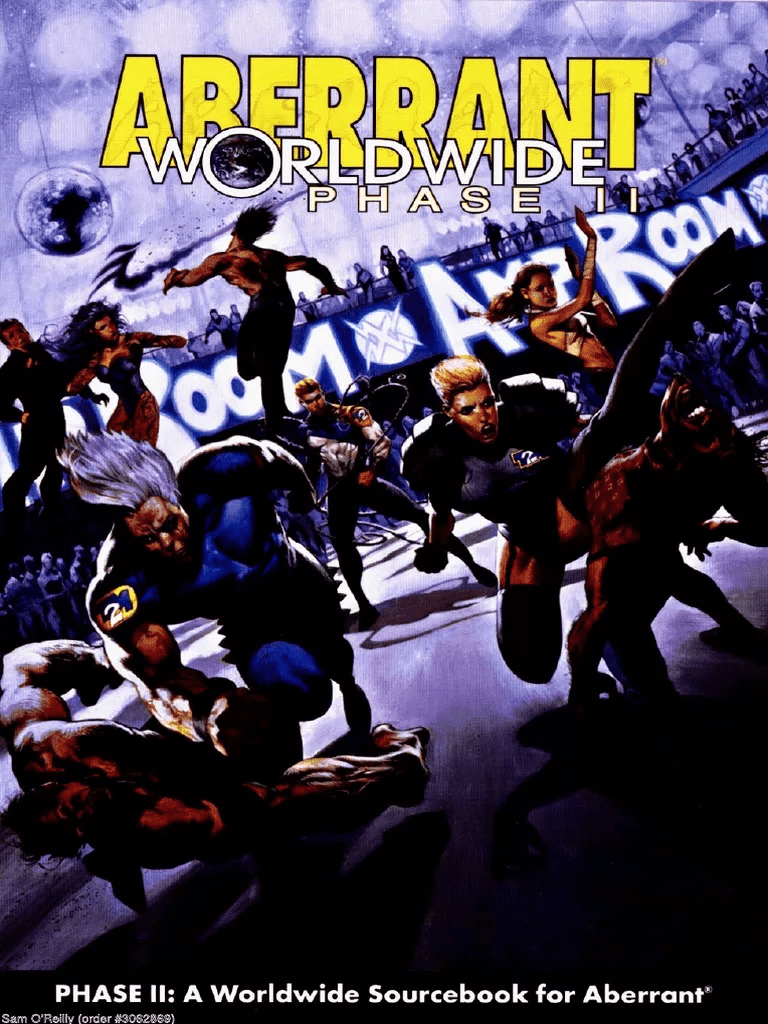
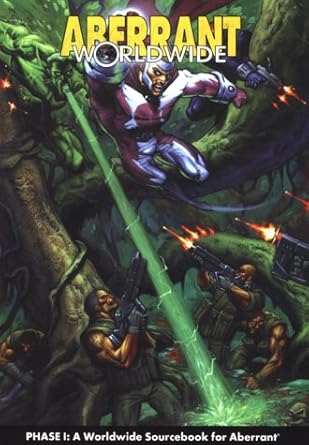
Like Worldwide Phase One, it contains four scenarios, all of which are meant to be playable for a group of any faction and which revolve around major global situations. In fact, in a lot of ways, I think that this collection is the best example of what you were meant to actually do in Aberrant – the previous one was more about pushing the metaplot (and repeatedly made the players little more than the audience for the same), but here the incidents are contained enough that the setting is pretty much the same at the end as it was at the beginning. So, what does your character do in Aberrant? Have four examples.
SCENARIO ONE: THE POPE OF BABYLON
Ungh. This is the “psychotic rage” portion of the book, right at the start. I mean, it’s not as bad as the Divis Mal ass-kissing in One, but… well, let’s take it from the start.
The scenario is based on a plot hook from The Storyteller Companion, so again with the self-cannibalising… Anyway, it concerns a scheme by the eeeeeeevil Catholic organisation Opus Dei to eeeeeeevilly frame the cool, liberal Pope for crimes he did not commit, so as to politically neuter him. Did we mention that Opus Dei is eeeeeeeevil? Don’t worry if you missed it, the book will remind you. And remind you. And remind you.
And, like… did the writers get that Opus Dei isn’t some fictional supervillain organisation? It’s an actual thing, with actual people in it! I’m sure a lot of those people are ones I wouldn’t particularly get along with, but they are flesh-and-blood human beings trying to live their best lives, and the writers are just straight up calling them brain-washed monsters. This is even worse than what they did last week, because at least the Church Astaroth and the Church of Michael Archangel are fictional organisations even if they are pretty clearly meant to stand in for all Satanists and all evangelicals respectively. Like, there was the fig leaf of them at least theoretically being works of fantasy. But here, it’s not some invented Catholic order that is totally-not-Opus-Dei-wink-wink-nudge-nudge. It’s just Opus Dei.
White Wolf always had this… thing in all their games where they kept being frustrated that their audience kept engaging with the fantastic elements they actually put in their game instead of using it as a starting point for dealing with Real Important Issues. A lot of sidebars of variable bitchiness was spent chewing the reader out for ignoring the regular, non-magical parts of the modern world in favour of having vampires fight werewolves.
With Aberrant, I guess, they were trying the novel approach of actually putting those Real Important Issues into the actual game instead of expecting their customers to do it for them. A lot of page count is genuinely dedicated to explaining how the real world works (or how the White Wolf writers thought it worked, at any rate – they had a tendency to be know-nothing know-it-alls) and how the players can affect it. It is, as far as it goes, a commendable step in the right direction.
It also shows very clearly why it was and always would have been a really bad idea. Because, see, a roleplaying game requires villains, people that it’s okay to beat up. When you create your villains out of thin air, that is perfectly fine, and you should definitely ignore the wet blankets who whine about racism against orcs. But when you insist on your game being about interacting with the actual, as-is, no-names-changed real world… you are effectively taking some real people and saying, “these are villains. These are okay to hurt.”
And that is not cool with me. No matter how little I would get along with those people, I will never agree with dehumanising a person who actually exists.
And just in case you thought I was overreacting, the very last page of the scenario lets you know that that cool, liberal Pope that you’ve spent the scenario fighting to defend? He’s owned by the mafia. What, you thought there was such a thing as a good Catholic? Don’t be silly!
I hate you, Aberrant. I really freaking hate you.
SCENARIO TWO: A GREEN AND PLEASANT LAND
This one is about an evil British aristocrat who’s erupted as a super-genius nova and who’s putting together a sinister scheme to return England to the top of the international food chain. He does so partly by means of a brain-washing cult disguised as a gentleman’s club. It’s… passable. I mean, it’s basically a slightly-more-realistic version of a supervillain plot, and that’s where Aberrant is the most comfortable, for better or worse.
On the other hand, the multiple pages at the start that describe how England has turned into festering pile of decay from refusing to cooperate with Project Utopia… feels excessively mean-spirited. I mean, did we miss the part where Project Utopia is run by a bunch of yahoos whose laughable schemes always fail? You’d think that the writers would have some sympathy with the Brits wanting to keep those yahoos at arm’s length, but of course that’s not how it works. It’s only the glorious novas who shouldn’t let Project Utopia tell them what to do – those filthy baselines should know what’s best for them and bend the knee.
I hate you, Aberrant. Though not, I admit, as much as I did after the first scenario. I mean, let’s face it, the British have a long and proud tradition of putting themselves down in very much the ways this book puts them down. I feel like Terry Pratchett would have been like, “well, they could have said it better, but they have a point…”
SCENARIO THREE: DOMINION
This one is about a megalomaniac trying to conquer the Ukraine. Ehehehehehe, yyyyyyyyeah, that’s a little more uncomfortable in the Year of Our Lord 2026 than it was when it was written, it must be said…
Having that said, this one I don’t have any major problems with. I mean, it’s not great, and there are a couple of things I could pick on – a particular sidebar whining about how players always have to ruin Teh Story by having their characters, like, do stuff, for example – but I’ve already ranted my fill this week. Plus, it’s got novas actually fighting across a major city for military objectives, and that’s sort of hardcore in a good way.
SCENARIO FOUR: WHERE HEAVEN ENDS
This one is actually really good. I mean, the premise is that Project Proteus is trying to do something evil, again, and completely messing it up, again, in a way that causes a ton of trouble for everyone, again. And I’m honestly getting a little tired of Proteus being portrayed as this hyper-secretive group of super-geniuses who walk between the rain drops but are somehow still not capable of tying their own shoes. But the actual content? It’s solid.
Specifically, Proteus is setting up a sting operation in the all-nova club The Amp Room in Ibiza to nab a whole bunch of Teragen and Aberrant members. But amazingly enough, storming into a place with several hundred superhuman beings who are most of them drunk off their asses and bellowing that everyone’s arrested… does not work out too well. In fact, it results in an all-out brawl that spreads across Ibiza and practically lays it in ruins.
Meanwhile, the players are tasked with finding a couple of novas who have (it turns out) been kidnapped by an aspiring elite calling himself the Angel of Bones and who plans to execute them in front of a bunch of journalists to show off what a badass he is. They get a front-row seat to all the human misery of a natural disaster, while also having to dodge flying debris and quantum bolts from the fights that keep going on, and avoid attack helicopters from the militaries that are trying to restore order. It’s pretty intense, and it makes actual good use of the setting.
Oh, and I mentioned last time that Aberrant might hate bulimics? Yeah, apparently the Angel of Bones used to be obese, and he erupted from trying to starve himself thin, so now he’s a walking skeleton who can kill people by causing them to gain several hundred pounds of fat in seconds. I’m… genuinely uncertain whether that is tasteless and offensive or if it’s so tasteless and offensive that it’s actually kind of awesome.
Though the fact that it’s implied that Count “stop maliciously misquoting me, I only said you were like monkeys to me!” Orzaiz spends his captivity as a giant tub of lard to keep him from easily escaping? That I find genuinely hilarious. Welcome to life in the plus sizes, you smarmy bastard!

 Mister Monster's Workshop