Category: Daggerheart

  • Where I Read: Daggerheart (part six)

    Where I Read: Daggerheart (part six)

    When we last left our hero, he was blowing his top over the pointlessness of money-counting in a game where nothing has a definite value. This time, we’ll tackle the actual weapons and armour setting. Will it redeem what came before? Time will tell.

    First, though, there’s a page on “player best practices,” essentially finger-wagging pointers to how you should approach the game as a player. Okay, let’s take a look.

    The first one is to embrace danger. Do not make the boring, safe choice, make the interesting but risky one. Eh, I don’t know about this. To some extent, it makes sense to emphasise that if you didn’t want to have an exciting life, you should have become a cobbler like your mom wanted you to instead. But the way this is phrased gives me less of a sense of “you’ve got to be in it to win it” than one of “stop thinking sensibly and walk into the obvious trap already!” I feel like that’s unreasonable – players should do what their characters would do, yes, but their characters can be assumed to want to survive, so you can’t let it break the game if they act prudently and with forethought.

    The second one is “use your resources,” meaning to look at your character sheet, see what points you’ve got laying around, and actually spend them. Mmm, okay. I’m on the fence about this one. On the one hand, I kind of like meta-currencies and subsystems – they’re fun to work out how to make the most of. But on the other hand, I also know that there are a lot of people who absolutely can’t even with those things, who just want to make decisions based on the fictional situation and not bother with a bunch of fiddly mechanics. I also note that this is very much in keeping with the first practice – this is very much a game where you’re not supposed to immerse yourself, where you’re supposed to remember at all time that you’re telling a story. Which is… fine, certainly there is plenty of pitfalls on the opposite end of the spectrum, but it still feels symptomatic of how afraid this game is of actual emotional intensity. I am starting to conclude that “epic” means something very different to the designers than it does to me.

    Third one, appropriately enough, to tell the story. Most of that I have no issue with – it’s about things like detailing aspects of the game world so that the GM doesn’t have to, and letting them know if there is something in particular you want your character to get a chance to do. But then it goes back to lecturing about how you should make tactically suboptimal choices if that makes for a better story, and, uhm… Thing is, any story is about people trying to accomplish something, whether that’s saving the world or finding some treasure, and they’ll absolutely be trying to make the choices that brings them closer to that goal. They won’t always succeed, but then, players won’t always be tactically brilliant either, so it evens out. In fact, all this hectoring about “think of the story, you philistine, the story!” just feels to me like a fundamental insecurity about your own mechanics, because good mechanics create the incentives for telling a certain type of story.

    The last practice is to discover your character over time. I… actually have no problem with that at all. Huh.

    Levelling up! Levelling up happens when the GM says it does, but preferably no more commonly than once every third sessions or so, and it happens to every character at the same time. Level translates into tier, with level 1 being tier 1, levels 2-4 being tier 2, levels 5-7 being tier 3 and levels 8-10 being tier 4. Every time you advance a tier, you increase your proficiency (which determines how many dice of damage you roll), and you get a new Experience. You can also only raise each core attribute once per tier, so a new tier means that you can get your minmaxing on some more.

    In addition, you can choose a two of a number of other mechanical options to improve, like extra hit points, extra damage, more Stress, higher Evasion… All pretty basic stuff, but it seems to be intended to let you build your character in roughly the direction you want to. You also get the option to multiclass, in which case you get the foundation card of one of the new class’ subclasses and access to one of its domains.

    When levelling up (not just when switching tiers), you also increase your damage threshold by one and you get to pick a new domain card at your current level or lower. You may also, if you like, switch out one of your existing domain cards for another one of equal level or lower. Okay, nice touch, makes it harder to get stuck with suboptimal builds.

    Inventory! You can only use weapons and armour that you have equipped, and you can only carry two weapons (and no armour) in addition to what you have equipped. You can switch weapons in mid-fight by taking Stress. Weapons can be “primary” and “secondary” which seems to be mostly about which one you hold in your dominant hand – a shield is a “secondary” weapon, for instance. You can attack with either weapon if you have two equipped, and some secondary weapons also give extra perks.

    You can also throw weapons, in which case you make a regular attack with them using Finesse, and do damage upon hit. After that you can’t attack with that weapon again until you reclaim it. Uhm, duh? That should go without saying – I recall something about “rulings, not rules” quite early on, and I’m pretty sure that most GMs can figure out that you can’t hit people with a sword that you just flung away…

    There are some notes on what different stats of a weapons means, nothing terribly surprising there. The only thing I’d note is that there’s a distinction between physical and magical damage, and some enemies may be resistant or immune to one or the other.

    Armour – okay, let’s see if we can get some clarity here. Armour comes with a base score, which determines how many armour boxes you get in it, and two base thresholds, which determine whether a hit inflicts 1, 2, or 3 hit points on you upon taking damage. When you’re hit, you can also mark an armour box to reduce that amount by one. Okay, that’s… a little finicky, but I guess it’s straightforward enough.

    If you’re wearing no armour at all, your damage thresholds are correspondingly low – anything that inflicts as much damage as your level takes away 2 hit points and anything that inflicts as much damage as twice your level takes away 3. And of course you have no armour boxes at all.

    There’s a note that you can reflavour armour as you like – a wizard might wear heavy armour, for instance, but it’ll actually be a variety of protective rings and amulets, and the reason why he can’t move around as fast in it is that he’s always preoccupied with maintaining the magic. Fair enough.

    Weapons are listed in tiers. I’m not sure if there is any rules significance to those, or if they’re just guidelines for when the GM should leave some of them around? Either way, there is a variety of magical ones of every tier, but at least on the lower tiers the magical ones mostly differ in what stat you use to attack with them, though there are some exceptions like the Returning Blade, that returns to your hand if you throw it. Higher up, among a ton of weapons that are just the lower-tier ones with “Improved” or “Advanced” in front of the name, there are also things like the Ego Blade, which can only be used by characters with a Presence stat of 0 or lower. Heh.

    Blackpowder weapons are a thing, they require you to mark Stress to reload them after every shot.

    Then there is a section on combat wheelchairs – nope, nope, not touching that with a ten-foot pole – and after that it goes into secondary weapons. A lot of it is simple stuff like shields (add to armour score) and short blades (add to damage of the primary weapon), but there are also some standouts like whips (can be used to force every enemy to back away from you) and grapplers (which can be used to pull enemies close).

    Armour, finally, is pretty much what we just described – they have a static threshold and a depletable number of boxes, and the heavier ones give you penalties to evasion. Higher-tier armour seems to mostly be magical and have some special widgets associated with it, though I’d kind of wish it described how it works. Like, Rosewild Armour lets you mark an armour box instead of spending Hope, so does that mean that Rosewild Armour… steels your resolve in some way? That might be nice and flavourful if it was actually commented on. You know, like it would be in a game that was actually all about the story, man, where you weren’t supposed to care about those boring mechanical bits.

    I mean, this is really what it comes down to, and why I am growing to hate this game with a considerable passion. It’s not mechanics-focused or narrative-focused, it’s got mechanics and narrative forcibly kept apart to keep the one from inconveniencing the other in any way. It’s not a single game, it’s two different games that you’re meant to play at the same time! Insofar as there is a mission statement here, it seems to be the exact opposite to the sort of down-in-the-dirt, zero-narrative, let-the-dice-tell-the-story dungeon-crawler that crusty grognards tend to espouse.

    And in fact, I think that might, in a final analysis, be what the writers mean with “epic.” They don’t mean “sweeping and mythic with high stakes,” which is what I naively assumed back in part one. They just mean “absolutely not in any way gritty or realistic.” And while I don’t always want my games gritty and realistic, any game – or any other form of expression, really – that defines itself solely as being “not that, ew!” is pretty much doomed to suck.
  • Where I Read: Daggerheart (part five)

    Where I Read: Daggerheart (part five)

    We’re into a new chapter, and this one is about how you actually play the game. It starts out by explaining that the basic flow of the game is that the GM describe what’s up, then the players and GM talk about it so that everyone really understands what’s up, then the players do stuff and the GM resolves the stuff they do. Fair enough, that is more or less how it usually works, but I still feel like it’s a pretty clunky way to explain it.

    I mean, the Powered by the Apocalypse influence is pretty noticeable in how they try to distil the flow of play into something you can describe accurately instead of just going with the grand old roleplaying tradition of, “eh, it works at our table, you’ll figure it out.” And I’m technically all for that, but, well, some things really are pretty self-explanatory and every bit of wordcount you spend on explicitly describing them just takes time and attention away from the actually complicated parts.

    … if you’re reading this from a point in the future where I’ve finally gotten around to publishing my magnum opus Monstrous Mishaps and you want to point out that I’m pretty frequently guilty of said over-explaining myself, then I can only say… yes, okay, okay, but don’t do as I do, do as I say!

    There’s a piece of example play about a thief running away after stealing from a noble, nothing very exceptional there.

    Next we’re introduced to the concept of “spotlight,” and this actually gets my attention, because it sounds halfway clever: whichever character is acting has the spotlight. Usually the GM just lets it wander around the characters present, but there are also mechanics that can decree things like, “an enemy gets the spotlight.” A sort of narrative approach to initiative, huh? Interesting, interesting… Let’s see how it works in practice.

    Anyway, there is explicitly no such thing as a turn order or a limit to how many actions you can take at once, it’s up to the GM to decide what is reasonable. Being used to PbtA, I can testify that this works a lot better than it sounds like it should. There’s also the mention that not being “locked into combat” makes it easier to contemplate non-violent actions like running away, which I have also found to be true.

    A player acts by making “player moves” that describe what their character is doing, and a GM acts by making “GM moves” which describe, well, just about anything the GM wants to happen, really. GM moves are usually made when a player either fails a roll or rolls with Fear. Ah, so there is some universal effects to the Fear mechanic. Okay, that might work. The GM can also spend Fear to make additional GM moves if he’s starting to feel bored. NPCs or environments might also have unique “Fear moves” that can be activated by spending Fear.

    We are reminded once again that players roll with a d12 “Hope Die” and a d12 “Fear Die,” and when the Hope Die is higher you “rolled with Hope” and when the Fear Die is higher you “rolled with Fear.” If you rolled with Hope you gain Hope even if you failed, and if you rolled with Fear the GM gains Fear and makes a GM move even if you succeeded. Yep, that’s clear enough. If you roll the same number on both dice, you get a critical success, which means that you succeed with Hope regardless of what the result was. You also clear a point of Stress and, if it was an attack roll, do extra damage.

    Hope can be spent to assist allies with their rolls, to get the bonus from an Experience, or activate a Hope Feature. There are apparently two different ways to assist allies, “Help an Ally” and “Initiate a Tag Team Roll.” We’ll get both described in more detail later. You can only have 6 Hope at any given time, so you’re expected to spend it freely.

    Evasion gets another mention, and apparently it’s not just physical defence, it’s what an enemy rolls against for any sort of hostile effect against you. Hmm, okay.

    Hit Points and Damage Thresholds! Okay, here it gets complicated… But basically, you have a certain number of Hit Points, and you also have two Damage Thresholds, one Major and one Severe. If you take some damage, but it’s less than your Major Threshold, you lose 1 HP. If you take damage between your Major and Severe Thresholds, you lose 2 HP. And if you take damage at or above your Severe Threshold, you lose 3 HP. That… seems like a complicated way of doing it, but okay then. Lose all your Hit Points, and you have to make a “death move.”

    Stress is basically mental Hit Points. You can mark Stress as part of a special ability, as we have seen in several places already, or the GM can inflict it on you when things go badly, or require that you mark Stress to succeed at something you otherwise might have failed at. When you’ve marked all your Stress, you become “vulnerable,” which we’ll find out more of later, and also any further Stress you would have marked gets transformed into Hit Points instead. Fair enough.

    There’s a fairly long and unnecessary description of how to make a roll that just goes over everything we’ve already covered, but it does specify that rolling with Hope and Fear does change the outcome of success and failures. Essentially, success with Hope is “yes, and,” success with Fear is “yes, but,” failure with Hope is “no, but” and failure with Fear is “no, and.” And I guess a critical success is something like, “yes, and even more stuff,” but you get what I mean. Somewhat charming, and I can see the appeal, but my experience with trying to come up with layers of success and failure for Storyteller games have made me a bit weary of that much granularity. Oh well.

    There is a sidebar clarifying that there is no such thing as a roll with no consequences – the story always changes in some way, for the better or the worse or a little of both. That much I can get behind, yes.

    Okay, here is the “Tag Team” roll. Basically, once per session you can spend 3 Hope and explain how you and another player perform some kind of combo move. You both roll, and then you choose which roll you want to keep and have apply to both of you. If the action was an attack and you succeeded, you both roll damage and add it up. There is also a more standard “Group Action roll” where someone takes the lead and everyone else can make separate rolls that provide bonuses for the leader’s roll if they succeed.

    There’s a whole lot of text about how to make a attack roll, but it’s all stuff we’ve seen before. The attack gives you which die to roll, your proficiency tells you how many dice of that type to roll, and you add any bonuses to the result. It’s noted again that damage isn’t subtracted straight from Hit Points in Daggerheart, it’s compared with Thresholds to calculate the number of Hit Points lost, and armour and resistances also factor into it in some way that is yet to be revealed.

    Reaction rolls are a special sort of roll that are done when someone else is in the spotlight – mainly, to resist some action of theirs. They don’t generate Hope or Fear, but otherwise work as normal.

    Advantages and disadvantages on rolls… just mean that you add 1d6 or subtract 1d6. Okay.

    The style of play during battle is described, and here I get a bit confused, because now it seems like the spotlight always shifts to the GM whenever a player fails or rolls with Fear (or when the GM spends Fear to take the spotlight). Is that specific to combat, because I feel like this was described differently earlier? But okay, I guess that works.

    Domain cards! You can hold five cards in your “hand” at any given time, while the rest are going to be in your “vault.” The ones in your hand you can use normally, the ones in your vault are inaccessible for now but can be moved back into your hand when you rest or if you’re willing to spend Stress to get them. You might also permanently lose cards, in which case they are removed from play. When you level up, you also get to switch out one card, presumably so you can start using your cool new tricks immediately.

    Conditions! There are three universal conditions that can affect play: Hidden, Restrained, and Vulnerable. Hidden means that you’re out of all foes’ immediate sight, so they have a disadvantage on any rolls against you. Restrained means that you can’t move, but you can still take actions that don’t require you to move from the spot. Vulnerable  (that’s the one that happens when you’re all Stressed out, you might recall) means that you’re somehow off balance or on the spot, so all rolls against you have an advantage.

    The GM decides how a player can get out of a condition, and it may or may not require a roll. An NPC can always free themselves from a condition when they have the spotlight without needing to roll or spend for it, but then they have to pass the spotlight back to a player.

    Countdowns are mentioned as being a way to keep track of when something bad is going to happen, and they can tick down based on whatever criteria the GM sets – any time an action gets made, for example, any time there’s downtime, or any time a player rolls with Fear. We’ll learn more about countdowns later, apparently.

    There is a section on ranges. Apparently this game mixes the lackadaisical modern approach, where ranges come in a few loose categories like “within arm’s reach” and “within a stone’s throw,” and the grognardy old-school approach where ranges are carefully measured up and woe betide anyone who gets an inch wrong. Specifically, each category is given a precise number of inches on the tabletop. This… seems like the absolute worst of both worlds, frankly. And again, what happened to being all about Teh Story?! I should not have to break out the measuring tape for a game where it’s all about the fluffy feelz!

    Muttermuttermutter… anyway, you can move anywhere that’s Close to you as part of another action, but if you want to move further than that you need to succeed at a roll and the GM decides how hard it will be. Enemies can likewise move within their Close range freely, or can move within their Very Far range by using up their spotlight but without needing to roll for it.

    There are rules for cover (disadvantage to rolls against you) and for targeting groups (all members of the group has to be within Very Close range of whatever you aim for) and line of sight and I swear that there is something about all of this that makes me see red. There shouldn’t be all these fiddly rules! Not in a game where everything in the setting itself (what there is of one) is so fluid and undefined! The rules and setting are meant to match, guys! They’re meant to reinforce each other! If you want to go loosey-goosey that’s fine, and if you want to nail down every stray variable that’s also fine, but pick one!

    Aaaarrrrgghh. Isn’t this chapter done yet?

    Gold! Gold is counted in handfuls, bags, and chests, with 10 handfuls to a bag and 10 bags to a chest. But, it also notes, there aren’t actually any prices set for anything in this book, so it’s up to each GM how much gold to hand out and how much to charge for anything.

    But.

    But.

    Buuuuuuut.

    BUT THEN WHY EVEN BOTHER WITH AAAARRGGGGGH AAAARRGGGGGH AAAARRGGGGGH AAAARRGGGGGH AAAAAAAAAAAAAAAARRGGGGGH!!!!!!

    Sorry, sorry, I think I just marked my 6th Stress box and became Vulnerable… But I can do this. There’s just downtime and death left in this part of the chapter.

    Downtime! You can take a short rest or a long rest, but once you’ve taken three short rests the next one has to be a long’un. Each option gives you access to different downtime moves, of which you can perform two during each downtime. They involve things like regaining Hit Points, clearing Stress, repairing armour, and gaining Hope. The downtime moves for long rests are, naturally, a little stronger than the ones for short rests – more Hit Points regained, more Stress reduced, etc. However, whenever you stop moving, the GM also gains Fear, 1d4 at a short rest and 1d4+the number of players for a long rest. Works for me. You can also work at some project, like crafting a weapon or something.

    Death! When you mark your last Hit Point, you have three choices. You can go out in a “blaze of glory”: choose to perform one action of your choice that automatically gets a critical success, then you die. You can “risk it all,” in which case you make a roll and if you roll with Hope you regain some Hit Points and can continue, but if you roll with Fear you die. Or you can “avoid death,” in which case you get knocked unconscious and maybe permanently get your maximum amount of Hope reduced by 1.

    Okay, I have nothing to complain about in the last two sections. But man, this isn’t getting any easier.

  • Where I Read: Daggerheart (part four)

    Where I Read: Daggerheart (part four)

    All right, communities. They can represent either a location, an ethos, or a common goal, meaning that more than one could apply to your character’s background, but you should choose the one that has most defined their outlook. Also, it’s all very complicated and nuanced and you should consider your character’s inner-most delicate feelings and THIS IS A GAME WHERE YOU CAN PLAY A WALKING FUNGUS WITH A TURTLE SHELL WILL YOU PLEASE STOP PRETENDING THAT IT’S SOME KIND OF HIGH ART?!!!

    Sorry, sorry, I just couldn’t hold it in anymore. Honestly, it’s probably a miracle that it took this long for this readthrough to turn into an angry rant, usually that happens on circa page four…

    Okay, let’s try to get through this without further outbursts…

    Highborne communities… well, they’re nobles, basically. High and mighty, like to think that they’re better than the people who are really not their sort of people. They get an advantage on rolls to negotiate with those impressed by titles and wealth, which, let’s face it, are a not inconsiderable portion of the population. A suggested variation is that the aristocracy might actually be a magocracy, with nobles being those with magical powers.

    Loreborne communities are all about learning and skill, and of furiously politicking to rise through the ranks. Guilds and schools are both typical Lorebornes. They get an advantage to rolls to have read about something in a book at some point.

    Orderborne communities are ones that be described as an “order,” a group of people who think that they stand for something and are very serious about it. Clerical and knightly orders are the obvious examples. Once per day, they get to roll a d20 as their Hope Die if they can explain how what they’re doing is in keeping with their beliefs.

    Ridgeborne communities are sturdy hill folk with a chip on their shoulder about how those damn dirty flatlanders can’t be trusted. That’s about it, they live in the mountains and hills where most people don’t wanna live. They get an advantage on traversing and surviving in harsh environments.

    Seaborne communities live by and off of the water, as sailors, fishermen or pirates. Some might even be nomads who live their whole lives on their ships. Every time they roll with Fear, they get a token that they can trade in for a bonus on another roll, because they “can sense the ebb and flow of life.”

    Slyborne communities are crooks, your basic thieves and scoundrels from the wrong side of the magic-powered train tracks. They lie, scheme, and get in trouble with the law. They get an advantage to rolls to detect lies, hide, or negotiate with criminals. There’s also some flavour descriptions of gambling dens, black markets and hideouts with hidden escape routes.

    Underborne communities live underground, either in your typical fantasy gigantic cave system or just in a hole in the ground like a hobbit. There are some examples of houses hanging from the roof in the silk of giant spiders, or being built into the base of stalagmites. They get an advantage on rolls to either spot or hide in an area with poor light.

    Wanderborne communities are fully nomadic. Examples offered are people traveling in great big air balloons, piloting kite-drawn skimmers across the sea, or just walking on their own two feet and living in portable dwellings. They get the ability to spend Hope to reach into their pack and take out precisely what they needed for the situation they’re currently in.

    Wildborne communities live deep in the woods to commune with Nature. Possibilities include tree houses, hollowed-out trunks, or homes built into giant mushrooms. They get an advantage on rolls to move without being heard.

    So that’s all of them. Okay, so none of that is terrible or anything, and some of the flavour ideas are nice, certainly it’s more interesting to have the players come upon a village of dwarves living in giant mushrooms than just have them stumble on yet another community of dirt farmers, but I don’t really like how non-mutually-exclusive a lot of these are. Honestly, I feel like these are the ones that should have been possible to combine for additional customization, not the ancestries. For instance, a pirate should be a mix of Slyborne and Seaborne, a scion of a magical overclass should be Highborne and Loreborne, a monk from a mountain monastery should be Ridgeborne and Orderborne… I feel like that would have made for more interesting and nuanced characters than being the bastard offspring of a turtle and a toadstool… Oh well.

    The chapter ends with a long teary-eyed lecture on how to play disabled characters Sensitively, and I have decided that I’m not going to touch it with a ten-foot pole. Instead, I’ll try to get back into the spirit of things by trying out the character creation system.

    So, first up I need a class and a subclass. Let’s go with Wizard, of the School of Learning. I’m all about the utility spells! I’m instructed to take my subclass’ foundation card – ah, okay, so you do get it for free, I missed that earlier – which in my case means I can take an extra domain card, and also I can take Stress instead of spending Hope when I want to invoke an Experience. Because my brain is all big and shit, see.

    Further fringe benefits: I have the ability to perform flavour magic tricks at will, and when I roll a number I like (let’s say 5) on a die I gain Hope or clear Stress. I have the ability to make an enemy reroll a successful attack against me by spending 3 Hope. Naa na na na – na na – na na – can’t touch this…

    I also get either a book I’m trying to translate or a small, harmless elemental pet. Okay, I decide that I travel alongside Sparky, my pet fire-imp. There are also a bunch of questions, and I’ll get to those, but let’s put the character together a bit more first.

    Hum hum, I start with level 1, makes sense… Choose my name and pronouns, my name is Scielbald Fleetflipper and I’m a boy-frog (at the moment, at least – us frogs are known to switch depending on environmental factors…). Ancestry, as I just alluded to I’m a Ribbet, because while I’m not as psyched about that as I started out being I still think it might be fun.

    Community… well, there it gets a little more interesting, doesn’t it? I could really double down on the nerd angle and go with Loreborne, but that feels a little too boring. So let’s say I’m Seaborne. I grew up among the fisher-frogs on the banks of the Great Gahoola Lake, until I was apprenticed by a wandering wizard. That’ll get me that ability to gather up bonus from Fear, making me more mystical.

    Character Traits… well, my spellcasting comes from Knowledge, so I’d better take +2 in that. I also think I’m pretty good at hopping and skipping, so let’s put the +1s in Agility and Finesse. My spindly little frog-limbs don’t lend themselves to heavy lifting, so let’s put the -1 in Strength. That leaves the +0s for Presence and Instinct. I’m a little too bookish to be good at social niceties and noticing what’s going on around me.

    As a Wizard, I start with 5 Hit Points and Evasion 11, and like all characters I start with 6 Stress boxes and 2 points of Hope.

    Equipment! Apparently I get suggestions for equipment in my character guide. I had to spend some time trying to find my character guide, but it was hiding at the back of the book. It apparently suggests I start with a quarterstaff and leather armour. Sounds good. I also get a bunch of other standard adventurer stuff like rope and rations. Fine, fine – equipment always bores me.

    Okay, so now it’s time to answer those background questions. Let’s go find them.

    “What responsibilities did your community once count on you for? How did you let them down?” I was meant to follow in my father’s flipper-steps as the wiseman and lorekeeper of our village, and I was only meant to study enough magic to be more useful. However, once I saw the wonders of the world outside, I could never bring myself to return.

    “You’ve spent your life searching for a book or object of great significance. What is it, and why is it so important to you?” I am searching for the Frozen Egg of Eugastine the Truth-Croaker. She was a great hero of the Gahoolan lands, but her bloodline has been extinguished over the years. Legend has it that one of her eggs was preserved in magical statis, and if it could be found and revived, the heir of Eugastine might yet return. If I could do that, it would prove that my wanderings were ultimately in my family’s interest, and I would be vindicated and forgiven!

    “You have a powerful rival. Who are they, and why are you so determined to defeat them?” Ah, that would be that puffed-up buffoon Martinus Bloodwart! He’s always getting ahead of me, snatching up tomes of eldritch lore by offering prices that I can match. He seems to think that the High Art of magic is something you can buy your way to. Well, I’ll show him that the Gift cannot be bought for gold!

    Next I choose two Experiences. Let’s go with “Lake-Town Shaman” and “Travel the World in Search of Elusive Lore.” That sums up my main conflict pretty well.

    Then I need to choose my domain cards. Usually I’d choose two from the first-level cards for Codex and Splendour, but my foundation card gives me an extra one, so three in total. The Codex cards are all “grimoires,” so they give me several spells apiece. The ones I can choose between are Book of Ava (lets you knock people back, strengthen armour, and summon an ice spike), Book of Illiat (put people to sleep, shoot magic missiles, and speak to people telepathically), and Book of Tyfar (set people on fire, conjure a mist, and telekinetically lift things). For Splendour I can take Bolt Beacon (damage an enemy, and also they glow in the dark and get easy to hit), Mending Touch (heal) and Reassurance (let an ally reroll their dice).

    Well, first of all, this is… really kind of flavourless. I mean, it’s pretty clearly repackaged D&D spells, but D&D spells are quirky and fun. These ones barely bother to tell you what they do other than strictly mechanical effects. Oh, all right, all right. I guess I’ll take Book of Illiat, Book of Tyfar, and Mending Touch. That’ll give me some nice tricks up my sleeve.

    The last part is connections to other players, but as I have no other players, I guess I’m done. Well… I guess I can see myself playing this character, sure? There’s some quirky appeal to him, he’s got a nice range of abilities (almost a little too many, but it’s within reasonable limits), and there’s fuel for me to ham it up and get over-enthusiastic about stuff, which is really my forte as a player. But I can’t say that I’m all too psyched, either. It’s all passable, but it’s also all kind of… meh.

    I can’t believe they took the fun out of playing a humanoid frog…

  • Where I Read: Daggerheart (part three)

    Where I Read: Daggerheart (part three)

    Okay, so classes. First there’s a page repeating a lot of what we’ve already learned, but it also mentions a few new things. For instance, every class has a Class Hope Feature which lets them spend Hope to do something. Each subclass also has a Foundation Feature, Specialisation Feature, and Mastery Feature, though you don’t get those for free, you have to take them as a card when you level up. Okay then.

    First up is the Bard. They’re charismatic and slightly bitchy arteeeests, and their domains are Grace and Codex – so they know mysterious lore and can express it really prettily, basically. Their Hope Feature is that they can spend Hope to distract an enemy, and their Class Feature is that once per session they can give the party a rah-rah pep talk that grants each other PC a d6 that they can roll, once, to add to another roll or to reduce Stress.

    They can also choose to start the game with either an unsent letter (ooooh) or a… romance novel. Okay, so again I’m noticing that the cutesy postmodern humour kind of clashes with the stated intention of making the game feel epic and evocative… though that is, I will admit, a problem I have with a lot of modern fantasy. The Dragon Prince, I’m looking at you!

    Bards can be Troubadours or Wordsmiths. Troubadours have some abilities related to healing and bestowing Hope, while Wordsmiths have some advantages in terms of boosting actions and reducing Stress. So basically the one is about getting people to chill, and the other is about getting them to excel.

    Next up are Druids, who are your basic nature nuts. Their domains are Arcana and Sage, so they practice natural magic of the forest. They can turn into animals by taking Stress, or by using their Hope Feature that lets them spend Hope to do it instead. They can also pull off minor cosmetic acts of nature-magic, like making flowers bloom.

    They can be Wardens of the Elements, in which case they can channel one of the elements in combat for some perks, like doing damage to anyone who strikes them for fire or raising their resistance to injury with earth. Any Warden of the Elements can channel any element, but only one at the time. Alternatively, they can be Wardens of Renewal, who can restore Hit Points and clear Stress in people.

    There are a couple of pages of animals you can turn into, along with special rules for them. It all looks kind of fiddly, but it certainly makes Druids pretty adaptive – even sticking to just the ones you have access to at level one, that’s a pretty big bag of tricks.

    The Guardian! As mentioned before, this dude’s into Valour and Blade. He protects people, and his Hope Feature is that he can spend Hope to clear out Armour Slots. I guess that means they can take more of a beating. Their Class Feature is that they can turn themselves Unstoppable, during which time they take less damage and do more damage. Each time they do damage, they increase the amount of extra damage they do, but once that reaches a maximum, they drop out of Unstoppable again. Okay, so that’s kind of cool.

    Guardians can be Stalwarts or Vengeances. Stalwarts can tank even better, while Vengeances have higher Stress tolerance and can also spend Stress to cause people who attack them take some damage in return. On higher levels, Vengeances can also select a target to prioritise, and on attacks on them they can swap the results of their Hope and Fear Dice (so they gain Hope no matter what the roll is, I suppose).

    Rangers are cunning hunters and outdoorsmen who use the wilderness to their advantage and fight pragmatically, as showed by their domains of Bone and Sage. Their Hope Feature is that they can spend Hope to make a successful attack hit three different enemies at once. Their Class Feature is that they can mark an enemy for takedown, which means that that enemy suffers Stress when struck and also that the Ranger can turn a failed attack into a successful one, though at the cost of unmarking them.

    Rangers can be Beastbounds and get an animal companion, who levels up as they do, our they can be Wayfinders, giving them more bonuses on hitting things and some extra skill in, well, finding their way to places. There’s a page of rules just for the animal companions, who need to be fleshed-out characters in their own rights…

    … I’m trying to keep an open mind here, but I’m increasingly feeling like this game was written by people who felt like D&D 5E wasn’t fiddly enough. Which, okay, if that’s what floats your boat then more power to you, but… how does that fit in with the whole “focus on the story more so than the mechanics”?

    Rogues… well, they’re what you’d expect. They sneak around and stab people in the back. Their domains are Midnight and Grace, for hiding and lying. Their Hope Feature lets them spend Hope for a bonus to Evasion, and their Class Feature lets them remain hidden even from enemies who should be rights be able to spot them, right up until they attack.

    Rogues can be Nightwalkers or Syndicates. Nightwalkers can teleport from one shadow to another and hit harder when they’re Vulnerable (which we don’t know what it means yet, but I guess it’s meant to give them a “cornered rat fights twice as hard” style), while Syndicates automatically know someone in every new town they come to who they can ask for a favour.

    Next up is Seraphs, our holy warriors. They have Splendour for the healy-healy and Valour for protecting the innocents. Their Hope Feature is a limited healing, and their Class Feature is that they get a bunch of bonuses per session that they can use to boost allies’ rolls, reduce incoming damage, or give them Hope. They can be Divine Wielders, in which case they can fling their melee weapons at enemies and then cause them to return to their hands, or Winged Sentinels, in which case they can, well, fly.

    Sorcerers we have already dealt with in the form of that sample character. They are people with inherent magic that runs in their family. Their domains are Arcane (for inherent magic) and Midnight (for illusion). Their Hope Feature lets them reroll damage dice for damage-dealing spells, and their Class Features lets them sense magic, create minor illusions, and discard a domain card to gain Hope or enhance a damage-dealing spell. They can have an Elemental Origin, in which case they can do some tricks with the elements, or a Primal Origin, in which case they can enhance magic (mostly magic that deals damage – yeah, I’m sensing that Sorcerers are very much meant to be a DPS class).

    Warriors are more big fighty types, though they have a bit more of a “swordsmaster” or “warrior philosopher” vibe than just “I hit people onna head.” Their domains are Blade, for the swording, and Bone, for the intelligent swording. Their Hope Feature is a bonus to attack, and their Class Feature is that they get an attack of opportunity when their enemies try to retreat from them.

    Warriors can have the Call of the Brave or the Call of the Slayer. The Call of the Brave gets Hope and Stress-relief when failing a roll with Fear or when performing a ritual before engaging a superior opponent. So basically, you’re at your best when you’re doing something that’s clearly a bad idea but you’re going to do it anyway because it’s HONOURABLE!!! Heh. I kind of like that, to be honest. The Call of the Slayer can build up bonuses every time they roll with Hope that they can then spend for a powerful strike. Hiyah! Okay, I’ll grant you that I like this class a good bit better than the standard D&D Fighters…

    Wizards, finally! They are nerds who can do magic because they’ve done their homework. Their domains are Codex (for magic books) and Splendour (for healing, since in this game they’re the ones who do that, too). Which makes sense, honestly – like I’ve said before, I don’t really get the whole D&D convention whereby wizards can’t heal. Curing diseases is, like, the first thing that people expect from a wizard! After that it’s love potions, fertility, and putting curses on people you don’t like, in no particular order.

    Anyway, the Wizards’ Hope Feature is, somewhat interestingly, the ability to make an enemy reroll an attack or damage roll. Their Class Feature is that they can do minor magic tricks and that whenever they roll a particular number on their Hope and Fear Dice, they gain Hope or lose Stress, since they’ve spotted an auspicious sign. That’s sort of neat.

    Wizards can be of the School of Knowledge, in which case they can draw additional domain cards and can use their Experiences by gaining Stress instead of by spending Hope. Or they can be of the School of War, in which case they get extra HP and when they succeed at an attack while rolling with Fear they do extra damage.

    Next up is ancestry. There’s a lot of frankly tiresome hand-waving about how everyone is a unique individual first and foremost and yay the brotherhood of sentient beings and look, we’re totally not racist, honest! Yes, yes… Anyway, each ancestry gets two features, so let’s dive right in.

    Clanks are robots or golems – some sort of manufactured creature, either way. They can look pretty much like anything. Their Ancestry Features are that they were built for a purpose that aligns with one of their Experiences, so they get an additional bonus when using that Experience. Also, they rest up faster than feeble organic creatures.

    Drakona are humanoid dragons. They can look more draconic or more humanoid – from just being people with scales and sharp teeth to having tails, snouts, back ridges, and vestigial wings. They have protective scales and can breathe some element, like fire, lightning, or ice.

    Dwarves are… well… Dwarves. They can embed gemstones in their skin, though, for extra sparkliness. Also, their nails are tough and stonelike, and dwarves like to polish them and carve them into facets. Their features are about taking damage really well.

    Elves, likewise, nothing much to see here. They do develop a “mystic form” when they devote themselves to the protection of the natural world, though, which can manifest as them having freckles that twinkle like stars or ivy growing in their hair. I’ll give the game this much, there has been a considerable effort spent on impressive visuals… Anyway, Elves can get an advantage on initiative and can perform an extra “downtime move” while resting.

    Fairies, on the other hand, are a little different from their usual depiction. Here, they are actually insectoid to varying extents – much like the Drakona, how much varies between “pretty girl with chitin instead of skin” to “big humanoid beetle.” They all have some variety of insect wings, though. They also range in size from two feet to seven feet. They can spend Hope to reroll their own or an ally’s action.

    Fauns are goat-men with powerful legs and stately horns. In much the same way as the Fairies and Drakona, they range from “human with horns and hooves” to “goat that inexplicably walks around on two legs.” They can jump and kick really well.

    Firbolgs are honestly pretty similar to Fauns, in that they’re half human and half horned animal, only the animal part is usually something a bit more dignified than a goat.  Firbolgs who look like half-bulls are also known as minotaurs. By any name, they have a 1 in 6 chance of shrugging off Stress gain and also get a bonus to charging enemies.

    Fungril are… okay, I think I’m spotting the theme here. They’re mushroom-people. They grow elaborate caps on their heads that they can decorate in various ways. Their Features are that they can speak telepathically (through their “mycelial array”) to speak with other Fungril, and by touching a corpse they can extract one memory from it.

    Galapa are turtles. Okay, I think this is getting a little old now, and I’m not even halfway through the list… They have shells that offer them protection from injury, and they can retract into them to be even safer (though then they can’t move). Galapa shells can be carved into decorative shapes or reinforced with metal, though it’s a slow and painful process.

    Giants are big dudes, though maybe not as big as you’d expect – they’re somewhere between six and nine feet tall. They are born without any eyes, and new ones may appear or disappear on their faces throughout their childhood, with them finally ending up with between one and three of them. They get extra HP and reach.

    Goblins are little dudes with great big eyes and ears. They also come in every colour of the rainbow. They are good at keeping their balance and spotting danger. Gotta admit that the picture of the little Goblin witch on this page is kind of adorable…

    Halflings are small people with prominent ears, noses, and feet. The fluff text mentions them possessing acute hearing and smell, but that’s not part of their Ancestry Features – instead, they may reroll a 1 on their Hope Die. Also, at the start of extra session, everyone in a party who has a Halfling in it gains 1 Hope, because halflings are good luck. Heh. That’s kind of nice.

    Humans are maybe not quite Humans as you know them – they apparently regularly live to be a hundred, so I guess Daggerheart Humans are supposed to be one of those older and nobler races that modern man is but a fallen remnant of, sort of thing. Otherwise they are what you’d expect – they can take more Stress, because of the good ol’ human spirit, and they can reroll failed Experience rolls, because they adapt well to new situations.

    Infernis are humanoids with horns… Seriously? Another kind? That’s three now. Okay, I am definitely starting to feel like this game has a clutter problem. Save some for the supplements, guys, that’s where the money is! Oh well. Infernis are descendants of demons from the Circles Below. Aside from horns, they also have fangs, and occasionally forked or arrow-shaped tails. They look demonic, and when they get angry they start looking extra demonic, enough to get a bonus to intimidate. They can also take Stress to turn a roll with Fear into a roll with Hope, because they fear nothing.

    Katari are cat people. You know the drill by now, they can look more like cats or less like cats, they can look like different sorts of cats, bla bla bla. I mean, I do approve of this approach from an ease-of-play standpoint, because it means you don’t have to internalise a ton of specific lore – you can just say that Katari are cat people, and whatever people picture when they hear “cat people,” that’s perfectly correct. I’m just kind of losing interest in all these ancestries that are all “human mixed with something else” and carefully avoiding specifics. Oh well… Katari are very agile and have retractable claws.

    Orcs have tusks and green, grey, blue or pink skin. Some have no body hair at all, while others are giant fur balls. They get extra resistant to attacks when they’re down to their last HP, and they can gore people with their tusks.

    Ribbets are the frogs. See, I was all set to be excited about them, but the game sort of ran the formula into the ground before we could get here… Variations include webbed fingers, warty or smooth skin, and any number of vibrant skin colours and patterns. They have a long prehensile tongue and can breathe underwater.

    Finally, Simiah! They’re monkeys or apes. They’re good at dodging blows and climbing. I refuse to spend more words on them than that.

    There are also rules about being a mix of two ancestries, because Lord knows we don’t have enough choices as it is… It’s pretty basic, though, you just pick one Ancestry Feature from each of your two ancestries. So if you really want to be a walking fungus with a turtle shell, that’s a character you can play here.

    Next part is communities. Which I seem to recall there are at least not that damn many of.

  • Where I Read: Daggerheart (part two)

    Character creation! You start out by first choosing a class and a subclass (of which each class seems to have two to choose from). Bards can be Troubadours or Wordsmiths, depending on whether they sing healing songs or engage in “clever wordplay.” Hmm. Weaponised punning, huh? I am cautiously intrigued… Druids can be Wardens of the Elements and throw elemental magic around, or Wardens of Renewal and heal people.

    Guardians seem to be your basic big guys with swords, except they’re different from Warriors, who are further down. They can be either Stalwarts or Vengeances, I guess depending on whether they’re pure tanks or leaning towards damage-dealers. Rangers can be Beastbounds (you get a pet) or Wayfinders (you get to hunt and kill things). Rogues can be Nightwalkers (who can sneak) or Syndicates (who know a guy).

    Seraphs are another class that’s not quite standard D&D, though the closest analogue seems to be paladins. They can be Winged Sentinels, in which case they fly, or Divine Wielders, in which case they get a legendary weapon. Also, the Winged Sentinel seems to be the flying knight chick from the cover.

    Sorcerers can have an Elemental Origin and “channel the raw power” of an element, or a Primal Origin and focus on “versatility.” So brute force versus finesse, I guess? Also, the picture for the Elemental Origin Sorcerer is the frog dude from the cover. Aw yeah. Still calling dibs on playing a frog!

    Warriors can have the Call of the Brave or the Call of the Slayer. The former “[uses] the might of [their] enemies to fuel [their] own power,” while the latter strike with “immense force.” So I guess maybe the Call of the Brave gives you some kind of bennies for being hit, maybe? Not sure. Finally, Wizards can have the School of Knowledge to be super-nerds, or the School of War if they basically just want to throw fireballs.

    I don’t know about this, to be honest. I feel sort of like I’m drowning in options here, and some of them are really kind of samey-sounding. I mean, that’s a problem I have with D&D to start with, and they’ve made it even worse here. But we’ll see, perhaps the classes are more distinctive in their actual writeups.

    Having chosen a class, you get a Class Feature, which is on your sheet. You may need to choose one of several available Features. Hmm, okay.

    Next you choose your Heritage, which is made up of ancestry (what species you are) and community (what your folks did for a living, basically). Your ancestry gets you two features, and your community gets you one. There are eighteen different ancestries (including the regular spread of Human, Elf, Dwarf and Halfling, some more unorthodox ones like Giant, Orc and Faerie, and some that I have no idea what they are, like Clank, Fungril and Katari) and nine different communities, but they’re not described here. One of the ancestries is the Ribbet, which I assume are the frog guys. Ribbet, huh? I take it that for all the talk of epicness, this isn’t a game we’re supposed to take entirely seriously? I mean, don’t get me wrong, I’m all for that, but I’ m sensing some tonal mismatch.

    Next is your Traits, which are Agility, Strength, Finesse, Instinct, Presence, and Knowledge. It’s basically the regular D&D ones, except they’ve broken Dexterity into two and mashed Strength and Constitution into one – both of which are, to be honest, excellent ideas. You assign an array of +2, +1, +1, +0, +0 and −1 among your Traits, in best Powered by the Apocalypse spirit.

    You also get some fixed values. Your Evasion and Hit Points are both based on your class, and everyone starts with 6 Stress and 2 Hope. Stress is Hit Points for your brain, basically – you lose them when you start cracking under the pressure. You gain 1 Hope every time your Hope Die shows a higher number than your Fear Die, while the GM gains 1 Fear every time the opposite happens. In both cases they can be used to power some not-yet-described effects. Evasion is what it sounds like – it’s your defense stat. It’s noted that it’s up to you how you describe your defenses, so for instance a wizard might describe as a magical force field that attacks shatter against. That’s a nice touch.

    You get to choose either one two-handed weapon or two one-handed weapons to start the game with, from the Tier 1 list. The weapon you’re wielding determines the type of dice you roll for damage, while the number of dice is determined by your Proficiency (which starts at 1).

    Likewise, you can choose one set of a Tier 1 armour. Armour is mentioned as having a “damage threshold” which determines how much damage you can take before you lose HP. That’s phrased a little ambiguously, and it’s kind of implied that it’s not as simple as “roll damage, subtract armour, lose that many HP,” so that’s another thing we’ll see how it turns out. Armour also has something called “Armor Score” which I think gives you a limited number of times when your armour can reduce how badly a hit hurts you – essentially, the armour takes some of the impact, but it breaks a little from it at the same time. Okay, cool, cool…

    You also get a basic set of adventurin’ supplies, a bit of gold, a Health or Stamina Potion (restores HP and Stress respectively) and one special item from your class. That’s another detail I approve of, buying gear is my least favourite part of chargen in any game.

    Next you get to choose two Experiences, which are kind of like FATE-style Aspects – they’re ideas that describe your character’s background, talents or approach, and if you can argue that one is relevant to a roll, you can spend a Hope point to get +2 on that roll. I’m not sure I see why it’s necessary to spend something to make use of a trait that’s always supposed to be true, but then, I have pretty much the same gripe about FATE… Either way, there are some guidelines about making Experiences both specific and flavourful, all decent stuff but nothing out of the ordinary.

    Your class, it turns out, is composed of two different “domains” that it shares with some other classes – for instance, the Bard class has Grace (being quick on your feet) and Codex (magical study), while the Rogue class has Grace and Midnight (shadows and secrecy). You start out with two “domain cards” taken from your available domains, with each card giving you certain skills and abilities. Interesting approach, and it does somewhat justify why there are so many classes – they really are meant to overlap a little.

    Finally, you are supposed to describe your connections to the other PCs, which you can do with questions provided by your class. Another bit of PbtA-ing there, I guess, though not a bad one.

    Next follows an example character, the Elven Sorcerer Marlowe Fairwind. Her Experiences are “Royal Mage” and “Not On My Watch.” As a Sorcerer, her Class Features apparently include sensing magic, creating illusions, and doing something very crunchy called “Channel Raw Power” that apparently lets her surrender one card to gain Hope or empower a damage-dealing spell. Her backstory is that she’s in the King’s service and she’s apparently the only one who can save him from some mysterious danger, but he refuses to tell her what that danger is. Okay, that’s kind of cool.

    There’s a list of the domains, some of which are more intuitively named than others. They are: Arcana (inherent magic), Grace (charisma), Blade (weapons), Midnight (shadows and secrecy), Bone (bodies and combat… yeah, I don’t know, I think this is going to turn out to be a “monk” thing, but I’m not sure), Sage (knowledge of nature), Codex (scholarly magic), Splendour (healing and necromancy) and Valour (protection).

    There’s a flashy image that shows how the classes overlap in terms of domain, though it’d be easier to follow if the names of the domains were written out instead of represented by images… but okay, I see here that the Guardian is poised between Valour and Blade, while Warrior is between Blade and Bone. So I guess Guardians protect people with weapons, while Warriors are more about just kicking ass. Well, that’s a distinction… I guess… A Seraph lies between Valour and Splendour, so yeah, they’re paladins, basically. Wizards, perhaps a little more unusually, are between Splendour and Codex, so it looks like they’re healers in this game and there’s no such things as Clerics. Fair enough, I never did get the whole “arcane casters can’t heal” thing that D&D insists on. Also somewhat interestingly, Sorcerers share Midnight with Rogues, so apparently they’re supposed to be a bit sneaky in this game.

    There’s also an example of a domain card and some explanations of how to read it. Every domain card has a level and a domain, and you can only choose cards you have the right domain for and are of an equal or higher level than. There are also some rules for “recalling” domain cards, since apparently after level five you will have more cards than you can hold at any one time, so you need to choose a loadout whenever you rest. There are three types of cards, abilities (which are non-magical), spells (which are magical) and grimoires (which are bundles of small spells). Other than that, it seems you just follow the rules written down on the individual card. Okay then. Next up is the list of classes.

  • Where I Read: Daggerheart (part one)

    Where I Read: Daggerheart (part one)

    Hello and welcome to my readthrough of Daggerheart, one of those new-fangled roleplaying games who turned up while I wasn’t looking. I figure giving it a thorough look might be a good way to find out where things are at the moment, so here we go.

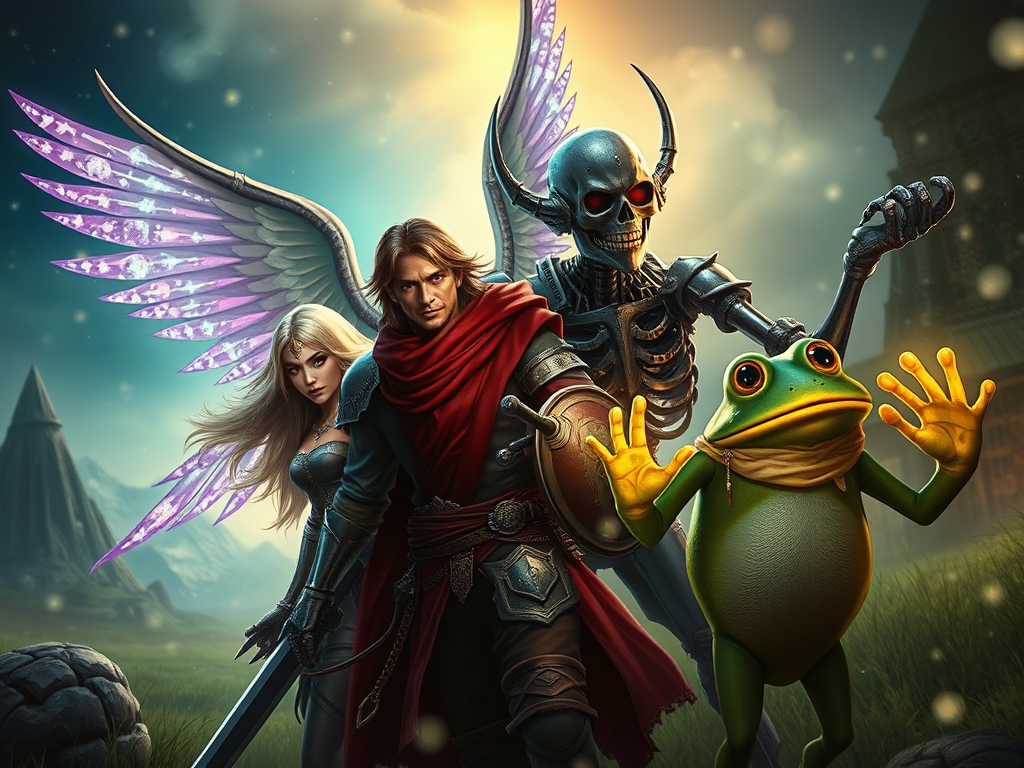
    First off, the cover. It’s very shiny. It portrays a whole bunch of fabulous-looking characters – there’s a knight chick with wings, a dude who seems to be all mouth and no face, a mechanical Necron-looking skeleton with a staff, and what seems to be a humanoid frog with a glowing hand. Huh. Okay, if I can play a magic frog, I’m totally gonna, just for the record.

    We’re on to the introduction. Daggerheart is a game of fantasy adventure where you explore exotic locations and save the day. It “provides the tools to tell a story that is both heartfelt and epic.” All right, so we’re definitely aiming for the flash and sizzle more so than the grime and gore, then. Fair enough. It also “takes a fiction-first approach” and “focus on the story [it’s] telling rather than the complexity of the mechanics.” Oh dear, that gives me a sense of foreboding, but it might just be my emotional scars from spending my formative years with Storyteller games that tended to combine over-complicated mechanics with a snotty contempt for anyone who wanted to actually use them… We’ll see, maybe this one will be better with 30 years of extra wisdom to draw on.

    More emphasis on “epic battles and emotional narratives.” Okay, I’ll grant you that I like both those things. Well, to be exact, I like kicking ass and looking really pretty doing it, and so far the game seems like it supports that.

    There’s a long list of inspirations (or “touchstones,” as it calls them). The roleplaying games include a couple of Powered by the Apocalypse ones, along with Lady Blackbird and Shadowrun. Under literature, we have A Song of Ice and Fire, Sabriel, A Wizard of Earthsea, Lord of the Rings and The Wheel of Time. Okay, that does suggest fantasy worlds where magic is a little more mystical and semi-spiritual, rather than just being a matter of flinging energy around.

    The video games session includes Elder Scrolls, Dragon Age, and… Borderlands. Okay, the last one is an interesting choice. Let’s see if I can spot the connection as we go on.

    The core mechanic is that you roll 2d12+modifier against a Difficulty. There is a special wrinkle, however, in that one of your d12s is your Hope Die and the other one is your Fear Die, and things can happen depending on which one rolled higher, irrespectively of whether the roll succeeded or not. Interesting. You also roll damage dice when you hit someone, to see how much you ruined his day.

    There’s a note on the Golden Rule (that is, you can change any rule you don’t like), and Rulings Over Rules (which here means that rules only apply when it makes sense for them to apply). Sure, sure…

    There is a rundown of what’s in the book. The first three chapters are called, respectively, “Preparing for Adventure,” “Playing an Adventure” and “Running an Adventure.” Heh. I do like the symmetry of that. The fourth chapter is the antagonist section, though it also seems to include environments (which can, to be sure, be plenty adversarial in their own right). The fifth is about “campaign frames.” Not sure I understand what that’s supposed to be, I guess we’ll see when we get there.

    What do you need to play? Well, 2-5 players and a Game Master for a start, and also the usual pile of dice. It notes that you need a d100, which I sincerely hope is just a mistake and d100s will be simulated by two d10s as usual, because I dread to think what one of those would actually look like…

    You also need tokens, which are “small objects that represent the look and feel of your character.” Hmm? Like some sort of miniatures? No, apparently not, because it’s mentioned that you’re going to need to place tokens on cards or character sheets to use certain abilities. Starting characters need about seven tokens, more powerful ones may need as many as 15.

    Okay, hang on, here it explains that tokens can really just be any kind of small objects used to keep track of stuff – paper clips are fine, for instance. But you’re supposed to pick something that expresses your character’s unique aesthetic. Ooooookay, that’s a little too precious for my taste, but oh well.

    You also need game cards, which represent your character’s “ancestry, community, subclass, and domain.” So… it’s basically just a cheat note for keeping track of your special abilities and so on? Finally, you need character sheets, and the game recommends getting the class-specific ones from the game’s website. Hrmpf. In myyyyyyy day we got a single one-size-fits-all character sheet, and we had to photocopy it ourselves so it was always smudged, and by Jove, that was how we liked it!

    (okay, no, we hated it, but still…)

    Maps and miniatures can be used but aren’t mandatory. Too bad, these days, what with Roll20 and the likes, I actually have an easier time playing with maps than I have playing with all those other kinds of handouts.

    There are a set of principles for play, which seem to be strongly inspired by Powered by the Apocalypse. Well, I’m all for those. They are:

    • Be a fan of your character and their journey.
    • Spotlight your friends.
    • Address the characters and address the players.
    • Build the world together.
    • Play to find out what happens.
    • Hold on gently.

    I do like “spotlight your friends,” which means to find ways that the other players can show off and get their moment to shine. It’s something I try to do when I play, and I don’t think I’ve ever seen it put into words like this before, so that’s nice. I also like “hold on gently,” meaning to think in terms of what would be interesting and evocative if it happened, but not be so married to it that you try to brute-force it. Again, that’s more or less my own philosophy too.

    The full-page picture before chapter one appears to be a anthropomorphic tiger with a monocle, which I admit does bring a smile to my face. So, Chapter one: Preparing for Adventure! We start with a brief description of the setting, or at least the underlying metaphysics (I am going to go out on a limb and guess that this is one of those games that has an implied setting in the form of classes and races and stuff, but the actual geography and history are up to you).

    Apparently the world consists of the Mortal Realm, the Hallows Above, the Circles Below, and the Realms Beyond. The universe used to be ruled by the Forgotten Gods, but they were overthrown by the New Gods and cast into the Circles Below. The New Gods now rule from the Hallows Above, and they have made it so that it’s hard to cross between planes, mostly to keep the Forgotten Gods from coming back for a rematch. There are also the Faint Divinities, who are a sort of demigod servitors of the greater gods. Some hang out in the Mortal Realm, others were banished with their makers into the Circles Below to become demons.

    The New Gods can see what’s happening in the Mortal Realm from the Hallows Above, but to actually go there they need to sacrifice something of great importance. Hmm, that’s interesting – usually it’s mortals who sacrifice something to get a god’s attention. It does say that it goes two ways, though, so mortals or demons can theoretically enter the Hallows Above through some great personal sacrifice. Also, arcane magic used in great acts of evil can open a portal to the Circles Below.

    The Realms Beyond are a catch-all term for every other dimension that’s not one of the three main ones – examples are “the Elemental Lands,” “the Astral Realm,” and “the Valley of Death.”

    There is a section on magic, and here’s where it gets complicated – apparently magic takes the form of cards, and every time you level up, if you’re a magic-user of whatever sort, you get more cards. Does this mean that I’m going to have to read through the cards too? Honestly, you’d think with 400 pages in this thing it would cover it all, but I guess not. Oh well. Guess I’ll just have to consider when to go over them.

    Anyway, there is another section that explicitly allows you to “re-flavour” your spells and abilities, as long as it makes no mechanical difference. Well, that’s nice, I know there was at least once when I was playing a 4E Druid in Dark Sun, and I felt that it was kind of off that my spells included damage-dealing “cold winds.” “Tearing sandstorms” felt more setting-appropriate… Anyway, there is also a reference to armour having “Armor Slots you can spend to reduce damage,” which sounds interesting, so let’s see what that’s all about when we get there.