Category: ports

  • More warhammering

    Today’s session turned out to be Dark Heresy, which reminded me that that port may have come a long way, but it’s still in an unfinished state. The basic moves work well enough, but they just don’t feel comprehensive in the way I want – I can usually find one that fits, but not always. I don’t have that problem with the WoD ports, despite them having half the number of basic moves. I don’t know. Maybe I need to think a little more broadly. For instance, today I ended up jury-rigging a move that’s really meant for communicating across language barriers and use it for getting across to someone in an agitated state – making it more generally a move to make someone listen and understand who would otherwise be unlikely to do either. That might be a way to approach it.

    Combat could use some fine-tuning, too. For one thing, I need to do something to make grenades less tempting to break out for everything. They do a ton of damage, but that’s supposed to be offset by them being awkward to use at close range and expensive to stock up on – I think I may need to try a little harder to enforce both those things.

    Also, copy-pasting together the actual options faced by a player whenever they succeed at throwing a grenade (as a Blast weapon) is still getting old. I don’t know, should I just write up separate combat options for each major type of ranged attack (Blast, single-shot, semi-auto and full auto)? That sounds awkward, but it might be a step in the right direction.

    Need some more flavourful GM moves, too. I’ve been using the regular, game-agnostic set (deal damage to them, take away their stuff, give them a tough choice, etc), but they’re not terribly inspiring. I’m thinking some more like:

    • Confront them with brutality and oppression, with them on the receiving end or not. The Imperium isn’t a nice place to live. Terrible things happen to perfectly ordinary people on a regular basis, ranging from merely being worked to death in a fabricarum to being hunted for sport by degenerate nobles. With this move, play up some routine horror, either as a background event (which they might try to stop, if they’re feeling foolhardy) or something that affects them directly.
    • Show them that they’re small. It’s a vast universe, and even the most accomplished human is only qualified to deal with a small part of it. With this move, reveal that the players are completely out of their depth, dealing with a situation far more complicated (and perhaps deadly) than they can even begin to address. Something as simple as finding your way through a labyrinthine hive city can be daunting, and once poorly understood technology and convoluted organisations get involved, things may simply be beyond your ability. For obvious reasons, this move must be used with care, to not cause the players to just stop trying. However, it’s integral to the setting that some problems just aren’t solvable.
    • Have something go terribly wrong on a large scale. Industrial accidents. Natural disasters. Entire swaths of space stations losing life support. When things go wrong in the Imperium, they tend to go wrong in a downright operatic way. With this move, smash something up that changes the entire environment the players are in. They should still have a reasonable chance to survive, of course, but they will likely need to start running.

    Something like that. I’ll need more of them, but that’s a little more fitting for the setting.
  • Houston, we have a resurrection!

    Houston, we have a resurrection!

    Today marks an occasion for my Mummy: the Resurrection campaign. We actually got to the resurrection part. The players finally returned from the Underworld, returning to life in the city morgue. Now let’s see them deal with the various parties who have developed an interest in them. And how long it takes before they stand before the Judges again, of course.

    We ended up spending a little more time in the Underworld than I intended. I’m not exactly sure what to blame that on. On the one hand, I grumble a lot about how my players keep hyper-focusing on whatever is right in front of them and ignoring the overarching situation, but in all due honesty… part of it is also that I set them to too ambitious a task while in the Underworld, having them rescue prisoners from a spectre stronghold. Which required them to first get hold of a Hierarchy cache so they wouldn’t have to do it bare-handed. And then they ran into trouble along the way, because the Shadowlands are dangerous.

    So yeah… in retrospect, I shouldn’t have gotten quite so ambitious with something I just intended to be filler. I do have this tendency to assume that things can get polished off in a session or two, but of course I also don’t want to rush through it without giving the situation proper gravitas, and then I sit there six months later and wonder why we never got to my super-cool “real” plot.

    Part of it is the nature of the World of Darkness, too. It’s supposed to be, if not “realistic,” then at least grounded in some sort of internally consistent setting. Everything is supposed to come from somewhere, everything is supposed to have context. That’s what I love about it. But it does mean that there aren’t much in the way of simple encounters – you can’t just go, “suddenly, you’re attacked by zombies!” because each individual zombie has to have its own angsty backstory or it feels like you’re phoning it in.

    Funny thing? Out of the WoD games I’ve tried, the one that runs the most smoothly is Mage: the Ascension, once I figured out how to manage it. There are still no simple encounters, but the game does encourage you to just throw more mismatched intrigues and general weirdness at the players, and then let them figure it out as best they can. Mummies and werewolves are supposed to be fighting a war. Mages are just meant to “reach enlightenment,” and the nice thing about that is that just about anything can be framed as another Very Important Step On Your Personal Journey. And of course, when the players get really interested in something random and start examining it from every angle, they are acting exactly like the sort of erratic geniuses they are meant to be.

    But yeah, as far as mission-centric games go, I probably should learn to break the missions down into smaller pieces.

  • Magey moves

    Magey moves

    This week, I managed to move on with my Mage: the Ascension port and write up a list of GM moves. This is something like my fourth or fifth version of this list – as usual, Mage resist easy summary. But I think this set works with my conception of Mage as a game about mystery, conflicting viewpoints, and the contrast between the magical and the mundane.

    • Introduce a tantalising mystery or an opportunity to learn. Every mage desires, in one form or another, to learn – to better understand a world that is strange, complicated and often contradictory. The fundamental GM move, then, is to offer the players something to learn about. Perhaps they stumble on the outer Ripples of a Mystery (see the section of Mysteries for details), or maybe they catch wind of a rare book of lore, a wise spirit, or a master who might share his knowledge with the worthy. It can even be something entirely mundane, such as the location of an elusive enemy. Whatever it is, it should not come cheap; the players will have to do the legwork if they want to unravel the enigma.
    • Add another ingredient to the witch’s brew. The world is a battlefield between billions of competing wills, and even a straightforward conflict between two parties can grow complicated in a hurry. With this move, introduce another factor to the scene that comes from a different Paradigm or with another agenda than any of the extant ones. The factor can be an NPC or an inanimate force, seemingly mundane or overtly supernatural – what matters is that it’s different, making the scene feel more disjointed and chaotic. For example, the players might spot a Dreamspeaker rival of theirs while infiltrating a Syndicate-owned night club, or have their Verbena grove invaded by a little grey-skinned alien. Less dramatically, if the players are arguing with their chantry leadership about some course of action, an impasse might be taken as an invitation by a previously neutral cabal to suggest their own preferred plan.
    • Remind them that they walk a world of dust. The world is a harsh place, full of petty injustice and bleak misery. With this move, introduce some purely mundane problem – a mugger, a flat tire, a failing business, a bad cold. The problem can even be the simple fact that things take time, and that the world won’t sit still while the players spend a week digging through the library for information on their enemy. Magic can solve a great many of these issues, but of course that tends to lead to problems of its own; force the players to choose between dealing with things like a Sleeper, reminding them of their fundamental humanity, or invoking greater debt in the form of Paradox or unwanted attention from using their supernatural powers to escape everyday concerns.
    • Have a carefully laid plan go awry. Mages know better than anyone how easily clever plans can go spectacularly wrong. With this move, what someone tried to do – whether the player, one of their allies, or the enemy they were opposing – has a drastic unintended effect, causing a huge mess that doesn’t do anyone any favours.
    • Offer their heart’s desire, at a cost. A mage knows that the world is his for the taking, but everything has a price. With this move, present the players with an opportunity, whether to get the upper hand in a fight, to discover a clue to a mystery, to win a convert to their cause, or otherwise get something they want. However, either make the opportunity fleeting and necessary to act on immediately, without any chance for the players to hedge their bets, or hint that there will be considerable downsides to seizing it.
    • Let them be touched by the flames. Mages try to avoid physical danger, and most of the dangers they face are of a subtler kind. All the same, it’s a dangerous world out there, especially if you take an aggressive approach. With this move, deal Damage to a player, with a level determined by precisely what the source is.
    • Inflict a slow poison or a lingering curse. Any mage knows that the subtlest cut is the one that will barely be noticed at first. Wounds can fester, poisons can take time to kick in, and curses can ruin your life over a period of days or months. With this move, have a player be poisoned, infected, or otherwise compromised, but only hint at it for now; keep the full effects in store for later.
    • Punish them for breaking the laws of the world. Mages attract the wrath of the Consensus by their very nature, and especially so when they use magic carelessly. This move either causes a player to mark Paradox, or creates a Paradox Effect with a level proportionate to how much Paradox the player currently has marked, or – as is usually the case when a player fails an Arete roll – both. It is also appropriate when a player draws attention to some ongoing Effect, when interacting with something supernatural and volatile, or when in the presence of a Maurader.
    • Challenge or threaten their values. Every Tradition value something, if only because it’s something they rely on for power. Hermetics revere the written word, Verbena places of unspoiled nature, Choristers hallowed ground. With this move, place something a player’s Tradition considers special and powerful in the cross hairs, perhaps as part of a plot by a rival Paradigm, perhaps just as a natural consequence of events. This can be a player’s own foci, a location where their Paradigm is strong, or just an abstract value or ideal that’s being contradicted or suppressed. Either way, this gives them a chance to practice what they preach, and stand up for something greater than themselves.
    • Confront them with folly. The ignorant and deluded can be more dangerous than the outrightly malicious, if only because they are so much more numerous. With this move, have an NPC’s failure to see the world for what it really is either cause trouble for the players or provide them with an opportunity. People who are obviously wrong are people who need tutelage, which can strengthen a player’s Paradigm, but they can also dig in their heels and insist on a disastrous course of action unless the players can stop them.
    • Let them define their own reality. A mage practices his craft as much in his way of life as in his spells. With this move, simply ask the player to describe something, whether a character, a location, or a piece of history. Then take that description and add something to it, preferably something that makes the players’ lives more difficult.
    • Teach them that nothing ever truly ends. The consequences of a mage’s actions echo down the ages, and lessons learned frequently have to be rediscovered. With this move, bring an element – a character, an event, a location, an arcane principle – that had seemed over and done with back into play.
    • Make a Paradigm Move. When the players are dealing with some particular Paradigm, you can make a move unique to it that expresses its flavour and feel. This move can be overtly supernatural or merely philosophical, depending on the situation, but either way it represents a particular idea of how the world is meant to work.

  • Principles of magehood

    This week, I’ve been hacking away at my Mage: the Ascension port. I think, at this point, that I have run enough of the game to actually get a feel for it, so now it’s just a matter of getting it out on paper in a way that’ll make me remember it (and possibly explain my way of doing it to others who want to try, but let’s be honest, it’s mostly for my own benefit).

    I’ve written up a new set of Principles that are meant to inform everything the Storyteller does. It was tricky to formulate them in ways that weren’t specific to any particular paradigm, but which still felt flavourful and non-generic. Not sure if I succeeded. Have a look:

    • Be a fan of the player characters. The characters are the larger-than-life, troubled antiheroes of this story of magic and horror. Give them every chance to make choices, and to suffer for them; to stand tall, or fall short; to find wisdom, or be brought low by hubris. Let them show who they are, not as a favour to them, but because you want to see it too.
    • Start and end with the fiction. A move is only ever triggered by the fiction, and its outcome must always ripple through the fiction. Never say something happens because the rules say so. Instead, show what event or condition in the world led to it. Likewise, don’t just state mechanical outcomes (e.g., “mark a wound box” or “take +1 forward”)—explain what they mean (e.g., “your arm’s sliced fending off the dagger,” or “a blessing guides your aim”).
    • Offer no escape from magic. To be Awakened is to live an interesting life, whether you want to or not. Mystery and intrigue will find you. Wherever the players go, let their magical destinies ensnare them ever deeper. Never let them rest for long without introducing a new problem or worsening an old one. The path to Ascension waits for no one — if you don’t seek it out, it will come knocking.
    • Showcase eccentric oddballs, alternative subcultures, and fringe beliefs. Mages aren’t normal people — and neither are the Sleepers they deal with. Neo-pagans and techbros, political extremists and cultists, fringe scientists and secret societies: every NPC should believe in something, and that something should be out of step with the mainstream. Some chase utopia. Others just want to feel something. But none of them believe in half-measures.
    • Contrast the sordid with the sublime. Mages deal in higher truths — glorious destinies, lofty ideals, and sacred dreams. But each is also a creature of fragile, hungry flesh. They reach for the stars while standing ankle-deep in mud. A path to godhood may lead through alleys so filthy and grimy that the very idea of magic seems like a cruel joke.
    • Fill the world with mismatched fragments of possible realities. Behind the curtain, countless paradigms clash — each one shaping reality, each wildly incompatible with the others. Mages make belief into truth, at least part of the time, leaving contradictions and broken stories in their wake. And the world is littered with the detritus of past workings — wonders abandoned, horrors forgotten. Mix mythologies and genres freely: let the world itself seem unsure whether it’s a wuxia epic, a spy thriller, a Norse saga, or a psychedelic fever dream.
    • Give everything arcane significance. Everything is magic, sooner or later. Every office drone on their 35-minute lunch break is unknowingly enacting a grand occult working of efficiency and monetary worship. Every addict shooting up in a condemned building is fumbling toward ecstatic revelation. No action is without philosophical weight — whether the actors know it or not. When imagining a scene, always ask: what higher vision — successful or failed — shaped this place?
    • Place a mystery behind every corner but keep it half-hidden. For a mage, the world is one vast riddle. Nothing is ever straightforward — there’s always a hidden force at work, a scheme unfolding, an impossibility pushing against Consensus. But mysteries rarely announce themselves. What players see first is a minor oddity: a strange coincidence, a subtle wrongness. Whether they pursue it is up to them.
    • Wrap the fantastic in the prosaic. This complements contrast the sordid with the sublime. Every act of magic brings consequences — and depends on logistics. A face-melting curse ends with a trip to the ER and a surgeon muttering “acid attack.” The God of Storms must be summoned with ingredients that arrive in shipping boxes. Spells punch holes in reality — but the rest of the time, mages live in the same world we do, and must navigate its systems.
    • Portray social and environmental ruin. The World of Darkness is a monument to failed utopias. Cities meant to be marvels now rot with smog, slums, and broken infrastructure. Streets reek of exhaust. Everyone’s at once overmedicated and sicker than ever. The system is crumbling — but for now, it clings to life with a rictus grip, too stubborn or afraid to admit it’s already dying.
    • Show spots of beauty and meaning, always in danger of being erased. The world isn’t dead — just almost. In the middle of polluted hellscapes, some still fight for dignity. Amid mass-produced junk, real art and brilliance survive. These things are always at risk — of being destroyed by bitterness, or forgotten in apathy — but they are hope. Let them shine.
    • Make everything someone’s creation, but only sometimes under anyone’s control. Nothing just happens. Every event, horror, or miracle began with someone’s will — or their failure to act. Every demon was summoned. Every curse began as fear. But control is an illusion. Most magical acts spiral far beyond what anyone intended. Chaos is more common than success.

  • Naming moves

    Naming moves

    This week, I’ve been taking another crack at my Mage: the Ascension port. In particular, I’ve tried to get something done with the move names.

    See, I use the same basic moves for all my WoD ports, or near enough – I figure that what a person can accomplish without superpowers in the World of Darkness is pretty consistent. But since each game has a very different tone and focus, I try to make the names of the moves imply it. Asking a player to roll to show your teeth feels very different than telling them to roll to swear holy retribution, even when the mechanics are exactly the same.

    Here is the same list of moves for Werewolf:

    1. Melee attack (Strength): Rend and tear
    2. Feats of strength (Strength): Perform a mighty feat
    3. Ranged attack (Dexterity): Take aim
    4. Feats of speed (Dexterity): Seize an opportunity
    5. Overcome injuries (Stamina): Relentlessly push on
    6. Diplomacy (Charisma): Deal honourably
    7. Manipulation (Manipulation): Cunningly manipulate
    8. Intimidation (Manipulation): Show your teeth
    9. Seduction (Appearance): Rely on animal magnetism
    10. Style (Appearance): Prowl fearlessly
    11. Knowledge (Intelligence): Display your wisdom
    12. Technology/Craft (Intelligence): Use the tools of man
    13. Perception (Perception): Sniff the air
    14. Self-control (Wits): Stay in control
    15. Pathfinding (Wits): Follow a trail

    And for Mummy:

    1. Melee attack (Strength): Smite the wicked
    2. Feats of strength (Strength): Strain your mighty thews
    3. Ranged attack (Dexterity): Let fly your vengeance
    4. Feats of speed (Dexterity): Seize the moment
    5. Overcome injuries (Stamina): Relentlessly push on
    6. Diplomacy (Charisma): Preach the truth
    7. Manipulation (Manipulation): Engage in intrigue
    8. Intimidation (Manipulation): Swear holy retribution
    9. Seduction (Appearance): Beguile with your beauty
    10. Style (Appearance): Appear haughty and regal
    11. Knowledge (Intelligence): Display wisdom and learning
    12. Technology/Craft (Intelligence): Practice artifice and craft
    13. Perception (Perception): See beneath the surface
    14. Self-control (Wits): Master your soul
    15. Pathfinding (Wits): Make the journey

    You get the idea. Werewolf is about pre-medieval tribal warriors who live half their lives as animals. So their move names are meant to invoke a primal, savage feel. Mummy, meanwhile, is a little more civilised, but still ancient – it’s faintly Biblical, about proud warrior kings and wise prophets trying to walk the righteous path.

    And then we have Mage, which I keep trying and failing to come up with something similarly flavourful for. I think a large part of the problem is that it’s harder to come up with a distinct theme for mages. Each Tradition effectively inhabits a genre all of its own, and there’s just not much overlap between a serene Akashic warrior-philosopher and an angry Virtual Adept anarchistic hacker.

    This is my attempt for this week:

    1. Melee attack (Strength): Fight for your beliefs
    2. Feats of strength (Strength): Push your limits
    3. Ranged attack (Dexterity): Strike from afar
    4. Feats of speed (Dexterity): Act with swift purpose
    5. Overcome injuries (Stamina): Endure the cost
    6. Diplomacy (Charisma): Speak for those with ears to hear
    7. Manipulation (Manipulation): Shape the narrative
    8. Intimidation (Manipulation): Make them fear your power
    9. Seduction (Appearance): Weave a sensual enchantment
    10. Style (Appearance): Come and go as you will
    11. Knowledge (Intelligence): Recall esoteric truths
    12. Technology/Craft (Intelligence): Place things in their proper alignment
    13. Perception (Perception): Spot the subtle signs
    14. Self-control (Wits): Master your inner turmoil
    15. Pathfinding (Wits): Blaze a trail

    I dunno. It’s a little better than my last effort, I think. Still not sure about some of them, especially the technology one and the diplomacy one.

  • Fiddling with Talents

    Fiddling with Talents

    This week, I have been working on my Dark Heresy port. I’ve decided that I’m mostly satisfied with how the rules work, but they need to be easier to look up. Since the system is so based on slight upgrades to existing abilities, it leads to a lot of flipping back and forth through files to figure out what a character is even capable of. That won’t do.

    The approach I decided on is to make each player’s character sheet less of a copy-paste from the rules and more something you build up according to the rules. That way, you can ignore all the rules that don’t affect that particular player, and concentrate on what applies to them, personally.

    So I’ve been writing the basic moves up like this:

    When you show healthy paranoia, roll +Perception. 10-14, you achieve a Minor Success. 15-19, you achieve a Basic Success. 20+, you achieve a Major Success.
    • Minor Success: if you are in some sense in danger at the moment, you sense an eerie feeling of menace, but no details of the nature of the threat.
    • Basic Success: the same, but if you are in fact in danger, the GM also gives you a hint as to how and why.
    • Major Success: you learn precisely what the danger is.
    • Absolute Success: you not only learn what danger is threatening you, but also the most promising way of avoiding it.
    Examples: Stopping to smell the air, glancing behind you, thinking back on what danger signs you might have missed.

    Then a player will start out with a move that looks like this:

    When you show healthy paranoia, roll +Perception. 10-14, if you are in some sense in danger at the moment, you sense an eerie feeling of menace, but no details of the nature of the threat. 15-19, the same, but if you are in fact in danger, the GM also gives you a hint as to how and why. 20+, you learn precisely what the danger is.

    Examples: Stopping to smell the air, glancing behind you, thinking back on what danger signs you might have missed.

    Then, if that player takes the Awareness (Known) Talent (which bumps up the results of a successful move to show healthy paranoia), the move gets altered to this:

    When you show healthy paranoia, roll +Perception. 10-14, if you are in some sense in danger at the moment, you sense an eerie feeling of menace, and the GM also gives you a hint as to how and why. 15+, the same, but you learn precisely what the danger is.

    Examples: Stopping to smell the air, glancing behind you, thinking back on what danger signs you might have missed.

    And if the player further takes the Awareness (Trained) Talent, which adds an additional result on a roll of 20+, the move again gets rewritten to this:

    When you show healthy paranoia, roll +Perception. 10-14, if you are in some sense in danger at the moment, you sense an eerie feeling of menace, and the GM also gives you a hint as to how and why. 15-19, the same, but you learn precisely what the danger is. 20+, you not only learn what danger is threatening you, but also the most promising way of avoiding it.

    Examples: Stopping to smell the air, glancing behind you, thinking back on what danger signs you might have missed.

    You see what I mean. At every turn, the player’s sheet only contains the information that will apply to that player themself. This would absolutely not work if we were still using pen and paper like some sort of savages, but of course these are modern times and everything is stored in easily edited .txt files.

    I do worry that this will make it more troublesome for the players to choose new Talents, since now the information on what a move actually does and the information on how it is altered by a Talent will exist in two different places. But I’ll see what happens when I have a chance to run a session with the new PDF.

  • Honour to the Administratum

    Honour to the Administratum

    This week, my players ended up exploring the byzantine bureaucracy of the Imperium of Man. Maybe it’s fitting, then, that most of my thinking this week has been about bookkeeping.

    Character bookkeeping, I mean. It’s not an especially sexy topic, but it’s something that really makes a difference for how easy it is to run a roleplaying session. You want to be able to tell, at a glance, just what rules apply to a character – what their abilities are, what modifiers are affecting them, what they can and can’t do. Because having to stop all the time and flip through the rulebook is freaking annoying.

    One of the charms of Powered by the Apocalypse style games is that they seek to make bookkeeping easy. Rules are kept as modular as possible, so that you usually just deal with one paragraph of text at the time, not three or four different ones that are spread throughout the book. When that isn’t possible, information is often repeated so that it appears everywhere it needs to be, even if that means adding to the page count. It’s part of what makes these games so smooth to run.

    As I’ve mentioned before, when porting Dark Heresy I eventually had to admit that I couldn’t make it quite that nice. I’ve tried my hardest to not make rules depend on other rules that depend on still other rules, but it’s still a big, sprawling, messy game set in a big, sprawling, messy world.

    For example, one thing that I struggled with in today’s session was constantly having to adjust the options available for fighting for the particular weapon the players were using. You see, my rules for ranged combat go like this:

    When you unleash the fire and fury, roll +Ballistic Skill. 10-14, choose 1 option below. You may spend Righteous Fury to choose additional options, 1 for each Righteous Fury spent. Each option can only be chosen once. 15-19, choose 2 options. 20+, choose 2 option, and hold Righteous Fury.

    • You manage to disengage from melee and get onto at least a range of reach to the nearest enemy.
    • You hit a single enemy within range of your weapon and inflict weapon damage on them.
    • You inflict 1 damage on an enemy Horde within range of your weapon.
    • A single enemy who has you within range of their weapon does not hit you and inflict weapon damage on you.
    • An enemy Horde who has you within range of their weapons does not hit you and inflict weapon damage on you.
    • You are not forced to retreat or to take or stay in cover.
    • You cause a single enemy within range of your weapon to find or stay in cover.
    • You establish overwatch; the first single enemy within range of your weapon to leave cover (including to fire a shot of their own) takes 1d10 damage, reduced by Armour.
    • You do not need to reduce your Ammo by 1. This can not be chosen for an Ammo-S weapon.

    Examples: Firing a lasgun, throwing a knife, sniping from ambush.

    But when you’re wielding a weapon with the Blast tag (such as the frag grenades my players were flinging around), the following extra rules apply:

    When you unleash the fire and fury with a weapon with the blast tag, you may also choose the following options:

    • You inflict 1d10 damage on an enemy Horde within range of your weapon.
    • You hit every character in a group standing closely together (such as enemies engaged in melee, allies covering each other’s sides, etc) within range of your weapon and inflict weapon damage on them.

    However, when you unleash the fire and fury with a weapon with the blast tag, you may not choose the following options:

    • You hit a single enemy within range of your weapon and inflict weapon damage on them.
    • You cause a single enemy within range of your weapon to find or stay in cover.
    • You establish overwatch; the first single enemy within range of your weapon to leave cover (including to fire a shot of their own) takes 1d10 damage, reduced by Armour.

    So while I can normally just copy-paste in the list of a player’s options as they succeed at something, neat as you please… here I have to edit the whole thing on the fly every time (okay, so after the first time I guess I should have saved the edited list, but I didn’t think of that at the time). And there seems to be no easy solution to it, beyond writing up the full list of options for every single weapon in the book… and that seems a little much even for PbtA.

    And then there are all the things that players can do, which are adjusted when they take certain Advances, and the things they implicitly can’t do because there are other Advances that allow you to do those things… It’s a lot.

    I think maybe I should restructure the port into a more traditional format. Man, Warhammer 40,000 fights back hard against being PbtA-ified! Possibly it thinks that it’s heretical or something…

  • The people who live anywhere

    The people who live anywhere

    I turned out to devote most of this week to session prep for a session that never happened – too many players had to cancel. Still, it let me get into doing some actual research for creating Nunnehi NPCs, which was kind of interesting.

    Nunnehi, for those not nerdy enough to know, are the World of Darkness faerie-folk native to the Americas. I’ve never really gotten into them, despite being a big Changeling: the Dreaming fan – the Kithain always felt plentiful enough to fill any number of campaigns. But given that I’m now running a sometime Werewolf campaign where one of the characters is an Uktena and the other character is a Fianna of American-Indian descent, it felt like they ought to show up.

    Which means first scouring Wikipedia for articles on Apache culture and history, since I figured my particular Nunnehi NPCs were residents of an Apache reservation, and then trying to broaden it to some other tribes who are connected to individual Nunnehi Families (like Inuits for the Inuas, Cherokee for the Nanehi, etc). This may take me a while, but I think I’m starting to get at least some kind of foggy grasp of what sort of folklore the Nunnehi come from.

    Things to pay especial attention to next might include traditional foodstuffs – those always tend to set the tone, and might give me more of a sense for the natural habitat my game takes place in, besides (I really do need to get a better feel for junipers and cacti). And apparently there is a series of thrillers by some dude named Tony Hillerman who features a lot of Navajo characters, and that might give me a better sense of their modern, everyday lives than a lot of theory.

  • Let’s make – ze magic!

    Let’s make – ze magic!

    So… what did I randomly end up working on this week? Because the only certain thing is, it wasn’t what I was meant to be working on!

    Yeah, it was my Mage: the Ascension port. I wrote up some more definite Paradox Effects to have a grab bag of them ready.

    Mage is one of those games that are definitely crying out for different rules. Not necessarily simpler rules, not necessarily more complex rules – just anything other than the mess it’s saddled with, which manages to be at once overly convoluted and vague and directionless. It is, accordingly, one I’ve put a lot of work into, and I’m by no means finished yet.

    The heart of the system, though, is the spellcasting rules, which rely on two separate moves, like so:

    WORKING MAGICK

    When you cast a quick spell, describe the Effect you’re after and how you will use your Spheres and Paradigm to achieve it. Then roll +Arete. 7-9, choose 2 options below. 10+, choose 3.

    • The Effect lasts until the end of the scene.
    • The Effect does precisely what you intended, no more and no less.
    • The Effect affects something other than yourself.
    • The Effect doesn’t deplete your mystical will (-1 ongoing to all Arete rolls until you get a chance to rest).
    • You don’t need to mark Quintessence.

    When you perform an elaborate ritual, describe the Effect you’re after and how you will use your Spheres and Paradigm to achieve it. Then roll +Arete. 7-9, choose 2 options below. 10+, choose 3.

    • The Effect lasts for as long as you need it to.
    • No hard-to-replace resource is lost, destroyed, or used up.
    • The ritual doesn’t take a long time.
    • You don’t need to mark Quintessence.
    • The Effect is especially strong, adding +1 to the mechanical effects (i.e., it does Damage-2 instead of Damage-1, clears 2 wound boxes instead of 1, gives +2 ongoing instead of +1 ongoing, etc).

    Take -1 ongoing to rolls to create a magickal Effect for each Effect you currently have active. Note that an Effect only have to be maintained if it either affects a living being (who inherently exert spiritual pressure to return to their natural form) or if its continuation is considered impossible under Consensual Reality. Thus, witch-light hovering in mid-air must be maintained, but if you use a spell to set a piece of wood on fire, the wood will keep burning on its own once ignited.

    The main power of magick is to change or explore the fiction. If you use magick to create a hole in the ground, then now there’s a hole in the ground; if you use magick to read someone’s mind, the GM tells you what they’re thinking about. Magick rewards creative thinking and clever approaches, not brute force. However, if it really comes down to the nitty-gritty, a magickal Effect can do the following things if the caster can explain how:

    • Create a Damage-1 (Damage-2 for Forces) weapon for its duration.
    • Clear 1 wound box.
    • Give a weapon Damage+1 (Damage+2 for Forces) for its duration.
    • Give a weapon the AP tag for its duration.
    • Grant someone Armour+1 for its duration.
    • Grant +1 ongoing to specific actions for its duration.

    PARADOX

    When you work magic carelessly, Paradox can result. Mark Paradox for each condition that is true:

    • The Arete roll failed.
    • The Effect was vulgar, i.e. obviously magical; couldn’t have been reasonably mistaken for coincidence, a trick of perception, cutting-edge technology, etc. Effects that could be plausibly explained away are called coincidental. This condition never applies in the Umbra or in a sanctum dedicated to your Paradigm. Note that repeated uses within a short period of time can make a coincidental Effect become vulgar; one strange coincidence might be accepted, whereas several in short order can itself be seen as a sign of supernatural power.
    • The Effect was vulgar and at least one Sleeper who is not a sincere believer in your Paradigm observed the Effect take place.

    A character has 15 Paradox boxes divided into Paradox rows of three Paradox boxes each (or 20 boxes in rows of four if the character has Background: Familiar). When the GM makes a Paradox Move, the severity of the move depends on how many rows are fully filled in.

    Paradox is the Consensus punishing you for your temerity in defying it, so to banish it again you must show that you can play by the rules even when it’s inconvenient. Thus, every time you fail an Attribute (not Arete) roll, you clear 1 Paradox box.

    Arete, for comparison, starts at +0 and can rise as high as +2 at the end of a long campaign, but you also take +1 to any Arete rolls that fits your Avatar Essence, and another +1 for any attempt to cast a Rote you have previously memorised. Combined with the way you’ll often have to choose to take penalties to Arete, and the way that Paradox builds up over time, it makes magic something that starts out very powerful as a mage steps fresh into the scene, but gets increasingly iffy as a situation drags on – which feels like how it should be.

    All in all, this system is working out reasonably well in playtests so far, and gives me plenty of opportunities to both make my players feel powerful and to mess with them – both of which are things that I, needless to say, especially enjoy…

  • Nothing new to add, so here, have some mages

    Nothing new to add, so here, have some mages

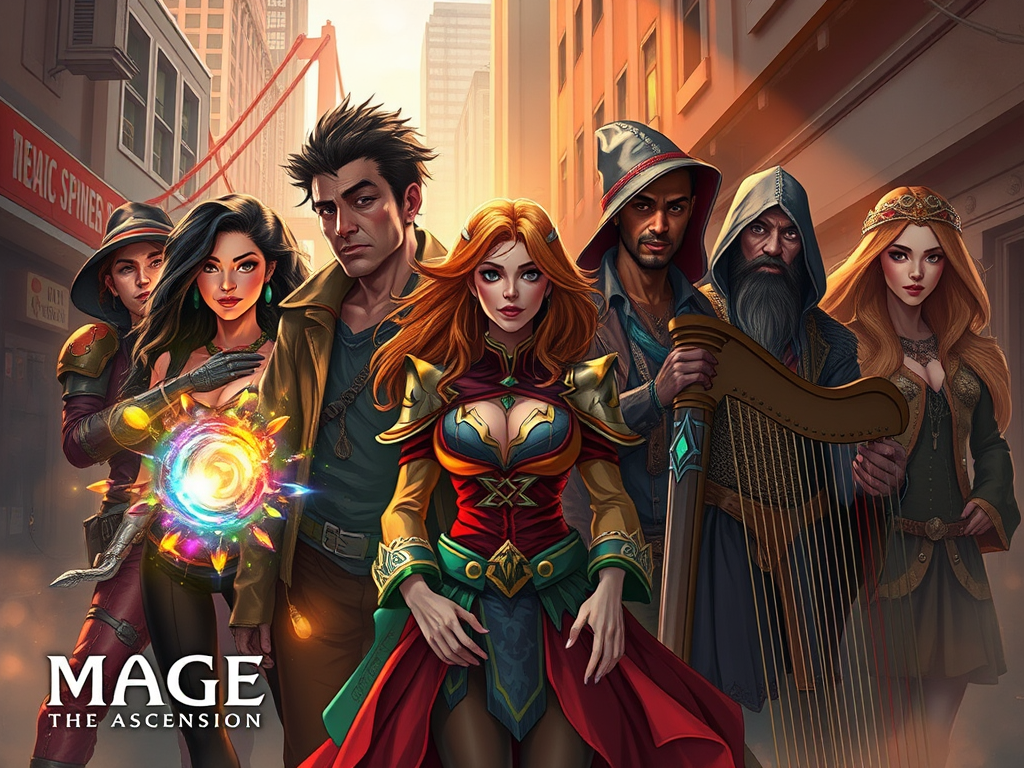
    This hasn’t been a very productive week by any means. I didn’t manage to do any actual work on any actual project – instead, I seem to have spent most of it inventing NPCs for my Mage: the Ascension game. Which I guess needed doing at some point, but still, my inspiration remains fickle and unreliable.

    All that said, here’s what I’ve come up with for the Traditions in the San Francisco area:

    • Cassie Moran – aging rock goddess and Cultist of Ecstasy. She uses her precognition and clairvoyance to play the entire underground music scene like an instrument, trying to build it up to a force for enlightenment, rebellion, and all-around grooviness. Anything she does is probably motivated by its sixth-level consequences.
    • Jonathan White Eagle – life coach to the wealthy and Dreamspeaker. Is gruff and set in his ways, all the more so since he worries that his attempts to make rich people connect to their spiritual side is diluting his own ancestral ways. He’s the last Dreamspeaker in the area, and looking to take on an apprentice.
    • Jeremy Linton – geeky pencil-neck and Virtual Adept. He messes around with nano-machine clouds and is enthusiastic about the idea of turning the Earth into “computronium” that will rearrange itself to the will of any human. Well, any human who’s good with computers, at least, but who cares about those other meat-headed jocks?
    • Rosa “Rush” Martinez – tough biker chick and Virtual Adept. A “neo-nomad” who thinks that permanent residence is just something The Man has invented to keep track of you better. Part of a cabal with Jeremy and Ranjit, and tends to handle the rough stuff for them.
    • Ranjit Morrow – a self-proclaimed “Doctor of Mesmerism” and Son of Ether. Practices hypnotic suggestion to manipulate “archetypes of the collective unconscious” and draw forth “unresolved defense mechanisms from failed stages of development.” Likes to stroke his beard wisely at people and puff his pipe. Tends to hang out with Jeremy and Rosa and handle all that nasty “people skills” stuff for them.
    • Rowan Flynn – a “warrior bard,” a Cultist of Ecstasy who would probably have been happier as a Verbena. An erstwhile apprentice of Cassie’s, but seems to be having some conflict with her now. She can heal people through harp music, incense, and touches, or work herself into a berserker frenzy where she can feel no pain. Has some anger management issues.
    • Aloysius Crane – a masochist and piercing enthusiast and Cultist of Ecastasy. Looks absolutely terrifying but is extremely soft-spoken and mild-mannered if you get to talking with him. He considers submission to pain to be the path to true enlightenment. He mostly backs up Cassie in whatever she does.

    And for the worthy opposition in the Technocracy, without names as of yet but called by the names the Traditions give them:

    • “The Nice Doctor”, NWO: A middle-aged man with long, wild-grown grey hair, usually wearing shabby clothes, cracked glasses, and untied sneakers. Despite looking like a crazy hobo, he’s a frequent visitor of city hall where he “consults” on details of policy being written, and a popular guest lecturer at USF within a surprising number of social sciences. His go-to apparatus is an innocent-looking device about the size and shape of a pen, which can emit high-frequency sonic waves that renders people instantly pliable to hypnotic suggestion. People who threaten to rock the boat in a serious way might be meet him, and the person who walks away from such meetings frequently has very different views than the person who came to it.
    • “The Woman in Grey”, NWO: a prim, plain woman in her forties, always dressed in a grey business suit and with her hair in a bun. She is most commonly seen taking part in investigations of major crimes and threats to national security, with the other detectives and agents involved being under the impression that she’s from one of any number of alphabet-soup agencies, or possibly one that’s too secret to even have a name. Either way, her cases tend to get solved promptly and without her taking credit, but almost always in some way that demonstrates the reliability of public investigators and the absolute need to keep giving them any and all powers they ask for. If you have done something illegal in your life – anything – then she most likely doesn’t care, but she absolutely knows about it, and has a meticulously prepared dossier to present you with should she ever need to apply some pressure.
    • “The Blank”, NWO: the Traditionalists are only mostly sure that this is a single person, and only because a number of people who seemed to have very different physical appearances have been noted as having suspiciously similar magical Resonances. Either way, the Blank kills people who the Technocracy regards as irredeemably disruptive to the Consensus; Marauders, Nephandi, terrorists, serial killers, the occasional non-human supernatural. When no one needs to be bumped off, the Blank is believed to be managing security at the San Francisco construct, but hell knows.
    • “Ol’ Henry”, Void Engineer: not technically part of the NWO amalgam made up of the Nice Doctor, the Woman in Grey, and the Blank, but sort of loosely attached to it, Henry is a Void Engineer who’s been grounded for extreme uncooperativeness and set to track down and dispose of the hobgoblins, rogue spirits, or sundry creepy-crawlies that San Francisco has more than its share of. He looks like a scruffy man in a faded jumpsuit, with a pair of high-tech bracelets with a tremendous array of built-in weapons. The Paradox building up from his use of vulgar Effects (the Umbra is so much more forgiving of such things, and he’s too stubborn to change his ways) has caused him to develop some peculiarities, like nictitating membranes and odd subdermal tumours that sometimes seems to move across his body. He has been known to grudgingly team up with Traditionalists to take down his prey; he has no particular love for Reality Deviants, but then, he seems to have no particular love for anyone or anything.
    • “Mr. Slick”, Syndicate: young, trendy, confident, and oilier than a can of anchovies. He firmly believes that what people want, really want, is the coolest and most expensive toys, and he’s got the personal collection of overdesigned bleeding-edge gadgets to prove it. He is also heavily into youth outreach, trying to mold the next generation into proper go-getters by showing them the benefits of a completely materialistic lifestyle; this has led him to both sponsor the Trinity Burning gang and to take promising young students from underprivileged backgrounds under his wing.
    • “Numbercrunch”, Syndicate: a strange, autistic teenage girl who rarely ventures out of her den of a thousand monitors beneath the construct. When she does go out for a field investigation, she wears a hood and headphones to prevent sensory overload. Her Empowering came when she read “The Seven Habits of Highly Effective People” and then spent the next forty-eight hours writing a new edition with another forty-two habits. She goes through media output and statistical data and predicting the future over the entire area, making the Syndicate amalgam very hard to take by surprise.
    • “The Slav”, supposedly Syndicate but actually Nephandus: a surly, hirsute Russian who looks more like a janitor than the master of middle management that he is. He does consulting work for a number of R&D divisions, where he snarls at engineers until their output skyrockets. He also heads up the a reclusive team that produces experimental weapons for field testing. Unknown to his colleagues, the Slav is actually in league with Pentex, who supplies him with Bane-powered fetishes that slowly corrupt the mages who use them. In his youth, he was a fervent believer in the American Dream and the promises of capitalism, having been raised on horror stories of his grandparents’ time in the Soviet Union. However, he Fell upon realising just how amoral the Syndicate truly was and now works to make capitalism every bit as bad as its worst critics claim it is; a human race that can turn any and every economic system into a nightmare, he believes, deserves to suffer.