Aha! Ahahahaha! I did it! I read the whole stupid thing! Half of it I didn’t particularly like and the other half I outright loathed, but I got through it all and now I can despise it while fully informed!
… sometimes I think the Internet has just broken me.
Anyway, here’s the last stretch. First off we have the Player’s Guide, which is usually the title in any game line where they cram in anything and everything they couldn’t find a place for anywhere else. Let’s see if there are some nuggets in there.
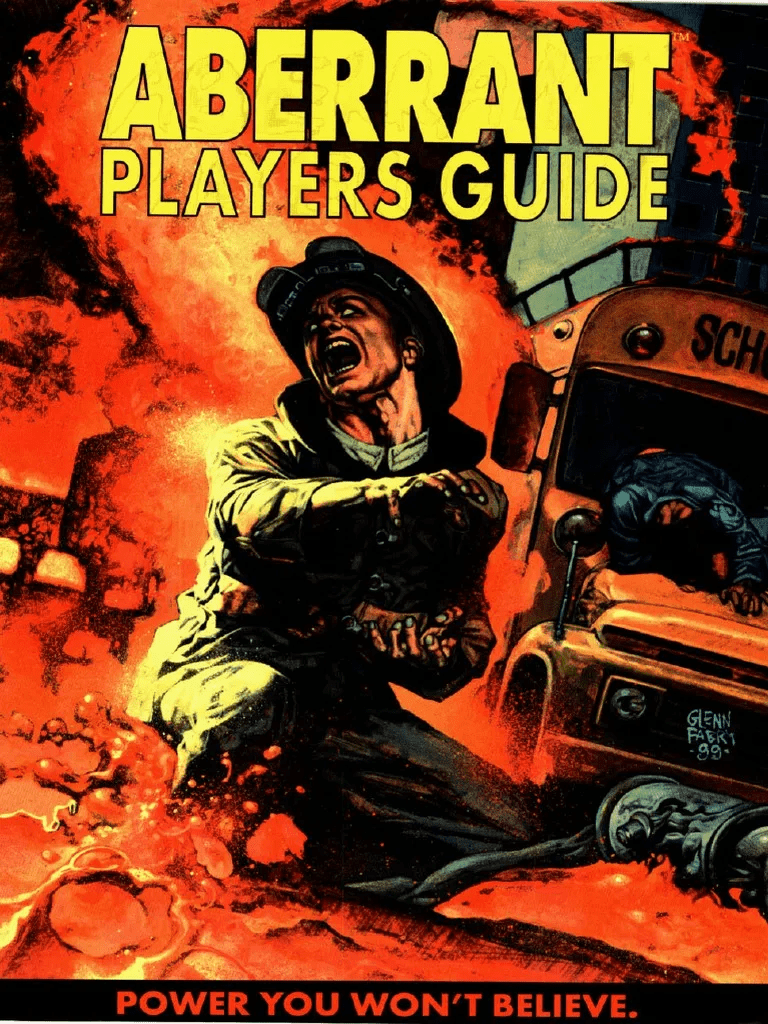
We start off badly with the infamous This Is Not The Superfriends essay, where we are berated for being so unimaginative as to play superheroes. Why, if we would only open our minds a little, we could play far more interesting things like… er… hmm… a teleporting courier of some sort! Or a mentally disabled pro wrestler! Don’t you see, the possibilities are endless! But suuuure, you can play a game where you wear tights and have code names and punch villains, if that’s really the level you want to stay on. Like, if you’re a complete philistine you could do that, yes.
Uh-huh. Here’s the problem with that. Well, there are many problems with that, but here’s the main problem with that. The game doesn’t offer any sort of support at all for playing one of those “more creative, more realistic” character types. And I know this for a fact, because I have read through the whole stupid thing so I can have an informed opinion! In the game that is delivered over sixteen books, of which this one is the fifteenth, most character you encounter wear tights. And have code names. And punch, if not villains, then at least people they don’t like. The situations you’re set up to encounter tend to involve international intrigue and looming large-scale disaster, not navel-gazing reveries of how it would really feel to have superpowers, you know, really, I mean really.
And there is a very good reason for that, which is that it’s hard to even imagine what a game about navel-gazing reveries would even look like or how you’d play it. Immersion is all very well, and there should certainly be more to most games than just rolling to hit, but you also need some kind of tangible conflict to interact with. And that was something White Wolf always seemed to acknowledge only reluctantly and with the greatest distaste, because ew, dice-rolling, how uncultured.
Okay, I’m five pages in and already I’m ranting, I’d better move along…
Immediately after the section about how shallow and boring you are for wanting to play a character with a code name… we get a long worldbuilding section about how novas choose their code names. Because this game is immune to irony. Okay, so I understand it’s really because the different chapters were written by different people who didn’t communicate very well, but still, you couldn’t have created a better example of tonal mismatch if you’d tried to…
And following that is a long worldbuilding section about novas acting as vigilantes. Are we sure they weren’t intentionally parodying themselves at this point?
There’s a semi-useful part about how you rise in the ranks as part of different factions, and what Backgrounds you might gain to symbolise your new assets. There’s also a rundown of each Background, alter on, that provides a bit more guidance for how it might actually be used. That’s cool. Also, someone realised that the Eufibre Background (which gives you… a spandex suit that won’t get shredded by your powers) was underwhelming, so now there’s also the option to use it to make your suit change shape, have it send out tentacles or form wings and just generally do the whole Venom-symbiote thing. That’s even cooler.
There’s a section of rules for going into space. Which is nice, I guess, very superhero-y… but it’d be even nicer if there was actually anything out there to get excited over. I mean, I’m pretty sure sentient alien life exists in the Aberrant universe, but apparently we’re not going to be using that until Trinity?
The OpNet gets a bit more description and it’s even more hilariously obvious that it’s basically the Internet of today. Like, credit where it’s due, they anticipated a lot of upcoming possibilities and annoyances at a time when dial-up modems were still state of the art. We also get stats for a pair of nova documentary-makers. Okay, I guess that might be useful at some point…
Novas used to exist before N-Day! They were weaker, but they were around, and people only don’t know that because Project Proteus has shushed it up (for… some reason?). So you can play a historical Aberrant game if you want to use these piece-of-crap rules without the piece-of-crap setting. Whatever.
We finally get a look behind the curtain of the Aeon Society (I may not have mentioned them. They’re the vaguely benevolent secret conspiracy of rich people who founded and run Project Utopia), and some general setting information about just what quantum powers actually are. In addition to novas, there is also something called psiads who don’t control quantum energies but “noetic energies,” which are basically magic, as if quantum powers weren’t… Anyway, psiads are weaker than novas and have subtler powers, but they don’t suffer Taint, so that’s nice. The Aeon Society knows about psiads and are discreetly researching them.
There’s also a third kind of super called paramorphs, but you can’t play one of those. There’s only one in existence and he’s super-cool and wonderful and godlike and DEAR LORD, I’m so glad that the game ended before we got to see more of that guy because I’d have ended up hating him more than Divis Mal. He also effectively runs the Aeon Society and thus in extension Project Utopia, but he’s totally not responsible for anything bad Project Utopia does because he’s just too noble to use brute, authoritarian force to get them to stop vivisecting people. Arrrgggghhhhh.
There are new nova powers. They are boring. You know, that bears repeating. The powers in this White Wolf game… are boring. That would be White Wolf, famous for being terrible at power mechanics but great at power flavour. You read a game like Exalted and go over the Charm lists, and you keep going, “oooooh, that’s cool. It’s absolutely, completely useless and I’d be screwing myself over by taking it instead of something that just gave me a flat dice bonus, but it sure is cool.” This game fails at the thing that the writers built their brand on being good at. Let that sink in.
There are overpowered powers that the players are never, ever, in a million years going to be able to buy and that are just there to justify the abilities of uber-NPCs. They are boring too.
There are rules for creating artificial superpower-gizmos like freeze rays and jet packs and stuff. They are delivered with a lot of sniffing and sneering and “well, if you must have them, here they are.” Yeah, you really hate the idea that power might come from something other than inherent speshulness, don’t you?
The book wraps with some “nova affiliations” (superteams. They’re superteams). That’s a thing I have actually asked for, so that’s nice. Nippontai finally gets outlined, and so does a Scandinavian team (except the writers seem to think that the Netherlands are part of Scandinavia…), an Australian team, a doomsday prepper team living in Antarctica (first mentioned back in The Directive, finally described here), a psychic team (that includes some psiads who don’t realise they’re psiads and not novas), an ecoterrorist team (who kill and torture people, and which the writers clearly meant for the players to be able to join. Yeah…), a team that explores space, and a gay team (I haven’t said anything about the game’s strident LGBT activism and I’m not going to start now, but… yeah, that was a cause the writers were clearly very passionate about). Well, that helps, actually I’d kind of have liked to see a similar writeup of the four Team Tomorrow groups, since they’re supposed to be the most high-profile group in existence, but, well…
What we do get is a membership roster of… Teen Tomorrow (ugh. Too cute), the teen superhero team. Which is such a terrible idea in a “realistic” setting that even Caestus Pax, authoritarian strawman that he is, is against it, but here they are anyway. And they have a Teragen counterpoint called the Kabal. Ugh.
Well, that wraps it up. Then all that remains is:
You know those crime syndicates that have hung around in the background for the entire game line? The ones that seem custom-made to provide antagonists but that are so vaguely defined as to give you nothing to work with? Well, here we finally get a closer look at them, and it turns out that they… do criminal-syndicate stuff.
Well, that was sure worth waiting fifteen books for!
Sigh. To be a little more specific, when Project Utopia ended crime as one of its opening moves (which it apparently did by loopholing the use of super-senses and mindreading as not counting as illegal surveillance and therefore being admissible in court, in a move that should definitely have gotten every halfway-sincere human rights activist up in arms but was apparently accepted by any but a few malcontents because “everyone was tired of seeing the mobsters get away with stuff”… I hate this game so much), the crooks who were smart and ruthless enough to not get caught banded together into four super-syndicates that now rule the underworld. Which is… convenient for ease of use, if nothing else; you don’t have to read up on the particulars of Mexican drug cartels when there’s just one big organisation that does all the drug-smuggling from Latin America.
There’s the Camparelli-Zhokov Mega-Syndicate. They’re the Sicilian mafia that’s teamed up with the Russian mafia so that we can have everything called “the mafia” under one umbrella, and never mind that they don’t actually have much to do with each other… There’s the Heaven Thunder Triads, who are Chinese and mystical and insidious and filthy and did I mention that this book has a sidebar berating you for indulging in ethnic stereotypes? There’s the Nakato Gumi, who are the yakuza and hyper-modern and also effectively allied with the Directorate (because the Nakato Gumi owns Kuro-Tek, which is a Japanese company that produces all sorts of interesting weapons that Utopia doesn’t want people to have). And there’s the Medellín Cartel, who are South American drug smugglers and also Nazis for some reason.
Naturally, the book does a lot of humming and hawing and trying to nudge you away from actually using its content. See, Project Utopia doesn’t actually want to fight crime (they want to attack the “root causes,” apparently), and the syndicates don’t actually have a lot of nova operatives for them to fight, so, you know, are you sure you wouldn’t rather play a mentally disabled pro wrestler? But fine, if you absolutely must, you can fight gangsters, or play gangsters, just as long as you keep in mind that it doesn’t actually matter to the setting in any way.
The book closes with a sample character. Who is… Spider-Man. Except a crook. So now we have that.
And that’s it, I’m done. I hope you enjoyed my increasingly deranged ranting, though I can’t really say the same. Next week, I might try to put together some kind of closing thoughts, and then I’ll see about writing about something I don’t actually hate. Now that’ll be a nice change of pace…
 Mister Monster's Workshop
Leave a comment