Continuing our readthrough of Aberrant, this week we arrive at the elites. Less a faction than a fact of life, elites are mercenary novas who hire themselves out to use their quantum powers for anyone who can pay, whether that is the military dictator of a banana republic or a UN agency that is looking to get something done off the books. Will they turn out to be more interesting than most of the others? We shall see.
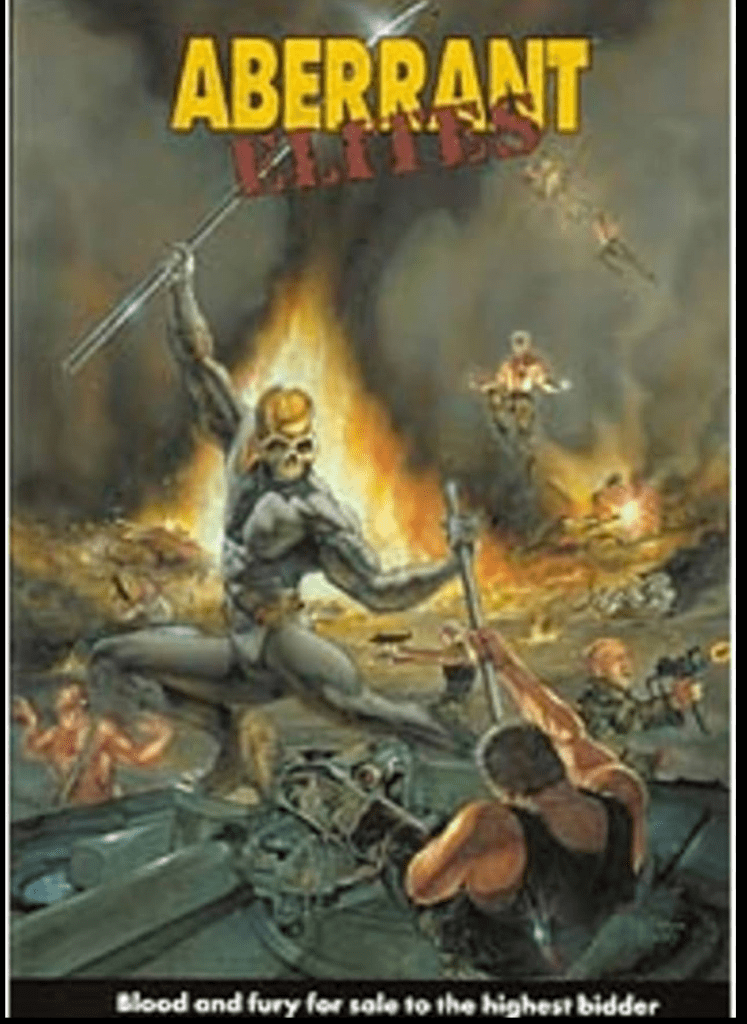
The book starts out with what I think is actually the best piece of fiction the line has had so far. It’s about a group of elites fighting in a miserable Third World conflict and dealing with the lousy conditions and the human misery that comes with it. While it’s very 90s in its way of taking real human suffering and using it to make its silly dice-rolling game feel serious and relevant, it also manages to show novas under physical, mental and moral strain, and there has been entirely too little of that so far.
The rest of the book is passable, if not great. It presents the DeVries Agency, which is the leading broker of elites worldwide, and a number of its smaller competitors. It suffers from the same problem that books like Project Utopia does, in that it seems to think that describing bureaucracies and paperwork is the way to make things feel realistic, and never mind that anyone who tried to actually roleplay out a dry legalistic contract negotiation would probably expire from sheer boredom. Still, it does present the world of the elites in a way that makes it feel vivid and like something that you could model at the table. You could absolutely use this to build a campaign where the players were working for a rent-a-nova outfit – in fact, in many ways elites are probably the closest thing you can find in this setting to regular RPG adventurers. They take on quests, they get into trouble trying to carry them out, and then they waste their reward partying so they have to do it again next week. Hey, it’s a classic for a reason.
One thing that constantly bugs me, though, is the way the writers always seemed to be hazy about how they meant the game to actually be played. There are all these endless descriptions of how realistic everything is, and how it’s all very serious, and then from time to time the books just go, “but hey, feel free to play the game like goofy four-colour action if you want!” For example, here you get told that if you want to, you could run a game where the characters were Noir detectives with eufiber trenchcoats and fedoras (yes, really, it says that) working out a ratty office. Never mind that the whole game endlessly stresses how novas can easily make the big bucks, you do you, man!
And, like… White Wolf, my dudes. If someone were to ignore your setting, then they’d be buying the books purely for the rules. And let me guarantee you, no one ever bought your books for the rules! Because they were terrible and everyone hated them. It was the feel and ambience that we liked, and the way you kept nervously hinting here that maybe we should just skip that and go punch some bank robbers makes it really painfully clear that you had no confidence in the setting you’d created.
And I could be mean here and add, “and rightfully so!” but you know what? No. That’s not true. There is something here that I haven’t seen before, even thirty years later, and which could have shone if it had been properly polished. If you’d just thought a little harder on what your themes were supposed to be. If you had just set up the conflicts better. If you had just… cared like obviously cared about your more successful games.
But oh well.
The book presents two specific war zones that players might get into, Kashmir and Congo. The former is a seemingly eternal hot spot where three different world powers (India, Pakistan and China) are glaring at each other over a bombed-out wasteland that neither of them really has any use for in its present state, but after all the misery they’ve gone through for it they absolutely refuse to let anyone else have it. Depressing but believable. Congo has a nova dictator who’s too overcome with Taint to dictate especially well, so a hundred tiny warlords are carving up de facto domains all over it. Both of them feel like decent settings for gritty military superheroics, a cross between an MCU movie and a Vietnam War story.
Much like in The Directive, the best part is really the equipment section, and I say that as someone who usually hate equipment sections. The DeVries Agency have come up with all sorts of cool shit like monomolecular whips and robotic wasp swarms that they’ll let you use if you show that you’re a closer. Works for me.
As with all these books – and yes, I will complain about this to the very end – is the lack of interesting NPCs. A superhero setting runs on its larger-than-life characters, and other than the Teragen, Aberrant suffers from being full of small, dull people with no discernable drives or passions. And this is in spite of the fact that novas in general and elites in particular are meant to be celebrities, people with very distinct images. It’d be one thing if those images were mostly publicity stunts covering rather ordinary, neurotic people, but here, even the images themselves are dull.
The best of the lot is this guy who goes by Totentanz, and apparently his thing is that… he kills people a lot. And then you read his backstory, and it turns out that he kills people a lot because he got so sad when his fuckbuddy made it clear that she had no feelings for him that his quantum powers switched off all his emotions other than psychotic rage. So… his thing is that he’s actually even more boring and one-dimensional than he seems? I mean, at least he’s got a cool name and costume, and that’s more than what most of them have, but there’s just no substance there.
So all in all, this is one of the better books, but that’s not saying much. Next time, we’re going over Worldwide Phase One, and that might need to be a two-parter, because oh yeah, I have things to say about that one! Which does admittedly mean that it’s not boring.
 Mister Monster's Workshop
Leave a comment