Ploughing on with our Aberrant readthrough, this week we are going to cover Year One (which is a general setting book) and Project Utopia (which is about, well, Project Utopia).
Both of these books are, I think, absolutely vital to running the game, for the reason that Aberrant is not the sort of setting where you can just make shit up. This is clearly by design – the developers didn’t want an anything-goes kind of setting, but one that was well-defined, interconnected, and where things happening in one place had consequences in other places. Whether that was necessarily a good idea is up to debate, of course – I’ve complained earlier about how it makes it really hard to really make good on the game’s promise of letting you use your superpowers to change the world. Everything is so bolted down and slaved to a rigid metaplot that the things you can change just feel flimsy and unimportant… and on the flip side, if you do manage to change the setting, then it’s no longer the same setting and all those expensive setting books just became obsolete. But okay, for better or worse this is clearly what they were going for.
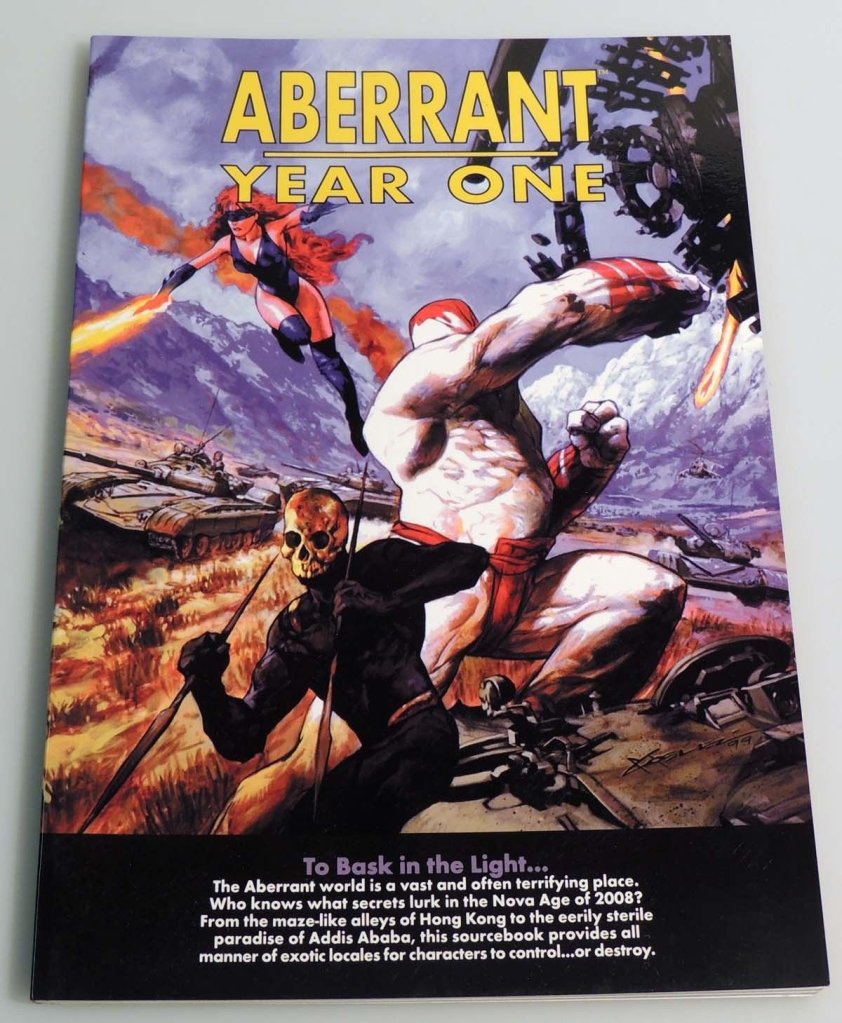
The bulk of the book describes a dozen major world cities and explains what nova-related shenanigans are going on in them, with a signature nova or two statted up at the end.
New York is boisterous and caught in a three-way tug-of-war between nova-hating religious nuts, nova-worshipping religious nuts, and nova-led rational inquiry (which also may contain nuts). Also, a nova has gone crazy from Taint and is actually leading both the pro-nova and anti-nova factions, under different identities, which is at least kind of funny.
Los Angeles is full of degenerate has-been celebrities and is plagued by police brutality. And within the game, it also has a dozen different time zones within the same city! (yes, yes, cheap shot)
Havana has gone from communist to an extreme laissez faire capitalism whereby anything is permitted as long as you can afford it. It’s a great place to buy and sell outlawed technology, corporate or state secrets, and the services of specialised novas. The fact that it sounds a lot like an old-timey pirate port mixed with a Cold War thriller is probably not coincidental.
Mexico City is the headquarters for Team Tomorrow Americas (Team Tomorrow is basically the best of the best among Project Utopia’s novas) and has gotten a lot wealthier in a hurry. However, people are suffering collective whiplash from all the changes and are starting to grumble, especially since a lot of Mexicans are sensitive about Americans and Europeans not respecting their culture.
Quebec is cold and bleak and boring, because this is a White Wolf publication, and I think the White Wolf writers considered Canada the polar opposite of all that was cool, edgy and gothic-punk, so any supplement that mentions it is going to portray it as absolutely miserable. They don’t like novas and they are killing each other over the stupid French/English thing. Feh.
Venice has also gotten a makeover, including a ton of new islands to plonk down new buildings on. It’s the headquarters for Team Tomorrow Europe and, much like Mexico City, there is some friction between the frantic future-optimism of Project Utopia and the people who actually quite liked yesterday and aren’t at all sure they want to have it paved over without even getting a say-so.
Lagos is under the competent but oppressive rule of a baseline dictator who is enlisting Nigerian novas to bolster his regime. I kind of like this guy just because he’s pretty much the only baseline I’ve seen so far that gets treated with some gravity. He’s clearly meant to be an example of the sort of realistic villain you can encounter in the setting, which is cool – he’s not out for WORLD DOMINATION!!!!, but he’s sure as hell out to expand his borders and cement his rule, and that will lead to him committing all sorts of interesting human rights violations that he’ll furiously deny to the media.
Addis Ababa is the headquarters of Team Tomorrow Central, and is sitting pretty since Project Utopia terraformed Ethiopia’s deserts to perfection. It’s basically a scale model of what Project Utopia is hoping to turn the world into, hyper-modern and prosperous and with high-speed rails and cleaning robots everywhere.
Moscow is the seat of the Directorate, which I’m still not going to go into too much because they’re still boring, but anyway, Moscow is basically a hotbed of Cold War style espionage and misdirection and general paranoia. It’s grim, it’s cold, and your hotel room is definitely bugged.
Mumbai is the new movie capitol of the world, having beaten out Los Angeles. Novas flock here to make really flashy movies where you’ll believe a man can fly because he actually is flying.
Jakarta is a mess. The whole nova boom just kind of didn’t happen here, and everyone is cranky about it. Also, organised crime.
Hong Kong. More organised crime, and the meeting between the West and the East or some such cliche.
Tokyo loves novas to a slightly unsettling extent. There are religions worshipping them, and even the secular fans are a bit scary. The Japanese government is part of the Directive but basically likes novas fine as long as they’re its novas, having formed a Japanese super team called Nippontai to compete with Team Tomorrow. We don’t find out much about them, which is a shame.
After the cities, there is a section about cutting-edge technology in the alternate year of 2008. Again, this is absolutely essential, because the books keep mentioning how the novas have created cool new technology while also stressing that this is not the sort of anything-goes setting where a super-genius can whip up a time machine in a few hours, and balance can be tricky to strike if you’re not up to date on what the latest technological forecasts are.
Specifically, new technology includes hypercombustion (cars still run on petrol, but they’re a lot more energy-efficient about it), a new super-fast Internet called the OpNet (which, impressively enough, really does resemble the Internet of 2025 to a prescient extent), genetically engineered microorganisms that can clean up pollution, limited cloning and limited cybernetics. People have abandoned floppy disks and CDs in favour of miniaturised “chips” that can be plugged into a carriable reader (yeah, it no doubt seemed terribly futuristic in 1998). Flying cars actually do exist, but most countries don’t let civilians drive them for obvious reasons. Reasonably lifelike remote-controlled robots likewise exist, but they are very limited (for one thing, they have a physical wire trailing after them) and so are mostly just used by politicains who want to make public appearances despite concerns about assassination. Cold fusion is being worked on, but no one managed to figure it out yet. Oh, and someone has invented a miniature remote-controlled tank, and the crime syndicates are absolutely going to get their hands on some and use them against the players.
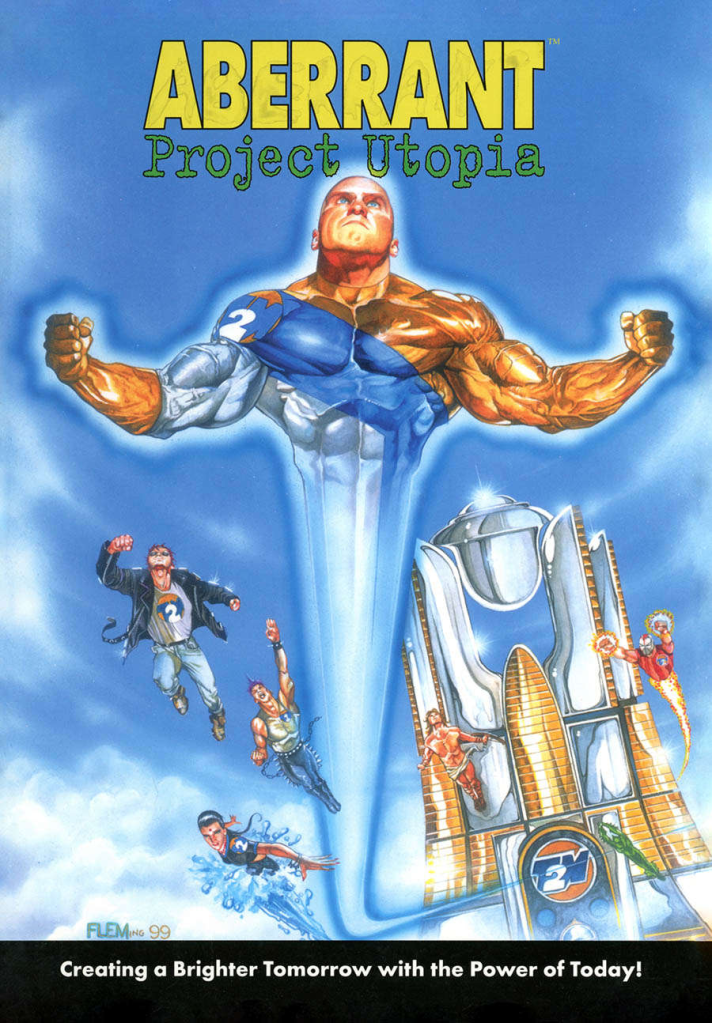
Project Utopia! Another thing you absolutely need, because this is supposed to be the massive organisation that has reshaped the entire world and who have their fingers in every pie, and the shady dealings of which form the spine of the entirely-too-inescapable metaplot. You need to read this book to play the game.
So it’s a shame that it’s so damn boring. Most of it is just the same tiresome gushing about how Project Utopia is doing all those things that all reasonable people agree ought to be done, and nyeeh-nyeeh-nyeeh to all the nay-sayers who said it wouldn’t work because they tried it and it totally does. We get a slightly more detailed history of the Project, most of which we already knew from the core book, and we get a rundown of all the various divisions and who’s running and them and what they do to make the world a better place. Again, this is certainly necessary, a lot of those details are ones that you need in order to really imagine how the organisation works and therefore how it will affect the players, but it’s just so dry.
We eventually get a description of Project Proteus and its secrets, which is a tiny bit more interesting. It turns out that Proteus isn’t a huge organisation or anything, it’s really just a small group of people who have cover identities within Utopia and keeps quietly co-opting its resources for their own shady business.
For example? Well, Utopia supposedly negotiated a peace treaty between Israel and Palestine (oooof, that’s a little harsher in hindsight) through nothing but skillful diplomacy and appeals to everyone’s better nature, but that’s a complete fib and Proteus actually covertly threatened both sides with complete destruction if they didn’t play ball.
There was this thing called the Equatorial Wars where a lot of Third World countries started hiring nova elites to fight each other, and Team Tomorrow supposedly went in and busted heads and got them to stop. Except that’s a lie and Team Tomorrow actually got their asses handed to them and just sort of declared victory and went home, with the press helpfully over-emphasising their few victories and downplaying the fact that there is, somehow, still a thriving market for elites after Team Tomorrow supposedly put a damper on them.
Utopia also fixed the Y2K bug, and what no one knows is that while it did so Proteus used the access to every computer on Earth to hide any and all evidence that novas existed (in limited numbers) long before the Galatea incident. And that’s good as far as it goes, but it’s still a somewhat thin gruel.
Also, have I mentioned before that the sterilisation plot and vivisection labs cause a MASSIVE tonal mismatch with the frantic happy-happy-joy presentation of Utopia as a whole? It’s like the writers genuinely didn’t see what the big deal was – they explicitly say things like how Project Utopia is the closest thing to a pure “good” faction that a “realistic” game allows, and uhm… STERILISATION PLOT! VIVISECTIONS! Come on, guys, I’m all for moral nuance, but if you mix squeaky-clean public service on the outside with double-plus-mega-Nazi crap on the inside, what you get isn’t a morally nuanced organisation, it’s a ridiculously evil organisation that is passing itself up as a ridiculously good one!
Anyway, know how I said that with these two books, I’d finally figured out Aberrant? Well, here it comes. Do not brace yourself, the truth is not particularly shocking. It’s like this:
Aberrant presents itself as a deconstruction of superhero tropes, but it’s actually not. It’s better thought of as reconstruction of them. A deconstruction takes the tropes and shows how absolutely terrible they would be in practice, or how they would absolutely not work that way in reality. A reconstruction, on the other hand, takes the tropes and attempts to justify them, attempts to present ways that they could still work very much as they do while still being realistic.
And that, pretty much, is Aberrant. It’s not a deconstructed superhero world. It’s a superhero world with additional narrative scaffolding and semi-realistic consequences.
- Project Utopia is the Justice League if they dealt mostly with peacekeeping, disaster relief, and other real-world issues rather than battling supervillains. Team Tomorrow is the high-publicity frontal figures that form the actual “superhero team,” but Project Utopia is much bigger because saving the whole world takes a lot of boring non-sparkly people in addition to the “superheroes.”
- The Teragen are Magneto’s Brotherhood of Mutants with some actual philosophical examination of the whole “we are the future, not them” sentiment, and with the caveat that while some of them are superpowered terrorists, others are more subtle and thoughtful in how they apply their posthuman ideals.
- The Directive are a version of SHIELD that acts more like a real intelligence agency crewed by cynical Cold War veterans rather than a bunch of action heroes in skintight uniforms.
- The elites are the sort of supercrooks-for-hire that tend to show up on the payroll of unpowered crooks like Lex Luthor and Wilson Fisk, except their profession is semi-legal (if only because they only admit to the jobs that are roughly above-board) and they charge a lot more than a local crime boss could afford, so they mostly work for dictators and international syndicates.
So, if we ignore Proteus and the Aberrants and the stupid sterilisation plot, how do you run Aberrant? Drum roll here, please:
You run it… like a superhero game.
Seriously. It’s a superhero game. It’s just a superhero game where you stop a little more often and consider the logistics and infrastructure behind the plots. You will probably play as a bunch of superpowered do-gooders (probably on Utopia’s payroll) with flashy costumes and nicknames (for publicity purposes) who run around righting wrongs (but the wrongs are real-world wrongs like terrorism, pollution, and poverty) and constantly have run-ins with superpowered goons (who are either elites hired by whomever you’re annoying with your do-gooding, or Terats who oppose novas doing good for baselines on general principle). There will be shiny technology that gets stolen, sabotaged or malfunctions, but it’ll be things like genetically engineered supercrops or alternate energy sources, not time machines. And so on. There’ll be shady government secrets, but the secrets will be things like, “bombed somewhere they weren’t supposed to bomb,” not attempts to build all-destroying superweapons. You take a regular superhero scenario, and then you turn it down a notch. That’s Aberrant.
Which at least makes it playable… but it’d have been nice if the game could just have admitted that without prevaricating quite so much…


Leave a comment