Hello and welcome to my readthrough of Daggerheart, one of those new-fangled roleplaying games who turned up while I wasn’t looking. I figure giving it a thorough look might be a good way to find out where things are at the moment, so here we go.
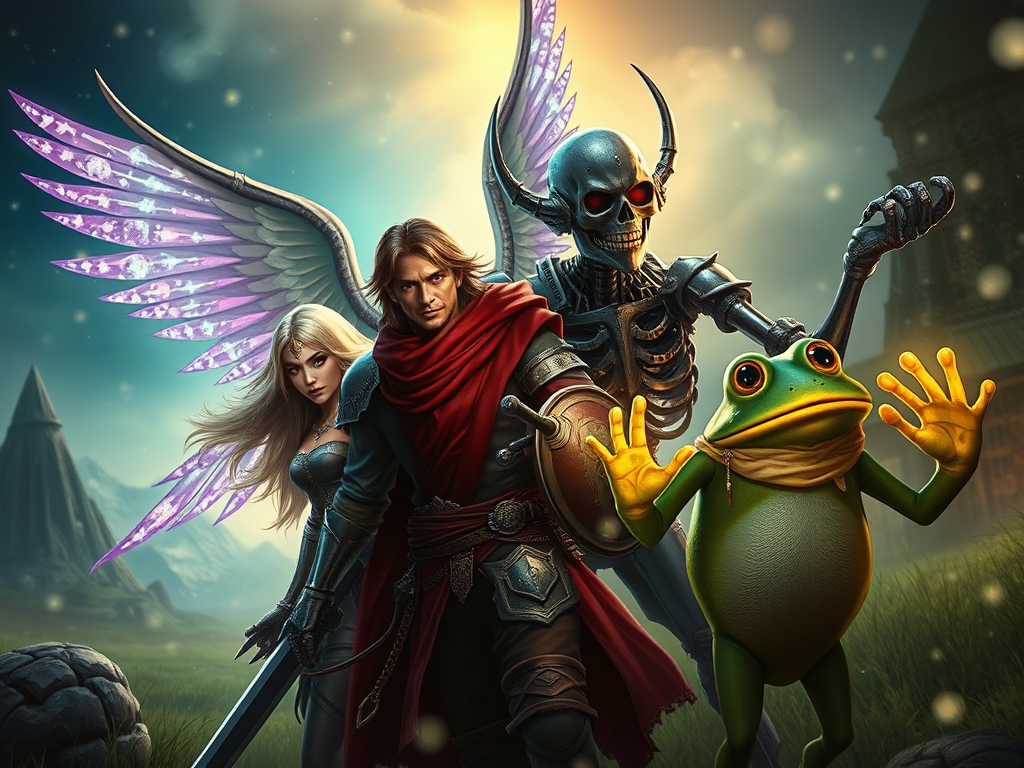
First off, the cover. It’s very shiny. It portrays a whole bunch of fabulous-looking characters – there’s a knight chick with wings, a dude who seems to be all mouth and no face, a mechanical Necron-looking skeleton with a staff, and what seems to be a humanoid frog with a glowing hand. Huh. Okay, if I can play a magic frog, I’m totally gonna, just for the record.
We’re on to the introduction. Daggerheart is a game of fantasy adventure where you explore exotic locations and save the day. It “provides the tools to tell a story that is both heartfelt and epic.” All right, so we’re definitely aiming for the flash and sizzle more so than the grime and gore, then. Fair enough. It also “takes a fiction-first approach” and “focus on the story [it’s] telling rather than the complexity of the mechanics.” Oh dear, that gives me a sense of foreboding, but it might just be my emotional scars from spending my formative years with Storyteller games that tended to combine over-complicated mechanics with a snotty contempt for anyone who wanted to actually use them… We’ll see, maybe this one will be better with 30 years of extra wisdom to draw on.
More emphasis on “epic battles and emotional narratives.” Okay, I’ll grant you that I like both those things. Well, to be exact, I like kicking ass and looking really pretty doing it, and so far the game seems like it supports that.
There’s a long list of inspirations (or “touchstones,” as it calls them). The roleplaying games include a couple of Powered by the Apocalypse ones, along with Lady Blackbird and Shadowrun. Under literature, we have A Song of Ice and Fire, Sabriel, A Wizard of Earthsea, Lord of the Rings and The Wheel of Time. Okay, that does suggest fantasy worlds where magic is a little more mystical and semi-spiritual, rather than just being a matter of flinging energy around.
The video games session includes Elder Scrolls, Dragon Age, and… Borderlands. Okay, the last one is an interesting choice. Let’s see if I can spot the connection as we go on.
The core mechanic is that you roll 2d12+modifier against a Difficulty. There is a special wrinkle, however, in that one of your d12s is your Hope Die and the other one is your Fear Die, and things can happen depending on which one rolled higher, irrespectively of whether the roll succeeded or not. Interesting. You also roll damage dice when you hit someone, to see how much you ruined his day.
There’s a note on the Golden Rule (that is, you can change any rule you don’t like), and Rulings Over Rules (which here means that rules only apply when it makes sense for them to apply). Sure, sure…
There is a rundown of what’s in the book. The first three chapters are called, respectively, “Preparing for Adventure,” “Playing an Adventure” and “Running an Adventure.” Heh. I do like the symmetry of that. The fourth chapter is the antagonist section, though it also seems to include environments (which can, to be sure, be plenty adversarial in their own right). The fifth is about “campaign frames.” Not sure I understand what that’s supposed to be, I guess we’ll see when we get there.
What do you need to play? Well, 2-5 players and a Game Master for a start, and also the usual pile of dice. It notes that you need a d100, which I sincerely hope is just a mistake and d100s will be simulated by two d10s as usual, because I dread to think what one of those would actually look like…
You also need tokens, which are “small objects that represent the look and feel of your character.” Hmm? Like some sort of miniatures? No, apparently not, because it’s mentioned that you’re going to need to place tokens on cards or character sheets to use certain abilities. Starting characters need about seven tokens, more powerful ones may need as many as 15.
Okay, hang on, here it explains that tokens can really just be any kind of small objects used to keep track of stuff – paper clips are fine, for instance. But you’re supposed to pick something that expresses your character’s unique aesthetic. Ooooookay, that’s a little too precious for my taste, but oh well.
You also need game cards, which represent your character’s “ancestry, community, subclass, and domain.” So… it’s basically just a cheat note for keeping track of your special abilities and so on? Finally, you need character sheets, and the game recommends getting the class-specific ones from the game’s website. Hrmpf. In myyyyyyy day we got a single one-size-fits-all character sheet, and we had to photocopy it ourselves so it was always smudged, and by Jove, that was how we liked it!
(okay, no, we hated it, but still…)
Maps and miniatures can be used but aren’t mandatory. Too bad, these days, what with Roll20 and the likes, I actually have an easier time playing with maps than I have playing with all those other kinds of handouts.
There are a set of principles for play, which seem to be strongly inspired by Powered by the Apocalypse. Well, I’m all for those. They are:
- Be a fan of your character and their journey.
- Spotlight your friends.
- Address the characters and address the players.
- Build the world together.
- Play to find out what happens.
- Hold on gently.
I do like “spotlight your friends,” which means to find ways that the other players can show off and get their moment to shine. It’s something I try to do when I play, and I don’t think I’ve ever seen it put into words like this before, so that’s nice. I also like “hold on gently,” meaning to think in terms of what would be interesting and evocative if it happened, but not be so married to it that you try to brute-force it. Again, that’s more or less my own philosophy too.
The full-page picture before chapter one appears to be a anthropomorphic tiger with a monocle, which I admit does bring a smile to my face. So, Chapter one: Preparing for Adventure! We start with a brief description of the setting, or at least the underlying metaphysics (I am going to go out on a limb and guess that this is one of those games that has an implied setting in the form of classes and races and stuff, but the actual geography and history are up to you).
Apparently the world consists of the Mortal Realm, the Hallows Above, the Circles Below, and the Realms Beyond. The universe used to be ruled by the Forgotten Gods, but they were overthrown by the New Gods and cast into the Circles Below. The New Gods now rule from the Hallows Above, and they have made it so that it’s hard to cross between planes, mostly to keep the Forgotten Gods from coming back for a rematch. There are also the Faint Divinities, who are a sort of demigod servitors of the greater gods. Some hang out in the Mortal Realm, others were banished with their makers into the Circles Below to become demons.
The New Gods can see what’s happening in the Mortal Realm from the Hallows Above, but to actually go there they need to sacrifice something of great importance. Hmm, that’s interesting – usually it’s mortals who sacrifice something to get a god’s attention. It does say that it goes two ways, though, so mortals or demons can theoretically enter the Hallows Above through some great personal sacrifice. Also, arcane magic used in great acts of evil can open a portal to the Circles Below.
The Realms Beyond are a catch-all term for every other dimension that’s not one of the three main ones – examples are “the Elemental Lands,” “the Astral Realm,” and “the Valley of Death.”
There is a section on magic, and here’s where it gets complicated – apparently magic takes the form of cards, and every time you level up, if you’re a magic-user of whatever sort, you get more cards. Does this mean that I’m going to have to read through the cards too? Honestly, you’d think with 400 pages in this thing it would cover it all, but I guess not. Oh well. Guess I’ll just have to consider when to go over them.
Anyway, there is another section that explicitly allows you to “re-flavour” your spells and abilities, as long as it makes no mechanical difference. Well, that’s nice, I know there was at least once when I was playing a 4E Druid in Dark Sun, and I felt that it was kind of off that my spells included damage-dealing “cold winds.” “Tearing sandstorms” felt more setting-appropriate… Anyway, there is also a reference to armour having “Armor Slots you can spend to reduce damage,” which sounds interesting, so let’s see what that’s all about when we get there.
 Mister Monster's Workshop
Leave a comment